Vietnam · Soups
Bún Bò Huế (Spicy Vietnamese Beef and Lemongrass Noodle Soup)
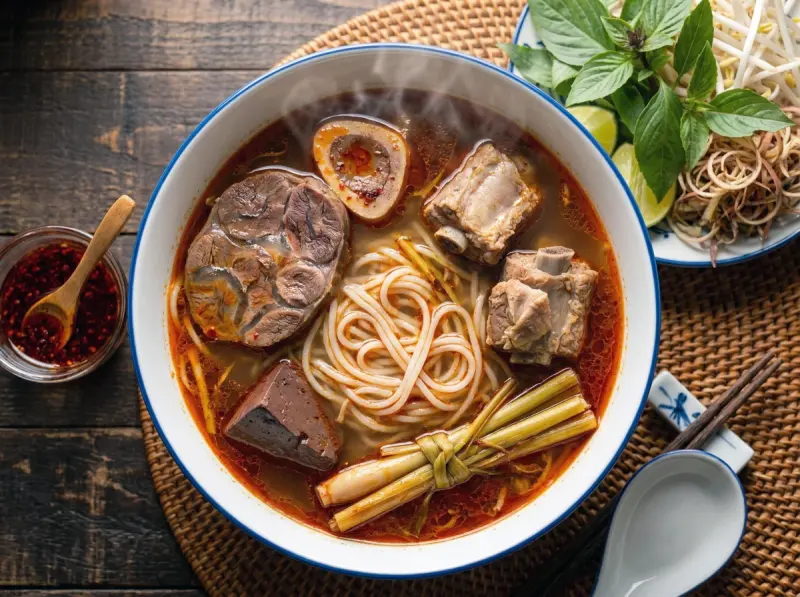
Bún bò Huế is a fiery red Vietnamese noodle soup from the central city of Huế, the former imperial capital.
Ingredients
- beef shank1 kg
- pork ribs500 g
- pork knuckle (giò heo), optional300 g
- congealed pork blood, optional200 g
- chả Huế (Vietnamese pork sausage), optional150 g
- beef marrow bones500 g
- lemongrass10 piece
- yellow onion1 piece
- fresh ginger5 cm
- shallots4 piece
- fresh pineapple200 g
- daikon radish100 g
- water4 l
- fish sauce30 ml
- rock sugar30 g
- salt15 g
- mắm ruốc huế30 g
- neutral oil60 ml
- annatto seeds15 g
- minced lemongrass45 g
- garlic cloves6 cloves
- shallots, minced (for the sate sauce)2 piece
- dried chili flakes30 g
- rice noodles800 g
- Thai basil for serving100 g
- mung bean sprouts for serving100 g
- Vietnamese coriander for serving50 g
- cilantro, for serving (optional)20 g
- banana blossom or shredded cabbage, for serving (optional)100 g
- limes for serving2 piece
Method
- 1Parboil the meat and bones. Place the beef shank, pork ribs, and beef marrow bones in a large stockpot, cover with cold water, and bring to a vigorous boil for 5 to 7 minutes. Scum and impurities will rise to the surface — this is the point of the parboil. Drain into a colander and rinse all the meat and bones thoroughly under running cold water. Wash the pot. This step is non-negotiable for a clear broth; without it the soup turns murky with greyish foam.
- 2Char the aromatics. While the meat parboils, halve the yellow onion lengthwise, the ginger crosswise, and the shallots. Place them cut-side down on a dry hot pan or directly over a gas flame and char until deep brown spots appear and the skins blister, about 4 to 5 minutes per side. Charring releases caramel sweetness and depth into the broth — raw onion and ginger taste flat in this dish. Bruise the lemongrass stalks with the back of a knife or a rolling pin 5 to 7 times along their length and tie them in 2 bundles with kitchen string for easy removal later.
- 3Build the broth. Return the cleaned meat and bones to the washed pot, adding the pork knuckle now too if you're using it — it simmers alongside the ribs and shank. Add the lemongrass bundles, charred onion, ginger, shallots, pineapple chunks, daikon, fish sauce, rock sugar, and salt. Pour in 4 litres of fresh cold water — the meat should be fully submerged. Bring to a boil over high heat, then immediately reduce to the lowest gentle simmer. Skim any remaining foam every 15 minutes during the first hour. Simmer uncovered for 2 hours.
- 4Remove the beef shank once it's fork-tender, around the 2-hour mark — a knife should slide into the thickest part with almost no resistance, and the meat should feel soft rather than springy. Lift the shank into a bowl and let it rest 30 minutes, then refrigerate covered until needed for slicing. Continue simmering the rest of the broth for another 1.5 hours — total simmer time of 3.5 hours extracts maximum collagen and flavour from the bones. After 3 hours total simmer, remove the pork ribs and the pork knuckle, if using, as well.
- 5Make the sate sauce while the broth simmers. Heat 60 ml neutral oil in a small saucepan over medium-low heat. Add the annatto seeds and stir for 3 to 5 minutes until the oil turns deep red — do not let it smoke. Strain out and discard the seeds. Return the red oil to the pan, add the minced lemongrass, minced garlic, and minced shallots, and cook 2 minutes until fragrant. Off heat, stir in the chili flakes (start with half if heat sensitivity is a concern). The sate sauce should be intensely red, glossy, and aromatic.
- 6Season the broth. Strain out and discard the lemongrass bundles, charred aromatics, pineapple, and daikon. Dissolve the mắm ruốc in 100 ml of warm broth in a separate bowl, let it stand 5 minutes for any solids to settle, then strain through a fine sieve into the main pot — solids stay behind, only the umami liquid goes in. Add half the sate sauce to the broth, stir to dissolve. Taste and adjust: more fish sauce for salt, more rock sugar for sweetness, more sate for heat. The broth should taste bold, slightly funky, complex, and visibly spicy red.
- 7Cook the noodles fresh, just before serving. Bring a separate pot of water to a rolling boil. Add the thick round rice noodles and cook 8 to 10 minutes (or per package directions), until fully tender but still slightly chewy. Drain and rinse briefly under cold water to stop cooking and remove surface starch. Slice the rested beef shank thinly across the grain, about 0.5 cm thick. Cut the pork ribs into bite-sized pieces.
- 8Assemble bowls. Divide the noodles between 8 deep soup bowls. Top each with a generous portion of sliced beef shank and pork rib pieces, adding sliced pork knuckle, cubes of pork blood, and sliced chả Huế too if you're using them — poach the blood cake gently in salted water for 10 minutes until firm before cubing it, and slice the chả Huế straight from the roll. Ladle the hot broth over until everything is submerged. Serve immediately with the herb plate on the side: Thai basil, Vietnamese coriander, mung bean sprouts, cilantro, sliced banana blossom or shredded cabbage, and lime wedges. Each diner customizes their bowl: tear the herbs and add directly into the soup, squeeze in lime juice, add extra sate sauce for additional heat. The herbs wilt slightly in the hot broth and release their oils — this final step is part of the dish.