Italy · Breakfast and Brunch
Italian Cornetto (Sweet Laminated Breakfast Pastry)
Cornetto (literally 'little horn') is the Italian breakfast pastry that people outside Italy take for a croissant: same crescent, different dough.
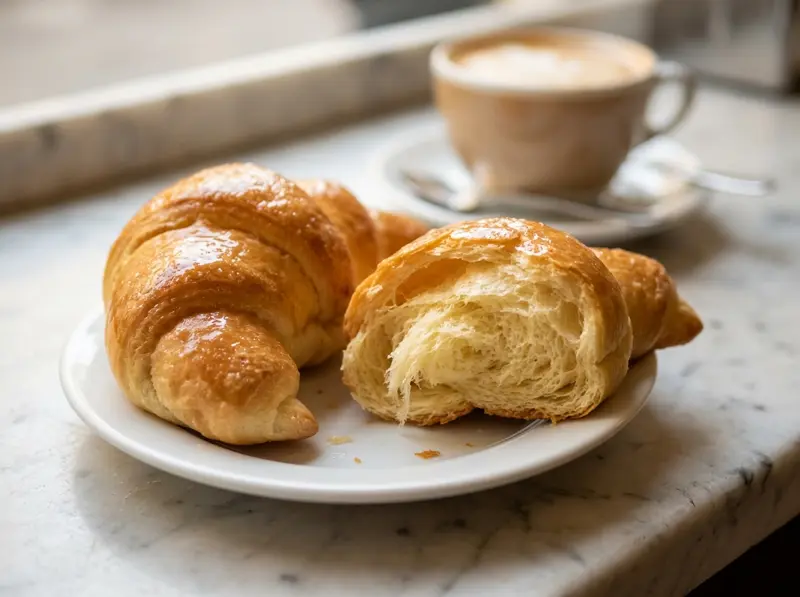
Ingredients
- bread flour500 g
- water150 ml
- whole milk100 ml
- granulated sugar70 g
- honey10 g
- salt10 g
- instant yeast5 g
- eggs2
- lemon, zest only1
- vanilla bean1
- unsalted butter300 g
- granulated sugar for glaze30 g
- water for glaze30 ml
Method
- 1Day 1 evening — make the enriched dough. In the bowl of a stand mixer with dough hook, combine 500 g bread flour, 5 g instant yeast, and 10 g honey. Add 150 ml water and 100 ml whole milk, both cold from the fridge (the long knead warms the dough), gradually while mixing on low speed for 3 minutes until the dough comes together. Add 1 egg (reserve the second for egg wash), the seeds scraped from 1 vanilla bean, and zest of 1 lemon. Mix for 5 minutes. Add 70 g sugar and 10 g salt, mix 3 more minutes. Finally add 50 g of the unsalted butter (softened, at room temperature) piece by piece, waiting until each piece is absorbed before adding the next; working it in and kneading the dough smooth takes about 10 minutes more. That makes 20–25 minutes of kneading in all. The dough is ready when it is smooth and elastic and a pinch of it stretches into a thin film you can see light through without tearing. Without a mixer, stir everything except the butter together in a bowl, then knead on the counter in the same order, squashing the butter in a piece at a time: by hand it takes about twice as long, 40–50 minutes, and the test is the same. Cover the bowl with plastic and refrigerate overnight (12 hours minimum) for slow cold ferment that develops flavor and makes the dough easier to laminate.
- 2Day 2 morning — prepare the butter sheet. Take the remaining 250 g cold unsalted butter (preferably 82–84% fat) from the fridge. Place it between two sheets of parchment paper. Pound with a rolling pin until pliable, then roll into a 22×31 cm rectangle, about 4 mm thick. Square the edges with a bench scraper. Wrap and return to the fridge for 15 minutes — the butter should be cold but pliable (14–15°C on a probe thermometer), not rigid. Too hard cracks during lamination; too soft melts into the dough.
- 3Lock the butter in. Take the rested dough from the fridge, press it flat with your palms to knock out the gas, and roll it on a lightly floured surface into a 25×50 cm rectangle, about 7 mm thick, with a short side facing you. Lay the butter sheet lengthwise on the lower two-thirds of the dough, leaving a border of 1–1.5 cm on three sides. Fold the bare upper third down over the butter, then fold the lower third up over it. Pinch all edges to seal completely. Wrap in plastic and rest in the fridge for 30 minutes.
- 4First two single folds (tours simples). Turn the dough 90 degrees so the two folded edges are on your left and right, then roll it lengthwise into a 60×30 cm rectangle with a short side facing you. Perform a letter fold: bring the bottom third up, then fold the top third down over it (like folding a letter — three layers). Rotate 90 degrees so the open seam faces right. Wrap and rest in the fridge for 30–40 minutes. This rest is critical — it lets gluten relax and the butter re-solidify, preventing tears. Roll out again to 60×30 cm, perform a second letter fold, rotate 90 degrees, wrap, and rest another 30–40 minutes in the fridge.
- 5Third fold and shaping. Roll the dough out once more to 60×30 cm and perform the third letter fold. Rest 30 minutes in the fridge. Now roll the laminated dough into a rectangle of roughly 70×25 cm, about 6 mm thick; do not try to stretch it thinner, that tears the layers. Use a ruler and a sharp knife to trim the edges for clean lines. Cut long triangles with a 12 cm base and a height equal to the full 25 cm width of the sheet, turning the knife the other way each time. You should get exactly ten; if you are getting twelve or more, the dough has been rolled too thin. Make a 1 cm slit at the center of each triangle's base. Starting from the base, roll each triangle toward the point with light downward pressure, creating a tight crescent. Tuck the tip underneath. Place on two parchment-lined baking sheets, five to a sheet, with the tip facing down and 5 cm between them. The traditional cornetto shape has the ends curving slightly inward.
- 6Final proof. Cover the baking sheets loosely with plastic and proof at 24–26°C for 2.5–3 hours, until the cornetti have almost doubled in size, look visibly puffy and wobble when you nudge the sheet. Test: press the side gently with a floured fingertip — the dent should fill back slowly. If your kitchen is cool, put the sheets in the switched-off oven with a cup of just-boiled water on the oven floor and a thermometer beside them; switch the oven light on only if it reads below 24°C, and take the cup out if it climbs past 26°C. Around 30 minutes before baking, take the sheets out and preheat the oven to 220°C (425°F) — static mode, or 200°C convection.
- 7Egg wash and bake. Beat the remaining egg with a fork until runny. Using a soft pastry brush, lightly coat the smooth outer surface of each cornetto, tips included, but keep the brush off the cut edges — the stepped lines between one turn of the roll and the next, where the layers show (egg wash there glues the layers and prevents rise). No puddles. Bake one sheet at a time on the middle rack, keeping the other in the coolest part of the kitchen: 5 minutes at 220°C, then lower to 190°C for 12–15 minutes more (with convection, 200°C and then 170°C); bring the oven back to the starting temperature before the second sheet goes in. The pastries are done when deep golden brown all over, with visible flaky layers and a hollow sound when tapped underneath. Internal temperature 88–93°C confirms doneness.
- 8Apply sciroppo lucido and serve. While the cornetti bake, prepare the sugar syrup: combine 30 g sugar and 30 ml water in a small saucepan and simmer for 2–3 minutes, until the sugar is fully dissolved and the syrup thickens slightly. As soon as the cornetti come out of the oven (while still very hot), brush each with the sciroppo lucido — it gives the characteristic glossy finish and a sweet crust, and seals in moisture. Cool on a wire rack for 10 minutes. They are best while still warm; eat them within 4–6 hours of baking, with espresso or cappuccino. To fill them, wait until they have cooled and pipe crema pasticcera (custard), apricot jam or chocolate cream in through the end with a piping bag.