Germany · Flour and Confectionery Products
Dominosteine (Gingerbread, Jelly and Marzipan Chocolates)
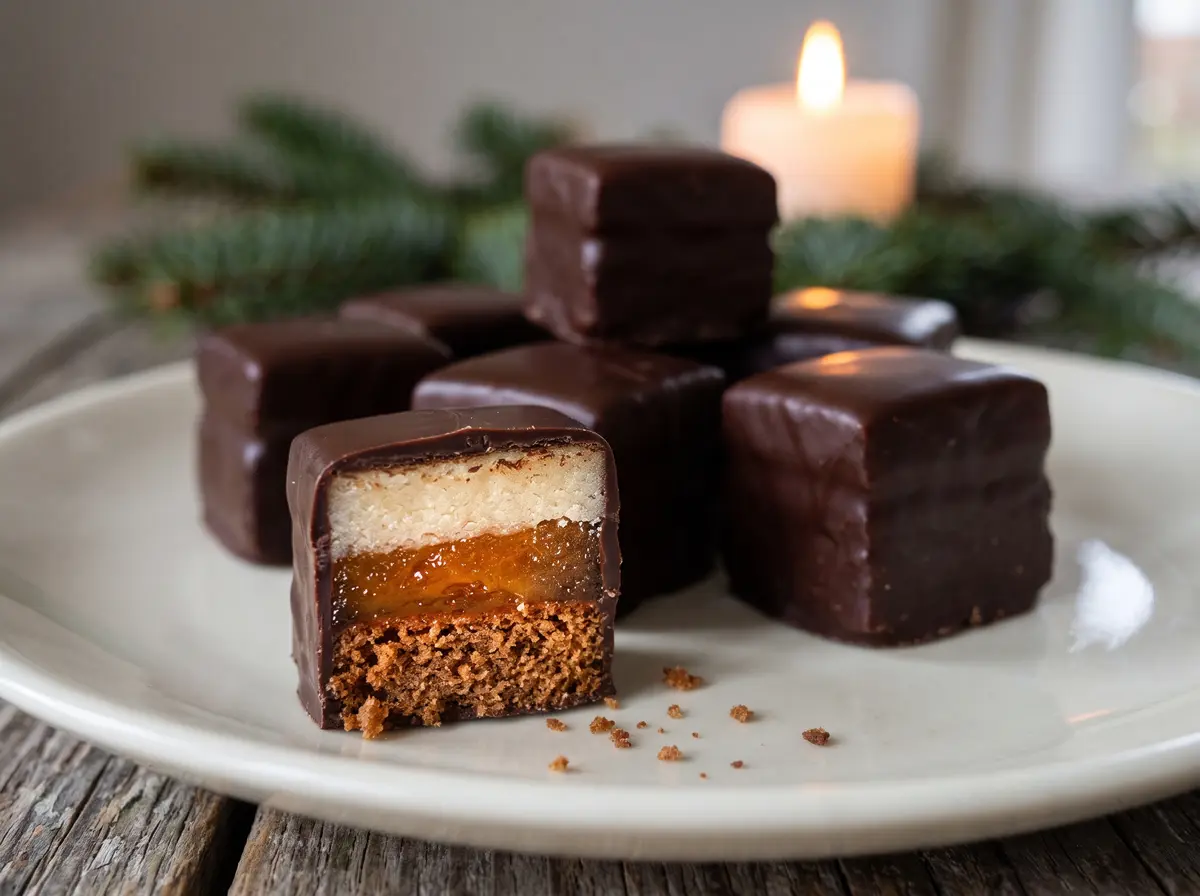
Dominosteine are German Christmas sweets: small cubes of soft honey gingerbread topped with fruit jelly and a thin layer of marzipan, with the whole stack coated in dark chocolate.
Ingredients
- honey150 g
- brown sugar40 g
- butter40 g
- flour200 g
- cocoa powder1 tsp
- gingerbread spice2 tsp
- baking powder1.5 tsp
- salt1 pinch
- egg1
- gelatin6 sheets
- apricot jam400 g
- water100 ml
- lemon juice2 tbsp
- marzipan250 g
- icing sugar40 g
- dark chocolate400 g
- coconut oil20 g
Method
- 1Put the honey, brown sugar and butter in a small saucepan over medium-low heat and stir for about 5 minutes, until the butter has melted and you can't see sugar crystals on the spoon. Don't let it boil. Take the pan off the heat and leave it for 10 minutes, until the mixture is warm rather than hot, so the egg won't set when it goes in. Meanwhile, line a 20 × 30 cm baking tin with one strip of baking paper that covers the base and the two long sides and hangs over the rim, heat the oven to 180 °C (160 °C fan) and sift the flour, cocoa powder, gingerbread spice, baking powder and salt into a mixing bowl.
- 2Pour the warm honey mixture and the egg (medium, size M) into the flour and stir hard until you have a smooth, sticky dough. Put it into the tin straight away and spread it right into the corners with a spatula or damp fingers, until the layer is even with no thin patches. Prick it all over with a fork so it doesn't puff up into bubbles in the oven.
- 3Bake on the middle shelf for 12 to 15 minutes, until the top is evenly brown and springs back when you press it lightly. Leave the base to cool completely in the tin. It will feel firm and almost dry, and that is fine, because it softens overnight under the jelly. While it bakes, soak the 6 gelatin sheets (10 g) in a bowl of cold water for 5 minutes. If you only have powdered gelatin, use the amount the packet gives for setting 500 ml of liquid.
- 4Bring the apricot jam, water and lemon juice to the boil in the small saucepan over medium heat, stirring until smooth. Take the pan off the heat and wait until it stops bubbling, then squeeze the water out of the gelatin and stir it in until no strands are left. Pour the hot jam over the cooled base in the tin and spread it to the edges. The layer will be about 7 mm thick, and the sides of the tin keep it from running off. Refrigerate for about 5 hours, or overnight, until the jelly has set and no longer moves when you tilt the tin.
- 5Knead the marzipan with the icing sugar until smooth. You want raw marzipan paste here (Marzipanrohmasse in German shops), the kind meant for baking. Roll it out between two sheets of baking paper into a 20 × 30 cm rectangle, about 4 mm thick, and dust it with a little icing sugar if it sticks. Peel off the top sheet, turn the marzipan over onto the set jelly, peel off the second sheet and press it down lightly. Cover the tin and leave it in the fridge overnight so the base can draw moisture from the jelly and soften.
- 6The next day, run a thin knife along the two short ends where there is no paper, then lift the slab out by the paper onto a board. With a large sharp knife, trim the edges thinly for neat cubes and cut the slab into 2.5 cm cubes, about 90 of them. Wipe the blade clean between cuts so the layers stay sharp. Spread the cubes on a tray lined with baking paper and put them in the freezer for 20 minutes, so the jelly is firm when it meets the chocolate.
- 7Meanwhile, chop the dark chocolate. Use dark couverture with 50 to 60 % cocoa. Melt two thirds of it (about 270 g) in a heatproof bowl over a pan of hot but not boiling water until it reaches about 45 °C, and no higher than 50 °C. Take the bowl off the pan and stir in the rest of the chocolate (about 130 g) and the coconut oil. If it gets thick before all the pieces have melted, set the bowl back over the water for a few seconds. Dip at about 31 to 32 °C, when the chocolate is smooth and glossy. Without a thermometer, dab a drop on your lip: it should feel neither hot nor cold. Chocolate that is still hot would melt the jelly.
- 8Dip the cubes one at a time. Set a cube on a fork, lower it into the chocolate until it is covered, lift it out, tap the fork on the edge of the bowl and wipe the bottom on the rim. Put it on baking paper or a rack and leave the cubes in a cool room until the chocolate has set hard and no longer marks your fingers. Store them in a tightly closed tin in the fridge for up to 3 weeks and let them come to room temperature before eating. They contain honey, so don't give them to babies under one year old.