France · Breakfast and Brunch
Classic French Omelette (Omelette Nature)
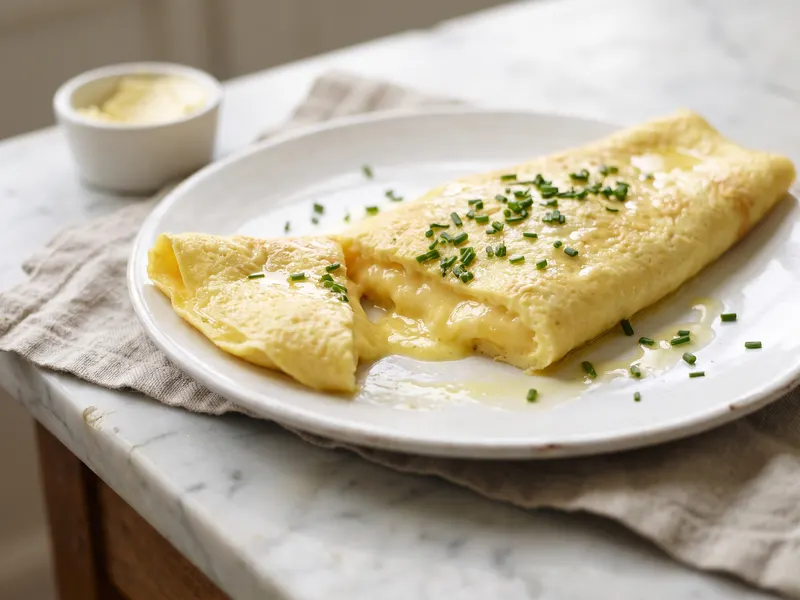
Three eggs beaten until completely uniform, cooked in foaming butter over medium-high heat with constant stirring and pan-shaking for under 60 seconds, then rolled into a pale, smooth cylinder with a soft, almost creamy…
Ingredients
- large eggs3
- unsalted butter15 g
- fine salt1 pinch
- freshly ground white pepper1 pinch
- fresh chives1 tbsp
- Gruyère or Comté30 g
Method
- 1Beat the eggs properly. Crack the eggs into a bowl. Add the salt, pepper, and herbs if using. Beat vigorously with a fork for 30 to 45 seconds until the mixture is completely uniform — no visible streaks of white, no lumps of yolk, just a smooth pale liquid that streams evenly off the fork. This is more thorough than most people beat eggs. The goal is a completely homogenised mixture: when you lift the fork, the egg should fall in a thin, unbroken stream. Properly beaten eggs make finer, more even curds. Under-beaten eggs give you an uneven texture with rubbery patches.
- 2Get the pan and butter right. Use a 20 cm (8-inch) non-stick pan. Place it over medium-high heat. Add the butter and let it melt, tilting the pan to coat the base evenly. Watch the butter carefully: it should foam and sizzle actively, but the foam should not turn brown or smell nutty. The moment the foam starts to subside — meaning the water in the butter has evaporated and the temperature is right — pour in the eggs immediately. If the butter browns before you add the eggs, the pan is too hot: wipe it, add fresh butter, and start again. Browned butter gives the omelette color, and a proper French omelette has none.
- 3Stir and shake simultaneously. The moment the eggs hit the pan, begin stirring vigorously with the flat of a fork while shaking the pan back and forth over the burner with your other hand. The fork draws small circles, the flat tines scraping lightly across the pan surface without scratching. The shaking keeps the egg moving and prevents sticking. The two motions together create very small, fine curds and an even, uniform texture across the whole omelette. This is the technique. It looks awkward the first time. After ten repetitions it becomes automatic.
- 4Stop stirring at the right moment. After 20 to 30 seconds of constant movement, the eggs will go from liquid to barely-set. Stop stirring when the omelette is still slightly wet on top — glossy, softly trembling, not runny but not fully set either. Take the pan off the heat at this point. The residual heat in the pan will finish cooking the surface in 5 to 10 seconds. If you are adding cheese, scatter it across the center of the omelette now, while it is still slightly soft. The cheese will begin to melt from the heat of the egg.
- 5Roll and serve immediately. Tilt the pan away from you at a 45-degree angle. Using the fork, begin rolling the near edge of the omelette over itself — like rolling a carpet — until you have a roughly cylindrical shape. Slide the roll to the far edge of the pan, then flip it seam-side down onto a warmed plate. The outside should be pale yellow with no browning at all. Tuck in any rough edges with a paper towel or your fingers. Serve within 60 seconds. A French omelette is the one dish that genuinely cannot wait even two minutes — the interior continues to cook from residual heat and the texture changes noticeably.