Greece · Fish and Seafood Dishes
Grilled Whole Fish (Mediterranean Style)
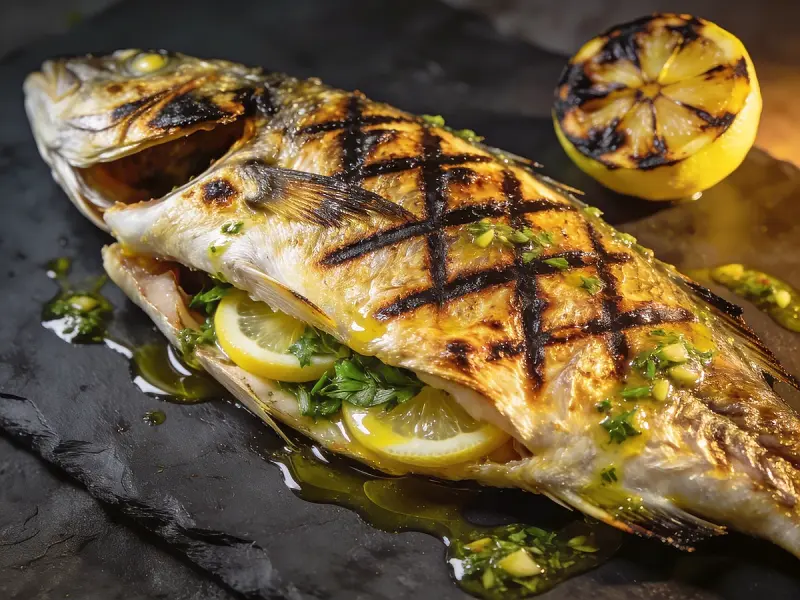
Grilling a whole fish over live fire is the defining seafood technique of the Mediterranean — practised from the Greek islands to the Spanish costa, from Turkey to Morocco — and it is dramatically simpler than it…
Ingredients
- whole fish, about 500 g each (sea bass or sea bream), scaled and gutted4
- extra-virgin olive oil6 tbsp
- coarse sea salt1.5 tsp
- freshly cracked black pepper1 tsp
- lemons2
- garlic cloves6
- fresh thyme1 small bunch
- fresh flat-leaf parsley1 small bunch
- fresh dill1 small bunch
- dried oregano1 tsp
- chilli flakes1 tsp
- capers2 tbsp
Method
- 1Prepare the fish. Pat each fish completely dry inside and out with paper towels — moisture on the skin causes it to steam rather than char, making it stick to the grates. Lay the fish on a cutting board. Using a sharp knife, make 3 deep diagonal score cuts through the skin and into the flesh on each side of the fish, spacing them evenly. The cuts should be at least 1 cm deep — timid shallow cuts do not allow heat penetration. Season both sides and inside the cavity generously with salt, pepper, and dried oregano, pressing the seasoning into the score cuts. Make a herb paste: mix 3 tablespoons of olive oil with the minced garlic, a pinch of salt, and the chilli flakes. Rub this paste over both sides of the fish, into the score cuts, and inside the cavity.
- 2Stuff the cavity. Layer thin lemon slices, sliced garlic, a few sprigs each of thyme, dill, and parsley inside each fish cavity. The stuffing serves as an aromatic steam generator — as the fish heats, the lemon and herbs release vapour that flavors the flesh from the inside. Do not pack so tightly that the cavity cannot close. Press the stuffed fish gently to close. You can tie the cavity with kitchen twine if you prefer, but it is not necessary for smaller fish.
- 3Prepare the grill. Set up your charcoal or gas grill for direct, medium-high heat — about 200 to 220°C (400 to 430°F). Oil the grates generously just before cooking: dip a folded paper towel in oil and wipe it over the grates using tongs. A well-oiled, properly hot grill is the single most important factor in preventing the fish from sticking. The fish is ready to place when a drop of water sizzles and evaporates on contact with the grates. Place the halved lemon on the grill cut-side down for the last 5 minutes to caramelize.
- 4Grill without moving — 7 to 8 minutes per side. Place the fish on the hot oiled grates. Do not move them. Close the lid. Wait a full 7 to 8 minutes before checking — the fish needs this time to form a full char crust that releases cleanly. If you try to move the fish before the crust has formed, the skin will tear and stick. At 7 minutes, try to gently slide a thin spatula under the fish — if it lifts cleanly, it is ready to flip. If it resists, give it another minute. Flip once using two spatulas for support. Cook the second side for 6 to 7 minutes. The fish is done when the flesh is opaque and flakes cleanly from the bone, and the internal temperature reads 63°C (145°F). These times are for fish of about 500 g each; a 700 g fish needs 18 to 20 minutes in total, so for any size go by the thermometer rather than the clock.
- 5Make the finishing sauce and serve. While the fish rests for 3 minutes on a platter, whisk together the remaining 3 tablespoons of olive oil, the juice of half a lemon, the capers, and a handful of roughly chopped parsley. This bright, pungent sauce is the traditional Greek ladolemono — olive oil and lemon — extended with capers and herbs. Drizzle it generously over the grilled fish. Serve with the caramelized grilled lemon halves for squeezing. Present the fish whole at the table: break the skin at the score lines, lift the top fillet away from the spine, then remove the spine and bones to access the bottom fillet.