China · Meat Dishes
Hong Shao Rou (Chinese Red-Braised Pork Belly)
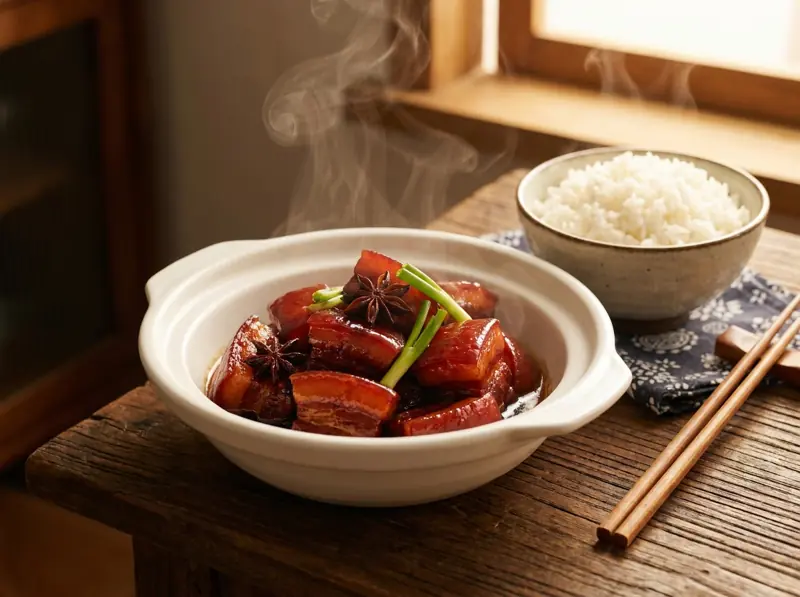
Hong shao rou (红烧肉), literally 'red-braised meat', is a Chinese home-style braise of skin-on pork belly cubes cooked until the surface turns a deep mahogany red and a thin, glossy sauce clings to every piece.
Ingredients
- skin-on pork belly550 g
- rock sugar30 g
- Shaoxing wine3 tbsp
- light soy sauce2 tbsp
- dark soy sauce1 tbsp
- fresh ginger4 slices
- spring onions2
- star anise2
- neutral oil1 tbsp
- hot water600 ml
Method
- 1Cut the pork belly into 3 cm cubes, keeping the skin on. Even cubes matter here: pieces that are too small dry out during the long simmer, and pieces that are too large won't take up the sauce all the way through. Leave the skin attached; it turns soft and jelly-like after braising and is part of what makes the dish rich rather than just fatty.
- 2Blanch the pork starting from cold water (冷水下锅焯水): put the cubes in a pot, cover with cold water, and add two of the ginger slices and one spring onion. Bring to a boil over high heat and let it bubble for 2 to 3 minutes, skimming off the grey foam that rises. Starting from cold water is what pulls the blood and impurities out slowly as the water heats; starting from boiling water instead seals the surface immediately and traps them inside, leaving the braise cloudy and faintly gamy. Drain, rinse the pork under warm water, and pat it dry.
- 3Make the caramel (炒糖色): put the rock sugar and 2 tablespoons of water in a dry wok or heavy pot over medium-low heat. Swirl the pan gently as the sugar melts and turns from clear to pale gold to a deep amber the colour of dark honey, with small bubbles covering the whole surface — this takes 4 to 6 minutes. Watch it closely once it passes gold: amber can slide into bitter, burnt sugar within seconds, and if that happens there is no saving it, so tip it out and start again rather than pushing forward with a scorched batch.
- 4As soon as the caramel reaches that amber stage, add the drained pork cubes and the neutral oil, and toss quickly to coat every piece. Cook for 2 to 3 minutes, stirring, until the pork looks glossy and the edges pick up a little colour. The sugar seizes fast against the cold meat, so keep the pieces moving instead of leaving them still in one spot.
- 5Add the Shaoxing wine (绍兴黄酒) and let it bubble for about 30 seconds; it should smell sharp and slightly sweet as the alcohol cooks off. Stir in the light soy sauce, dark soy sauce, the remaining ginger and spring onion, and the star anise, then pour in the hot water so the pork is covered by about 1 cm. Bring everything back to a boil.
- 6Cover the pot, lower the heat until the liquid barely bubbles, and simmer for 60 to 90 minutes, checking every 20 minutes or so that it hasn't dried out. The pork is ready when a chopstick slides into a cube with no resistance and the skin has gone soft enough to cut with the side of a spoon; thicker cubes and older pigs need the longer end of that range.
- 7Uncover the pot, fish out the ginger, spring onion, and star anise, and turn the heat up to medium-high. Reduce the sauce for 10 to 15 minutes, stirring often so it doesn't catch on the bottom, until it thickens into a glossy syrup that coats the back of a spoon and clings to the pork instead of pooling around it. This step, 收汁 or 'gathering the juice', is what turns a good braise into a lacquered one.
- 8Serve immediately over steamed rice, spooning the reduced sauce generously over the meat. A plate of quickly blanched bok choy or choy sum on the side cuts through the richness and is the usual accompaniment at a Chinese family table.