UK · Flour and Confectionery Products
Scones (British Buttermilk Scones)
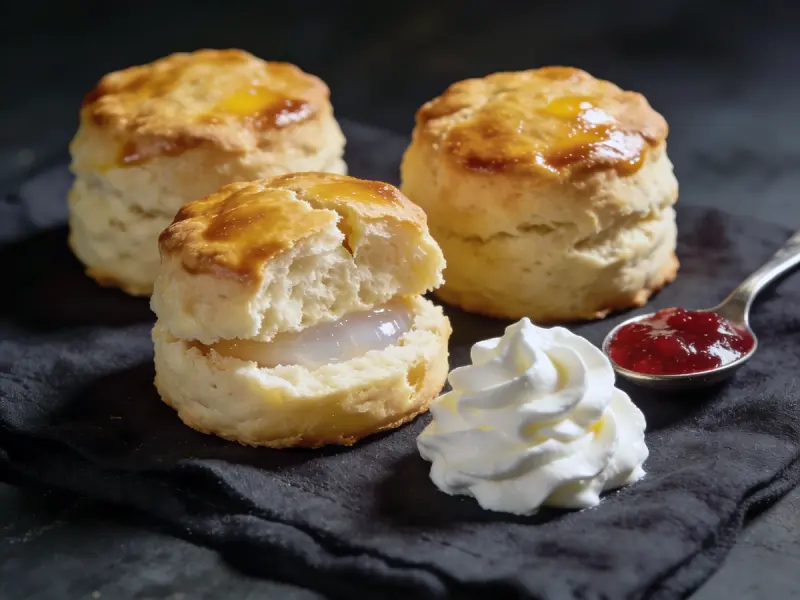
Scones are a British quick bread made from flour, cold butter, buttermilk and a little sugar, served warm, split and spread with clotted cream and jam as the centre of a cream tea.
Ingredients
- plain flour350 g
- baking powder1.5 tsp
- bicarbonate of soda0.5 tsp
- fine salt0.5 tsp
- caster sugar2 tbsp
- cold unsalted butter85 g
- egg1
- cold buttermilk180 ml
- vanilla extract (optional)1 tsp
- dried fruit (optional)80 g
- whole milk or buttermilk2 tbsp
Method
- 1Keep everything cold and preheat the oven. This is the foundational rule of scone-making: cold butter stays solid until it hits the hot oven, where it releases steam and creates flakiness. Butter on the verge of melting turns greasy and smears into the flour instead of rubbing in. Cut the butter into 1 cm cubes and place them in the freezer for 10 minutes before starting. Line a baking sheet with parchment paper. Preheat the oven to 220°C (425°F) — hot oven, fast bake.
- 2Make the crumb. Sift the flour, baking powder, bicarbonate of soda, salt, and sugar into a large cold bowl. Add the cold butter cubes. Using your fingertips — working quickly and lightly — rub the butter into the flour, lifting and flicking the mixture to incorporate air, until the mixture resembles breadcrumbs; a few small flakes of butter may still show. Stop there and do not work it into a paste. If the butter has warmed up, refrigerate the bowl for 10 minutes before continuing.
- 3Combine and bring together. Whisk the cold egg, cold buttermilk, and vanilla extract (if using) together in a small bowl. Make a well in the centre of the flour mixture. Pour in the wet ingredients and add the dried fruit if using. Using a round-bladed knife or a fork, cut through the mixture in a crossing motion until the dough just barely comes together into a shaggy, rough mass. Stop mixing the instant it holds — overworking develops gluten and produces a tough, bready scone rather than a tender, crumbly one.
- 4Shape and cut — do not roll thin. Turn the dough onto a lightly floured surface. Pat — do not roll — with your hands to a thickness of 3 to 4 cm (about 1¼ to 1½ inches). This thickness is critical: thinner than 3 cm and the scones will not rise significantly; the height comes from the starting thickness, not from oven spring alone. Use a floured 6 to 7 cm (2.5 inch) round cutter. Press straight down with a firm, decisive movement — do not twist, which would seal the edges and prevent the scone from rising straight. Press the trimmings together lightly and cut again: the dough makes six scones. Space the cut scones 3 cm apart on the lined baking sheet. Brush the tops only with the 2 tablespoons of milk or buttermilk — not the sides, which would inhibit the rise.
- 5Chill briefly and bake. Refrigerate the shaped scones for 15 minutes — this firms the butter back up after handling, ensuring maximum rise. Bake at 220°C for 12 to 15 minutes until the tops are deep golden and the scones have risen to show a pale 'waist' around the middle where the dough naturally split. Transfer to a wire rack. Eat warm, split by hand along the natural waist, with clotted cream (or very cold thick cream) and strawberry or raspberry jam. In Devon the cream goes on first and the jam on top; in Cornwall it is jam first and a spoonful of cream on top. Both are correct.