Germany · Cereal and Pasta Dishes
Semmelknödel (Bavarian Bread Dumplings)
Semmelknödel are bread dumplings from southern Germany, Austria, South Tyrol and Bohemia: stale white rolls soaked in hot milk, bound with egg, seasoned with onion and parsley, then poached in salted water.
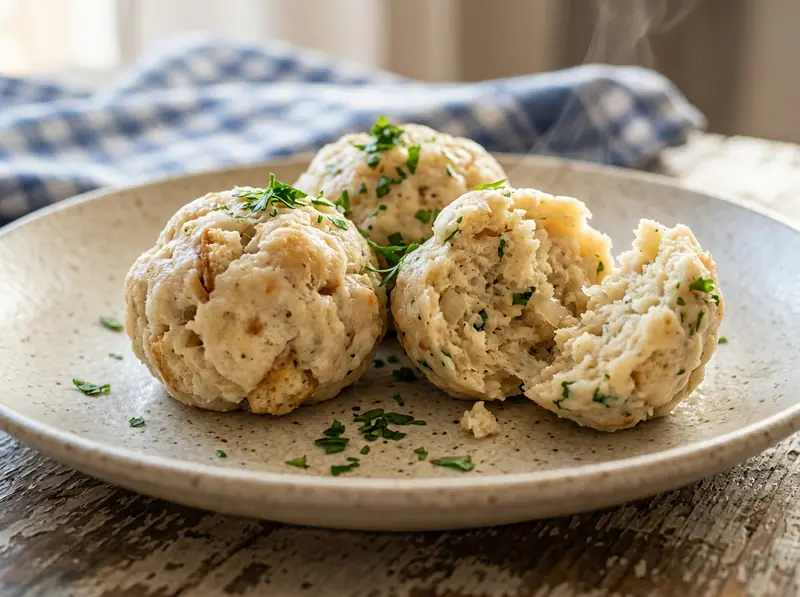
Ingredients
- bread roll300 g
- milk250 ml
- onion1
- butter20 g
- parsley15 g
- eggs3
- breadcrumbs3 tbsp
- salt1 tsp
- ground black pepper0.25 tsp
- nutmeg1 pinch
- water4 l
- salt1 tbsp
Method
- 1Use white wheat rolls that are a day or two old, still a little springy inside but no longer fresh, or a bag of Knödelbrot. Cut 300 g of them into cubes of about 1 cm (cut any big pieces of Knödelbrot down to the same size, because large chunks fray in the water) and put them in a large bowl. Heat 250 ml of whole milk in a small saucepan over medium heat until it steams and is just about to boil, pour it over the bread and stir with a spoon so every cube gets wet. Cover the bowl and leave it for 20 minutes. The cubes should then be soft right through with no dry corners (if some cubes are still dry in the middle, cover the bowl again for another 10 minutes), and there should be no milk left pooling at the bottom. Hot milk soaks in faster than cold, and small cubes hold together better in the water than big chunks.
- 2While the bread soaks, finely dice 1 onion and chop 15 g of flat-leaf parsley leaves. Melt 20 g of butter in a small frying pan over medium-low heat and cook the onion for 5 minutes, stirring now and then, until it is soft and translucent with no brown edges. Keep it pale, because browned onion shows up as dark flecks in the dumplings. Stir in the parsley for a few seconds so it stays bright green, take the pan off the heat and let it cool a little, so the hot butter does not start cooking the eggs when it goes in.
- 3Also during the soak, pour 4 l of water into a wide pot about 24 cm across that holds at least 6 l, add 1 tbsp of salt and bring it to the boil. Only when the bread has soaked the full 20 minutes and the cubes are soft right through, beat 3 eggs and add them to the bread together with the onion and parsley butter, 2 tbsp of the 3 tbsp of breadcrumbs (keep the last tablespoon back for step 4), 1 tsp of salt, 1/4 tsp of ground black pepper and a pinch of freshly grated nutmeg. Mix and knead with your hands for 2 to 3 minutes, squeezing the bread so the cubes start to break up. It is ready when the mass is evenly moist and sticky but not wet, there is no liquid at the bottom of the bowl, and a squeezed handful keeps its shape. A few cubes can still be visible.
- 4Turn the heat down until the water barely moves: tiny bubbles rise to the top, but it is no longer at a rolling boil. Wet your hands, roll a walnut-sized test dumpling (a Probeknödel), press it firm and lower it into the water. Let it simmer for about 5 minutes, then lift it out and cut it open. It should be whole, with a smooth surface, and set inside with no wet egg; only then taste it for salt. If it frayed or fell apart, knead the remaining 1 tbsp of breadcrumbs (not flour) into the mass; if it tastes flat, add a pinch more salt. Now shape the mass into 8 balls of about 105 g each, roughly 6 cm across, wetting your hands before each one and pressing them between your palms until the surface is smooth and compact. Set them on a plate. Wet hands stop the dough sticking, and a pressed, smooth surface does not fray in the water.
- 5Lower the 8 dumplings into the pot with a slotted spoon so they lie in one layer and set the lid half on. The cooler dough brings the water off the simmer, so turn the heat up to medium until tiny bubbles rise again, then turn it back down and keep that gentle simmer for 20 minutes, counting from the moment it simmers again. Do not let it boil at any point, because bubbling water knocks the dumplings apart. They sink at first, then rise, float and slowly turn. Lift one out and cut it in half: the inside should be evenly set, moist and springy, with no wet or runny streaks of egg. The dough contains raw egg, so if you have a thermometer, the centre should read at least 71 °C. If the centre is still wet, keep the rest simmering for another 5 minutes and check again.
- 6Lift the dumplings out with the slotted spoon, let the water drip off for a few seconds and serve them straight away in a warm dish, with a roast and its gravy or with mushrooms in a cream sauce. The dumplings are there to soak up the sauce, so serve plenty of it. Put leftovers in the fridge within 2 hours. They keep for 3 to 4 days, and the next day you can slice them and fry the slices in butter until golden, crisp and hot right through (74 °C).