France · Sauces and Dips
Aïoli (Traditional Provençal Garlic and Olive Oil Sauce)
Aïoli is the classic Provençal garlic and olive oil sauce — a thick, glossy, intensely garlicky emulsion made from raw garlic, egg yolk, and extra virgin olive oil.
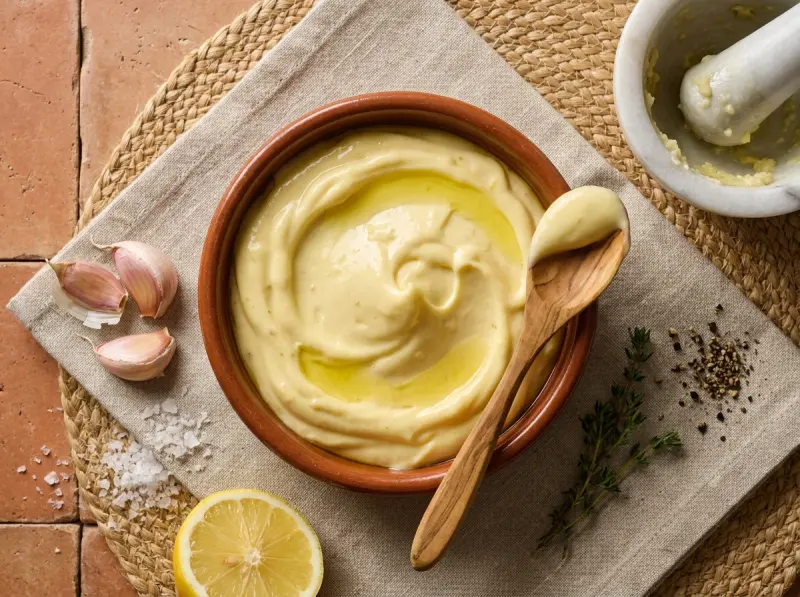
Ingredients
- garlic cloves4 cloves
- egg yolk1 piece
- extra virgin olive oil250 ml
- flaky sea salt0.5 tsp
- fresh lemon juice1 tsp
- black pepper1 pinch
Method
- 1Bring everything to room temperature. Take the egg out of the fridge 30 minutes before starting; the olive oil should also be at room temperature. Cold ingredients fail to emulsify because the lecithin in the yolk does not work well below 18°C. This is the most common cause of broken aïoli among home cooks.
- 2Prep the garlic. Peel 4 fresh garlic cloves and cut each one in half lengthwise. Remove the green germ from the centre of each clove with the tip of a knife — the germ is bitter, makes the aïoli taste harsh, and causes loud burping for hours after eating. If the garlic is young (spring) and the germ is still tiny and white, you can skip this step.
- 3Crush the garlic to a smooth paste. Use a mortar and pestle for the most authentic texture, or grate the cloves on a microplane (faster, same result). Add the flaky sea salt now — the salt breaks down the cell walls of the garlic and releases the essential oils that bind the emulsion. Without salt at this stage, the aïoli will be flat and the garlic flavour locked inside the cells.
- 4Add the egg yolk to the garlic paste and whisk vigorously for 30 seconds with a wire whisk (not silicone — it is too soft to develop the emulsion). The mixture should look pale yellow and slightly thickened, with no streaks. Use a damp kitchen towel rolled into a ring under your bowl to keep it stable while you whisk with one hand and pour with the other.
- 5Begin adding olive oil drop by drop. Whisking constantly and steadily, add the oil one drop at a time for the first 60 to 90 seconds — literally one drop, let it disappear, next drop. This is the make-or-break phase: pouring too fast overwhelms the lecithin and the emulsion breaks. After roughly 2 tablespoons of oil are incorporated and the sauce visibly thickens, you can switch to a very thin stream.
- 6Continue with a thin stream until all 250 ml of oil are incorporated. The aïoli will become glossy, thick, and pale yellow — thick enough to hold its shape on a spoon. One yolk holds a maximum of 250 ml of oil; pushing past that breaks the emulsion. If the sauce starts to look greasy or shiny on the surface, stop adding oil immediately and whisk for 30 seconds to stabilize.
- 7Finish with lemon juice and pepper. Add 1 tsp fresh lemon juice and a pinch of black pepper, whisk in. The lemon goes in last so you can judge how much the finished sauce needs; a little acid in the yolk at the start would not break it. What breaks aïoli is oil added faster than the yolk can take it. Taste and adjust: more salt for seasoning, more lemon for brightness, more garlic only if the sauce is going to sit overnight (garlic mellows fast in fridge).
- 8Cover and refrigerate at least 30 minutes before serving — the aïoli firms up and the flavours integrate. Serve cold or at cool room temperature with grilled vegetables, fish, boiled potatoes, hard-boiled eggs, or as the centrepiece of a Grand Aïoli platter. Keeps 3 to 4 days in an airtight container in the fridge; do not freeze. If it breaks at any stage, see the rescue method in the FAQ.