
Aïoli (Traditional Provençal Garlic and Olive Oil Sauce)
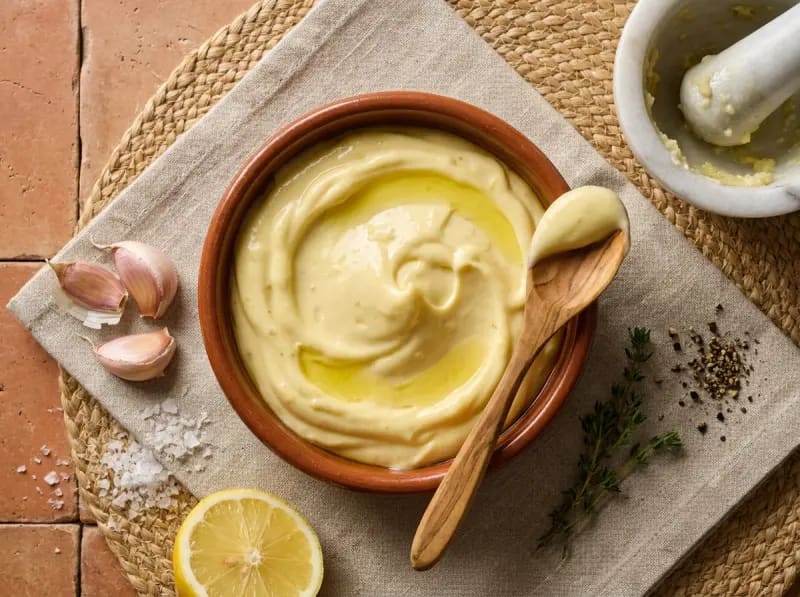
Aïoli is the classic Provençal garlic and olive oil sauce — a thick, glossy, intensely garlicky emulsion made from raw garlic, egg yolk, and extra virgin olive oil. Its name comes from Occitan: alh (garlic) and òli (oil). The authentic 'aïoli véritable' uses no egg and relies purely on garlic's emulsifying compounds, but Larousse Gastronomique and modern French restaurants now standardize the egg-yolk version as 'aïoli'. In Provence, this sauce is the centerpiece of Le Grand Aïoli — a Friday lunch of boiled vegetables, salt cod, and hard-boiled eggs all dipped into a communal bowl. Vegetarian, gluten-free, keto-friendly. Active work 15 minutes, no cooking. Yields 250 ml, serves 8.
Ingredients
- 4 clovesgarlic cloves
- 1 pieceegg yolk
- 250 mlextra virgin olive oil
- 0.5 tspflaky sea salt
- 1 tspfresh lemon juice
- 1 pinchblack pepper
Method
- Bring everything to room temperature. Take the egg out of the fridge 30 minutes before starting; the olive oil should also be at room temperature. Cold ingredients fail to emulsify because the lecithin in the yolk does not work well below 18°C. This is the most common cause of broken aïoli among home cooks.
- Prep the garlic. Peel 4 fresh garlic cloves and cut each one in half lengthwise. Remove the green germ from the centre of each clove with the tip of a knife — the germ is bitter, makes the aïoli taste harsh, and causes loud burping for hours after eating. If the garlic is young (spring) and the germ is still tiny and white, you can skip this step.
- Crush the garlic to a smooth paste. Use a mortar and pestle for the most authentic texture, or grate the cloves on a microplane (faster, same result). Add the flaky sea salt now — the salt breaks down the cell walls of the garlic and releases the essential oils that bind the emulsion. Without salt at this stage, the aïoli will be flat and the garlic flavour locked inside the cells.
- Add the egg yolk to the garlic paste and whisk vigorously for 30 seconds with a wire whisk (not silicone — it is too soft to develop the emulsion). The mixture should look pale yellow and slightly thickened, with no streaks. Use a damp kitchen towel rolled into a ring under your bowl to keep it stable while you whisk with one hand and pour with the other.
- Begin adding olive oil drop by drop. Whisking constantly and steadily, add the oil one drop at a time for the first 60 to 90 seconds — literally one drop, let it disappear, next drop. This is the make-or-break phase: pouring too fast overwhelms the lecithin and the emulsion breaks. After roughly 2 tablespoons of oil are incorporated and the sauce visibly thickens, you can switch to a very thin stream.
- Continue with a thin stream until all 250 ml of oil are incorporated. The aïoli will become glossy, thick, and pale yellow — thick enough to hold its shape on a spoon. One yolk holds a maximum of 250 ml of oil; pushing past that breaks the emulsion. If the sauce starts to look greasy or shiny on the surface, stop adding oil immediately and whisk for 30 seconds to stabilize.
- Finish with lemon juice and pepper. Add 1 tsp fresh lemon juice and a pinch of black pepper, whisk in. The lemon goes in last so you can judge how much the finished sauce needs; a little acid in the yolk at the start would not break it. What breaks aïoli is oil added faster than the yolk can take it. Taste and adjust: more salt for seasoning, more lemon for brightness, more garlic only if the sauce is going to sit overnight (garlic mellows fast in fridge).
- Cover and refrigerate at least 30 minutes before serving — the aïoli firms up and the flavours integrate. Serve cold or at cool room temperature with grilled vegetables, fish, boiled potatoes, hard-boiled eggs, or as the centrepiece of a Grand Aïoli platter. Keeps 3 to 4 days in an airtight container in the fridge; do not freeze. If it breaks at any stage, see the rescue method in the FAQ.
FAQ
Aïoli and garlic mayonnaise are different things, and this confusion is the central problem in modern understanding of the sauce. The authentic aïoli (from Occitan alh — garlic, and òli — oil) is an emulsion of only garlic, olive oil, and salt, no egg, prepared exclusively in a mortar. Garlic acts as the emulsifier — its cell membranes release compounds capable of holding oil in emulsion. This is 'aïoli véritable' as Larousse Gastronomique and old Provençal cooks describe it. The modern egg-yolk version (which most restaurants make and which Larousse codified) is technically garlic mayonnaise, but by cultural tradition it is also called aïoli. The difference between 'making mayo and adding garlic' versus 'making aïoli with yolk' is the amount of garlic (4 cloves per yolk versus often 1 in plain garlic mayo) and the technique (garlic is crushed to paste before the yolk goes in, to extract the essential oils). The old French saying 'le jaune d'oeuf ne devrait pas y avoir sa place dans l'Aïoli' (egg yolk has no place in aïoli) contradicts modern practice but reveals the original philosophy.
The green germ in the centre of a garlic clove contains a higher concentration of allyl sulfides — compounds responsible for bitterness and heavy aftertaste. In raw form, especially in large amounts (4 cloves per portion of aïoli is a lot), these compounds are very noticeable: the sauce becomes bitter, aggressively pungent, can cause heartburn and loud burping for hours after eating. In cooked dishes the germ is fine (heat destroys most allyl sulfides), but in raw aïoli — remove it. Technique: cut the clove in half lengthwise, lift the germ out with the tip of a knife at the base — takes 5 seconds per clove. If the germ is still small and white (young spring garlic), it can be left in, the difference is invisible. If the germ is large, green, and protrudes past the clove — definitely remove. Provençal grandmothers know this and almost no American food bloggers do, because US garlic rarely reaches sprouting stage on shelves, while in Europe and home conditions sprouting garlic is normal in spring. Aïoli with the germ removed also keeps longer in the fridge without flavour degradation.
A broken aïoli emulsion is the most common problem, happens to every beginner at least once. Signs: oil separates and floats on the surface, sauce looks watery and translucent, greasy droplets cling to the bowl walls. Main cause: oil added too fast (lecithin can't coat the droplets), less often cold ingredients. Rescue method 1 (90% success rate): take a clean dry bowl, crack a fresh room-temperature yolk, add a pinch of salt. Whisk for 30 seconds. Then drop by drop, painfully slowly, add the broken aïoli from the old bowl into the new yolk while whisking. The first 1-2 tablespoons take 5-7 minutes — each drop must dissolve completely. Once the new emulsion thickens, you can add the broken sauce in a thin stream. Rescue method 2 (no spare egg): ½ tsp warm water in clean bowl, drop by drop the broken sauce — works in 70% of cases. Method 3 (historically Provençal): a small piece of fresh white bread crumb without crust, or one cooled boiled potato, mashed into the broken sauce. If the bowl feels warm and the texture is gritty, the yolk has cooked from heat — no rescue, start fresh.
Homemade aïoli in an airtight container keeps in the fridge for 3-4 days maximum — this limit is set by the raw yolk, which can theoretically contain salmonella. Risk is minimal (1 in 20,000 eggs in countries with modern sanitation) but real. Risk reduction: use fresh eggs (within 2 weeks of purchase) from trusted producers, ideally organic or free-range; if standard eggs are unavailable, use pasteurized eggs sold in major supermarkets — they solve the safety question entirely. Vulnerable groups: pregnant women, children under 5, adults over 65, immunocompromised people — for them raw egg in any form (aïoli, tiramisu, homemade mayo) is not recommended; better to make 'aïoli véritable' without egg or use pasteurized eggs. Storage: airtight container, coldest zone of the fridge (bottom shelf, not the door), always a clean spoon when serving. Spoilage signs: color change (yellowish turning grey), sour smell, liquid separation, mold. Do not freeze — emulsion structure breaks on thawing and cannot be restored. Lemon juice at the end slightly extends shelf life via lower pH (up to 4 days) but not significantly.
In the Provençal tradition aïoli is not just a sauce but the centrepiece of a meal. Le Grand Aïoli (or aïoli garni) is a celebratory lunch traditionally served on Fridays during Lent or as a summer feast. On a large platter: salt cod (morue), soaked and boiled, plus boiled vegetables (new potatoes, carrots, cauliflower, green beans, sometimes artichokes and beets), whole boiled eggs, sometimes boiled whelks (escargots de mer) or shrimp. Aïoli sits in the centre in a large bowl; everyone eats by dipping vegetables and fish. It is a slow summer lunch, usually outdoors, paired with cold Provençal rosé and traditionally followed by a siesta — the sauce is heavy. Beyond Grand Aïoli, the sauce is served as: dip for bourride (Provençal fish soup — aïoli is whisked into the hot broth at the end); spread on croutons for bouillabaisse; sauce for grilled fish and seafood; spread on sandwiches (especially with tuna and anchovies — pan bagnat); sauce for roast lamb and potatoes; standard dip for raw vegetables as crudités. Modern dinners: aïoli with grilled vegetables (eggplant, zucchini, peppers), with roasted chicken, with baked fish. Wine: dry whites from Provence (Cassis, Bandol blanc) or rosé from Côtes de Provence — always cold.
Rate this
Recipes by email
One letter a week: a recipe picked for your taste, plus whatever is new on the site. Unsubscribe in one click.
Welcome gift: Sergei's cookbook (e-book).
By subscribing you agree to the privacy policy.
Tell us what you like to cook (30 seconds) →Keep browsing
More dishes from the French archive — picked by overlap with what you're cooking now.
Join the conversation
Comments
No comments yet — be the first!