
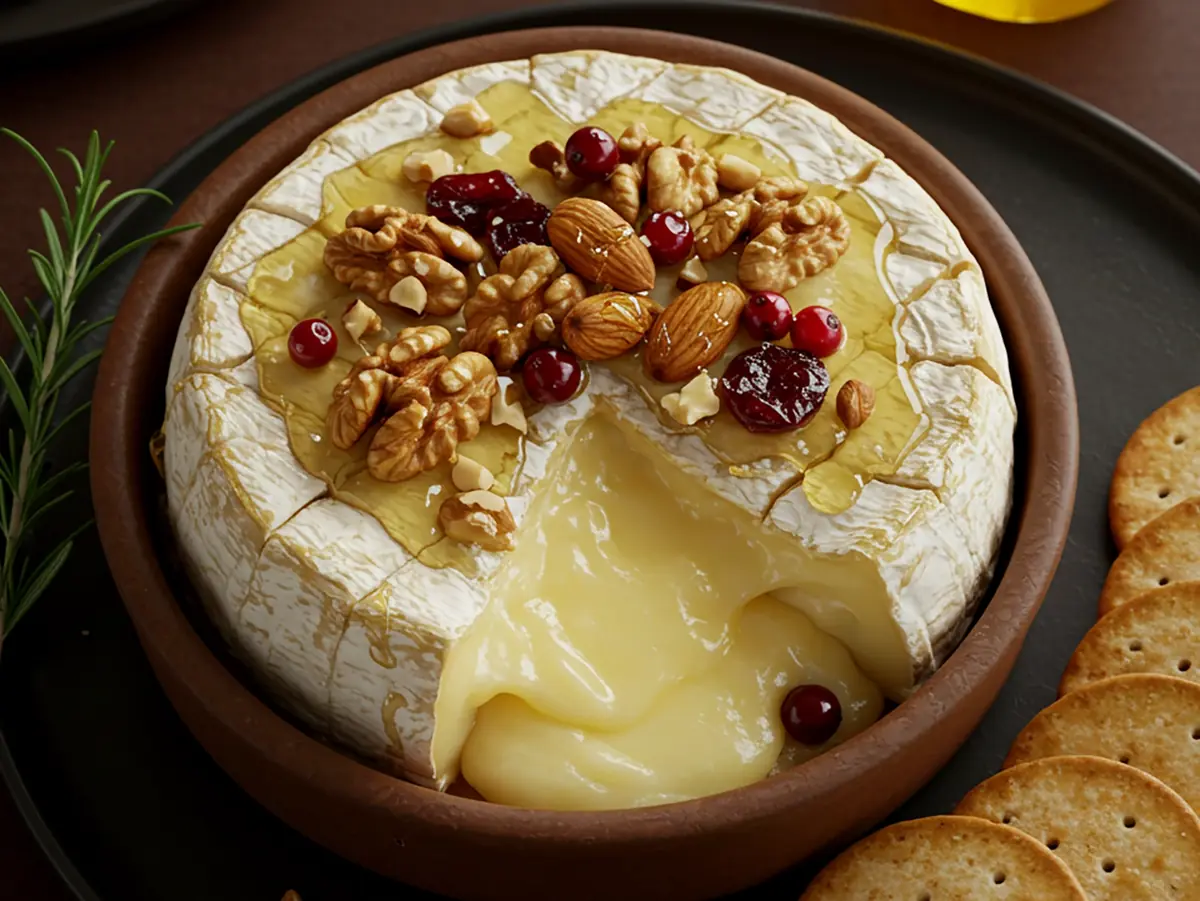
Oven-Baked Brie with Honeyed Nuts
Baked brie is a whole wheel of brie warmed in the oven until the inside turns into molten, spoonable cream while the white rind holds it together like a bowl. It is a party starter built for sharing: the cheese goes to the table in its dish and everyone dips bread straight into it. Here the top is scored and studded with garlic and rosemary before baking, then finished with walnuts toasted in honey, a pinch of flaky salt and a little dried fruit. It takes under twenty minutes and needs almost no work beyond watching the clock.
Ingredients
- 200 gbrie cheese, one whole ripe wheel
- 1 clovegarlic, thinly sliced
- 2 sprigsfresh rosemary
- 30 gwalnuts
- 2 tbsphoney
- 20 gdried fruit, such as cranberries or chopped apricots
- 0.5 tsppink peppercorns, lightly crushed (optional)
- 1 pinchflaky sea salt
- 1 for servingbaguette, sliced
Method
- Heat the oven to 180 °C. Take the brie straight from the fridge — the timings below assume a cold wheel, which melts more evenly than one left out to warm up. Choose a small ovenproof dish or skillet only a little wider than the cheese and line it with a square of parchment.
- Score the top and stud it. With a sharp knife, cut a criss-cross pattern into the top rind about 1.5 cm apart and 3–4 mm deep — through the rind, not through the cheese. Score only the top: the sides and base keep their rind so the wheel holds its shape. Push the garlic slices and small rosemary sprigs into the cuts, set the brie in the dish and sprinkle the pink peppercorns over, if using.
- Toast the walnuts in honey. Put the walnuts in a dry frying pan over medium heat and toast for 4–5 minutes, shaking the pan, until they smell nutty and darken slightly at the edges. Take the pan off the heat, add the honey and stir to coat — off the heat, because honey burns within seconds in a hot pan.
- Bake for 12–15 minutes for a 200 g wheel, or 15–20 minutes for a 250 g one. Start checking at 12 minutes: press the centre gently with a finger or the back of a spoon. It is ready when it feels very soft, as if it would give way under a little more pressure, and the sides have just begun to slump. If the rind splits and cheese runs out, it is slightly over — serve it at once and it will still be good.

- Top it straight away. Spoon the honeyed walnuts over the hot cheese so the honey runs into the cuts, scatter the dried fruit and finish with a pinch of flaky salt.
- Rest for 2–3 minutes, no longer, then bring the dish to the table with the sliced baguette. Cut in too early and the whole centre runs out; wait more than five or six minutes and the fat starts to set again and the cheese firms up.
FAQ
Bake brie at 180 °C: 12–15 minutes for a 200 g wheel straight from the fridge, 15–20 minutes for a 250 g one. Press the centre gently — it is done when it feels very soft, as if it is about to give way, and the sides have just started to slump. Score only the top rind; the sides and base keep theirs, and that is what holds the wheel together. If the rind splits and cheese runs out, it is a little overbaked, but serve it immediately and it is still good.
Wooden boxes are more common on camembert than on brie, and most brie is sold in paper or plastic, so you will usually need a dish anyway. If your cheese does come in a thin wooden box, you can bake it inside at 180 °C: remove all plastic, paper and labels first, and put the box on a tray in case it scorches. Otherwise use a small ovenproof dish or skillet only a little wider than the cheese — it does the same job of catching the cheese if the rind splits.
Brie and camembert are similar French white mold cheeses, but there are differences. Brie is from the Île-de-France region — more delicate and milky. Camembert is from Normandy — more pungent and intense with pronounced mushroom aroma. Both bake well. Camembert is slightly denser and holds its shape better. Brie melts faster and gives a creamier texture. The choice is personal preference.
Classic: honey plus walnuts plus rosemary. Very good: fig or apricot jam plus almonds. Unusual but delicious: cranberry sauce plus thyme (festive table feel). Spicy touch: a pinch of chili flakes or black pepper over the honey. Serve with: toasts, breadsticks, slices of green apple (its acidity balances the cheese's richness), grapes.
As it cools, brie returns to a firm consistency — the fat sets again. Within 5–7 minutes of leaving the oven the texture is already less creamy. Reheating will melt it again, but the rind becomes less attractive. Rule: bring it to the table straight from the oven, with guests already seated. This dish does not wait.
Rate this
Recipes by email
One letter a week: a recipe picked for your taste, plus whatever is new on the site. Unsubscribe in one click.
Welcome gift: Sergei's cookbook (e-book).
By subscribing you agree to the privacy policy.
Tell us what you like to cook (30 seconds) →Keep browsing
More dishes from the French archive — picked by overlap with what you're cooking now.
Join the conversation
Comments (1)
Presentation is half the battle with oven-baked brie with honeyed nuts. I serve it on a wooden board rather than a plate — it's more inviting and signals to people that they should reach in and help themselves.