Italy · Sauces and Dips
Italian Bagna Cauda (Piedmontese Hot Anchovy and Garlic Dip)
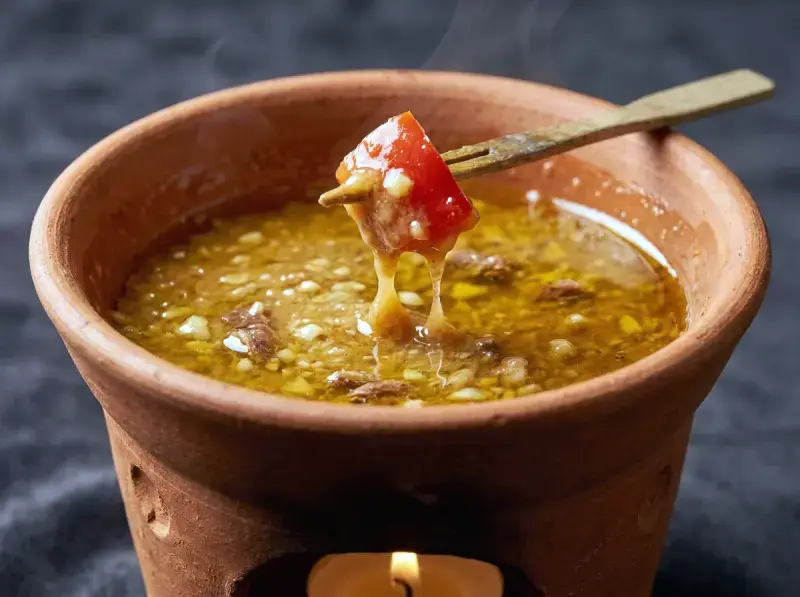
Bagna cauda — Piedmontese dialect for 'hot bath' — is the ancient warm dip of olive oil, garlic, and anchovies that defines Northern Italian conviviality.
Ingredients
- garlic60 g
- whole milk250 ml
- anchovy fillets80 g
- extra virgin olive oil200 ml
- unsalted butter30 g
- walnut oil1 tbsp
- salt1 pinch
Method
- 1Prepare the garlic. Peel 60 g of garlic cloves (about 15-18 cloves, 2 medium heads). Slice each clove in half lengthwise and use the tip of a knife to remove the green germ from the centre — this step is non-negotiable, the germ holds bitterness and a lasting harshness even when cooked. Slice the cleaned cloves thinly so they melt evenly during the milk poach. The Asti 2005 official recipe explicitly calls for de-germinated garlic.
- 2Milk-poach the garlic for elegance. Place the sliced garlic in a small saucepan and pour in 250 ml of whole milk to cover. Bring to a bare simmer over the lowest heat — do not let it boil. Cook gently for 15-20 minutes, stirring occasionally, until the garlic is completely soft (mashable with a fork) and the milk has thickened slightly. Drain the garlic, discarding the milk (or save it for a soup base). The milk-poach mellows the aggression and turns the garlic sweet — without this step you have the more pure Asti 2005 version, which is intensely garlic-forward.
- 3Prepare the anchovies. If using salt-packed anchovies (preferred — Cetara, Recca, or Spanish red anchovies): rinse 80 g of fillets briefly under cold water, then soak in red wine for 5 minutes (traditional Piedmontese method, the wine cleanses better than water and adds depth), pat dry. Lay each fillet flat and use a finger to lift out the central spine starting from the tail. If using oil-packed: pat 80 g of quality anchovies dry with paper towel — no further prep needed. Salt-packed brands cost more but give the deepest flavour and a silkier melt.
- 4Start the cold-oil confit. Place the milk-poached garlic and prepared anchovies in a heavy-bottomed small saucepan or terracotta fujòt. Pour in 200 ml of extra virgin olive oil cold from the bottle. Set on the lowest heat — and I mean the lowest, you should barely see a few bubbles around the garlic, never sizzling or frying. The Asti 2005 recipe explicitly states 'cook the sauce over low heat, taking care that it does not fry'. Cooking from cold oil is non-negotiable; hot oil burns garlic and destroys the dish.
- 5Confit slowly for 20-25 minutes. Cook on the lowest heat for 20-25 minutes, stirring with a wooden spoon every 2-3 minutes. The anchovies will dissolve completely into the oil — at first they hold shape, after 10 minutes they crumble, by 20 minutes they are fully dissolved into a unified savory base. The garlic should soften further but never brown — if you see any colouring, immediately reduce heat or pull off briefly. The sauce develops from broken anchovy chunks to a homogeneous fragrant golden-brown mixture.
- 6Finish with butter (optional but recommended). Off the heat, add 30 g of cold unsalted butter and 1 tablespoon of walnut oil to the warm sauce. Stir gently with a wooden spoon until the butter melts and integrates — the cold butter must mount into the warm oil without breaking, which is why heat must be off. The butter gives a silky velvet texture, the walnut oil adds a traditional Piedmontese nutty depth. If using egg yolk for extra creaminess (Asti 2005 lists as optional): whisk 1 yolk into the warm sauce off-heat after the butter.
- 7Taste and adjust. Add a pinch of salt only if the anchovies were unsalted enough — usually no salt is needed, the anchovies provide all the salinity. Taste the texture: it should be a thick warm liquid, not a paste, with visible flecks of garlic and dissolved anchovy. If too thick, add 1-2 tablespoons more oil; if too thin, return to lowest heat for 2 more minutes uncovered. The sauce should coat a wooden spoon and drip slowly off the back.
- 8Serve immediately, kept warm. Transfer to a fujòt (Piedmontese terracotta dip-pot with candle warmer) or a fondue pot with alcohol burner — bagna cauda must stay warm at 55-65°C throughout the meal, otherwise the emulsion separates and the aroma fades. Place at the centre of the table, surrounded by a platter of seasonal vegetables: raw cardoon, raw red bell pepper strips, raw fennel, celery sticks, carrot sticks, raw radicchio, savoy cabbage leaves, boiled potatoes, roasted onion wedges, fried polenta squares. Serve with crusty bread for dipping. Pair with red Piedmontese wine — Barbera d'Asti, Dolcetto, or Nebbiolo.