
Italian Bagna Cauda (Piedmontese Hot Anchovy and Garlic Dip)
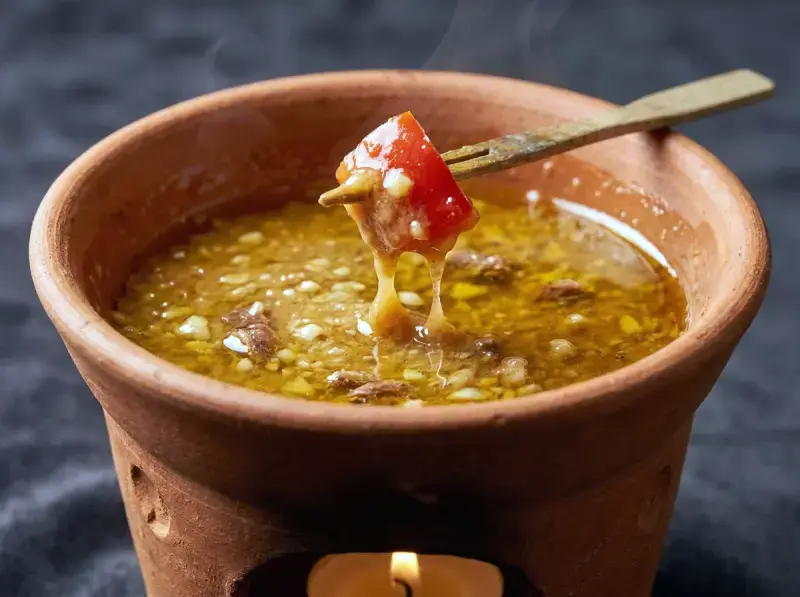
Bagna cauda — Piedmontese dialect for 'hot bath' — is the ancient warm dip of olive oil, garlic, and anchovies that defines Northern Italian conviviality. Slowly melted into a single silky emulsion, kept warm at the centre of the table in a terracotta fujòt over a candle, surrounded by raw and cooked seasonal vegetables and crusty bread for dipping. Origins trace to medieval Piedmont and the Strada Salis (the salt road) that brought anchovies and salt from Provence and Nice into landlocked Piedmontese valleys, fueling a cuisine built on cured fish far from the sea. In 2005 the Asti Delegation of the Italian Academy of Cuisine officially registered the recipe with a notary in Costigliole d'Asti. Every November-December Asti celebrates Bagna Cauda Day. This domestic balanced version uses milk-poached garlic for elegance, salt-packed anchovies for depth, and a finishing knob of butter for silky texture. Active 25 minutes plus 15 minutes milk-poach. Yields about 300 ml, serves 6 as a centerpiece dip.
Ingredients
- 60 ggarlic
- 250 mlwhole milk
- 80 ganchovy fillets
- 200 mlextra virgin olive oil
- 30 gunsalted butter
- 1 tbspwalnut oil
- 1 pinchsalt
Method
- Prepare the garlic. Peel 60 g of garlic cloves (about 15-18 cloves, 2 medium heads). Slice each clove in half lengthwise and use the tip of a knife to remove the green germ from the centre — this step is non-negotiable, the germ holds bitterness and a lasting harshness even when cooked. Slice the cleaned cloves thinly so they melt evenly during the milk poach. The Asti 2005 official recipe explicitly calls for de-germinated garlic.
- Milk-poach the garlic for elegance. Place the sliced garlic in a small saucepan and pour in 250 ml of whole milk to cover. Bring to a bare simmer over the lowest heat — do not let it boil. Cook gently for 15-20 minutes, stirring occasionally, until the garlic is completely soft (mashable with a fork) and the milk has thickened slightly. Drain the garlic, discarding the milk (or save it for a soup base). The milk-poach mellows the aggression and turns the garlic sweet — without this step you have the more pure Asti 2005 version, which is intensely garlic-forward.
- Prepare the anchovies. If using salt-packed anchovies (preferred — Cetara, Recca, or Spanish red anchovies): rinse 80 g of fillets briefly under cold water, then soak in red wine for 5 minutes (traditional Piedmontese method, the wine cleanses better than water and adds depth), pat dry. Lay each fillet flat and use a finger to lift out the central spine starting from the tail. If using oil-packed: pat 80 g of quality anchovies dry with paper towel — no further prep needed. Salt-packed brands cost more but give the deepest flavour and a silkier melt.
- Start the cold-oil confit. Place the milk-poached garlic and prepared anchovies in a heavy-bottomed small saucepan or terracotta fujòt. Pour in 200 ml of extra virgin olive oil cold from the bottle. Set on the lowest heat — and I mean the lowest, you should barely see a few bubbles around the garlic, never sizzling or frying. The Asti 2005 recipe explicitly states 'cook the sauce over low heat, taking care that it does not fry'. Cooking from cold oil is non-negotiable; hot oil burns garlic and destroys the dish.
- Confit slowly for 20-25 minutes. Cook on the lowest heat for 20-25 minutes, stirring with a wooden spoon every 2-3 minutes. The anchovies will dissolve completely into the oil — at first they hold shape, after 10 minutes they crumble, by 20 minutes they are fully dissolved into a unified savory base. The garlic should soften further but never brown — if you see any colouring, immediately reduce heat or pull off briefly. The sauce develops from broken anchovy chunks to a homogeneous fragrant golden-brown mixture.
- Finish with butter (optional but recommended). Off the heat, add 30 g of cold unsalted butter and 1 tablespoon of walnut oil to the warm sauce. Stir gently with a wooden spoon until the butter melts and integrates — the cold butter must mount into the warm oil without breaking, which is why heat must be off. The butter gives a silky velvet texture, the walnut oil adds a traditional Piedmontese nutty depth. If using egg yolk for extra creaminess (Asti 2005 lists as optional): whisk 1 yolk into the warm sauce off-heat after the butter.
- Taste and adjust. Add a pinch of salt only if the anchovies were unsalted enough — usually no salt is needed, the anchovies provide all the salinity. Taste the texture: it should be a thick warm liquid, not a paste, with visible flecks of garlic and dissolved anchovy. If too thick, add 1-2 tablespoons more oil; if too thin, return to lowest heat for 2 more minutes uncovered. The sauce should coat a wooden spoon and drip slowly off the back.
- Serve immediately, kept warm. Transfer to a fujòt (Piedmontese terracotta dip-pot with candle warmer) or a fondue pot with alcohol burner — bagna cauda must stay warm at 55-65°C throughout the meal, otherwise the emulsion separates and the aroma fades. Place at the centre of the table, surrounded by a platter of seasonal vegetables: raw cardoon, raw red bell pepper strips, raw fennel, celery sticks, carrot sticks, raw radicchio, savoy cabbage leaves, boiled potatoes, roasted onion wedges, fried polenta squares. Serve with crusty bread for dipping. Pair with red Piedmontese wine — Barbera d'Asti, Dolcetto, or Nebbiolo.
FAQ
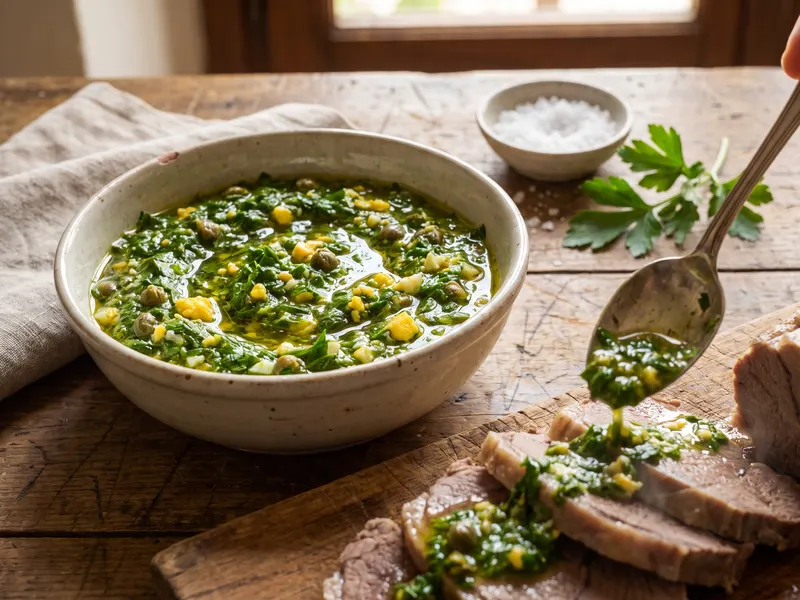
Bagna cauda (Piedmontese dialect for 'hot bath') is the ancient Piedmontese warm dip of olive oil, garlic, and anchovies, slowly melted into one silky emulsion and served hot at the centre of the table in a special terracotta fujòt with a candle warmer. Guests dip raw and cooked seasonal vegetables and bread — it is a convivial ritual, like fondue but olive-oil based. Origins are medieval Piedmont, the tradition is linked to the Strada Salis (salt road) from Provence and Nice into Piedmont: salt and anchovies travelled inland into the mountains, and landlocked Piedmont built a cuisine on cured fish. Bagna cauda is a symbol of cucina povera, in 2005 the Asti Delegation of the Italian Academy of Cuisine officially registered the recipe with a notary. Each November-December Asti celebrates Bagna Cauda Day. Differences from other anchovy sauces: salsa verde piemontese is a cold raw sauce of parsley-anchovy-capers-bread, served with bollito misto — different consistency (rough chop), different ingredients (bread, yolk, parsley), and never served hot. Anchoiade from Provence is a kindred spirit, also a warm dip of anchovies, garlic, and oil, but typically without the long garlic confit, more homogenized blend, sometimes with almonds or capers; served with vegetables or crostini but without the fujòt ceremony. Bagna verde (green bagna cauda) is a modern variant adding parsley or herbs. Acciughe al verde is a different starter: marinated anchovies under green sauce, eaten cold. The key distinction of bagna cauda: warm oil-based bath, garlic-anchovy infusion as the core, and the warm-serving ritual.
Raw garlic in large quantities (the Asti 2005 classic is 1 head per serving) gives an aggressive sharpness many find hard to digest. For a more delicate domestic version there are three proven mellowing methods: (1) Milk poach (preferred, used by Theo Randall and Nonna La Cucina Italiana): peeled sliced garlic in a small saucepan, cover with 250 ml of whole milk, simmer 20 minutes on the lowest heat until soft. Milk softens the sharpness through casein chemistry, garlic becomes sweet and tender like boiled potato. Drain the milk before confit in oil. (2) Double water-boil: same approach but in water 5-10 minutes, change water and repeat — three water changes remove allicin (the main pungent compound). Less effective than milk but lactose-free. (3) Removing the green germ from the centre — critical, unanimously recommended by all sources including Asti 2005. The green germ holds bitterness and lasting garlic aftertaste, halve each clove and remove with the tip of a knife. This step is mandatory regardless of other methods. (4) Cold-oil confit — slow warming of garlic in cold oil from the start (do not drop into hot oil) gives gradual melt without burn, and burn means bitterness. Burned garlic = bitter aggressive sauce. (5) Replacing part of the garlic with roasted (whole head roasted 40 min at 180°C) — gives sweet caramelized notes, less pungent. Methods can be combined: I recommend milk poach + germ removal + cold-start confit for the domestic version. Asti professionals do pure confit without milk, but it requires acclimation to intense garlic.
Bagna cauda is a hot dip and the centre of a convivial ritual, so vegetable and bread choice defines the experience. Traditional Piedmontese vegetables (per Bagna Cauda Day and Academia Asti): raw — Nizza Monferrato cardoon (artichoke thistle, regional specialty); spring onions quartered; raw savoy cabbage leaves; Jerusalem artichokes; raw fennel; raw red bell pepper strips; chioggia or red beet thin slices; raw Treviso radicchio; cauliflower florets; carrot sticks (must be baby or sweet, not watery); celery sticks; whole green onions. Boiled or roasted — boiled potatoes (peeled, warm); roasted whole onions in their skins (cut into wedges); boiled beets quartered; baked pumpkin slices; boiled cardoons; roasted Jerusalem artichokes. Fried — fried polenta squares (a classic, golden cubes); fried pumpkin slices. Bread — must be crusty rustic Italian: ciabatta, focaccia, pane casereccio, pan tostato. Ideally cut into thin slices and lightly grilled or charred for added depth. What does not work: avocado slices (texture too soft), cucumber (too watery), tomato (acidity clashes with garlic), raw broccoli (hard to dip), leafy salad (poor dipping). Modern additions for creativity: roasted brussels sprouts, blanched asparagus, charred carrots, leeks, baby zucchini, roasted parsnips. Presentation: vegetables arranged on a large rustic wooden or ceramic platter around the central fujòt, varied textures and colours important for visual appeal. Wine pairing: dry red Piedmontese — Barbera d'Asti, Dolcetto, Nebbiolo — traditional and balances the garlic-anchovy-oil intensity.
Bagna cauda must stay warm during the entire meal — this is non-negotiable. If the sauce cools, the garlic and anchovy emulsion separates, the aroma dulls, the texture solidifies and becomes unappetizing. Authentic ritual: serve at the centre of the table in individual or shared ceramic terracotta vessels, guests ritually dip and meet over the common pot. Traditional vessels: (1) Fujòt — individual Piedmontese terracotta or copper pot ~150 ml with built-in tealight or alcohol burner underneath. One per 1-2 guests. Buy at Italian housewares stores or online (€20-40 each). (2) Dian — large terracotta pot for the whole table, set on s-cionfetta (smouldering wood embers in ceramic). Most traditional, requires brazier, usually for restaurant service. (3) Tegame di terra cotta — large terracotta pan on open-fire stand. Modern alternatives: (1) Fondue pot with alcohol burner — simplest accessible domestic substitute (€30-80 for quality set). Cheese or meat fondue pots work — the key is holding 60-70°C. (2) Small slow cooker on 'warm' setting — not ideal (poor temperature distribution and slow response), but works in a pinch. (3) Candle warmer plate — pot sits on metal plate with candle below. Simple, cheap (€10-20). (4) Hot water bath / bain-marie — pot sits in a larger bowl of hot water; refresh water every 30 minutes. (5) Small electric warming dish — modern minimalist option. What does not work: a regular tealight under a fondue pot — too weak, won't hold temperature. Microwave reheat cycles — sauce separates, garlic burns. Direct heat on electric range — burns the bottom layer, anchovy oil splits. Ideal serving temperature: 55-65°C — oil still liquid, aroma active, edible-comfortable but not scalding. Test: should slightly steam but not boil.
Bagna cauda is usually made in large quantities for a convivial event and leftovers are common — and they are gold. The thick sediment (Italian: spesso — anchovy-garlic paste at the bottom) and infused oil have dozens of uses. Storage: fridge in a sealed glass jar up to 5-7 days — the sauce solidifies into a semi-firm texture (oil congeals when cold, especially walnut/butter components). Room temperature 2-3 days max. Freezing: up to 1 month in small portions (ice cube tray + zip-bag), but texture suffers after thawing — anchovy fragments separate and texture can be slightly grainy. Reheat: only on the lowest heat, stirring constantly. Never microwave (breaks emulsion), bain-marie or double-boiler is best. If sauce splits — add 1 teaspoon cold butter and whisk quickly, usually it recovers. Leftover ideas (classic Piedmontese): (1) Bagna cauda eggs — most famous leftover use. Crack 2-3 eggs directly into leftover bagna cauda in a pan and cook as scramble or frittata — anchovy-garlic flavor permeates the eggs. Breakfast or late-night snack. (2) Pasta sauce — toss 200 g cooked spaghetti or tagliatelle with 4-5 tablespoons of leftover bagna cauda, add 1 tablespoon pasta water, 1 tablespoon olive oil, grated Parmigiano. Done — pasta in olio Piedmontese style. (3) Polenta topping — plate of fresh polenta + spoon of bagna cauda + slice of pancetta or taleggio. Quintessential Piedmontese comfort. (4) Salad dressing — thin out leftover bagna cauda with 2 tablespoons red wine vinegar and 2 tablespoons olive oil. Perfect for radicchio or endive with walnuts. (5) Pizza topping — drizzle leftover bagna cauda on freshly baked pizza bianca at the finish (only after the oven). (6) Roast meat sauce — small spoon of leftover bagna cauda over roasted chicken or lamb as a finishing condiment. (7) Scrambled eggs — Asti grandmothers say the anchovy fragments at the bottom of fujòt are 'the best part', add to scrambled eggs or omelette. (8) Croutons — soak crusty bread cubes in leftover oil + 5 minutes in 180°C oven — bagna cauda croutons for salads and soups. (9) Roasted vegetables drizzle — straight from the oven, drizzle a spoon of leftover bagna cauda — instant flavor uplift. (10) Crostini spread — the thicker spesso part directly spread on toasted bread with roasted peppers or mozzarella. The Piedmontese saying: 'bagna cauda è meglio il giorno dopo' — bagna cauda is better the day after, when garlic and anchovy integrate even more deeply.
Rate this
Recipes by email
One letter a week: a recipe picked for your taste, plus whatever is new on the site. Unsubscribe in one click.
Welcome gift: Sergei's cookbook (e-book).
By subscribing you agree to the privacy policy.
Tell us what you like to cook (30 seconds) →Keep browsing
More dishes from the Italian archive — picked by overlap with what you're cooking now.
Join the conversation
Comments
No comments yet — be the first!