France · Flour and Confectionery Products
Brioche
Brioche is the defining bread of French viennoiserie — a category that sits between bread and pastry.
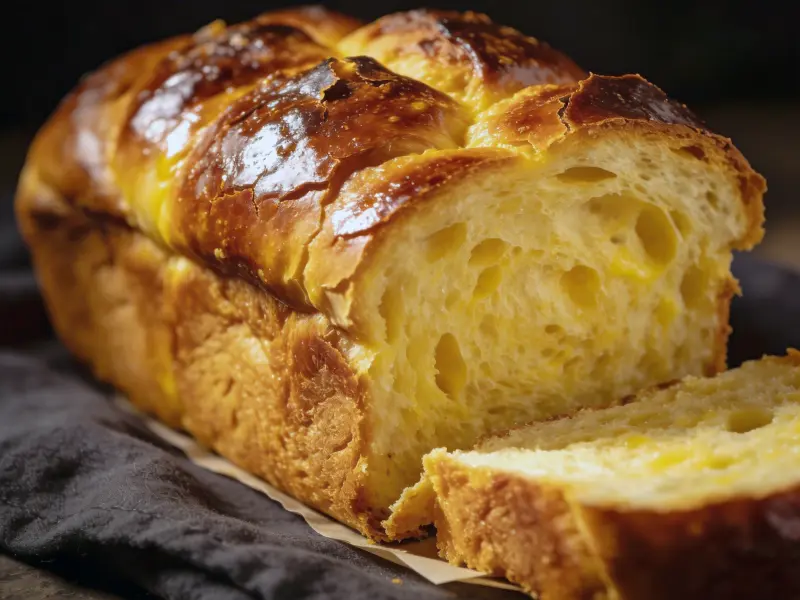
Ingredients
- plain flour500 g
- instant yeast7 g
- caster sugar50 g
- fine salt10 g
- eggs4
- whole milk, lukewarm80 ml
- unsalted butter, cold but pliable250 g
- whole milk1 tbsp
- egg, for the egg wash1
Method
- 1Build the base dough. Combine flour, yeast, sugar, and salt in the bowl of a stand mixer. Add the 4 eggs and lukewarm milk. Mix on low speed with the dough hook for 2 minutes until a shaggy dough forms, then increase to medium and knead for 8 to 10 minutes until the dough is smooth, elastic, and pulls away cleanly from the sides of the bowl. This develops the gluten structure that must later support the weight of all the butter. Do not add butter yet — fat inhibits gluten development. The dough at this stage will be firm and slightly tacky.
- 2Add the butter slowly — this is the critical step. Reduce the mixer to medium-low. Begin adding the cold butter cubes, a few pieces at a time, waiting for each addition to be fully incorporated before adding the next. This process takes 10 to 15 minutes. The dough will look greasy, broken, and unpleasant for most of this time — resist the urge to add flour. Continue adding butter patiently until all 250 g has been incorporated. Once the last of the butter is in, increase speed to medium and continue kneading for 5 more minutes until the dough is smooth, shiny, and pulls away from the bowl sides. It should pass the windowpane test: stretch a small piece — it should be thin enough to be translucent without tearing.
- 3First rise and refrigerate overnight. Shape the dough into a ball and place in a large lightly oiled bowl. Cover tightly with cling film and leave at room temperature for 1.5 to 2 hours until noticeably puffed (it will not fully double in this time — the butter slows fermentation). Deflate gently, cover again, and refrigerate overnight (8 to 16 hours). The cold retard serves two purposes: it chills and firms the butter-rich dough to make shaping possible, and it allows a slow fermentation to develop the complex, slightly tangy flavor that separates real brioche from bland enriched loaves.
- 4Shape and second rise. Remove the dough from the refrigerator and work quickly while it is still cold and firm. Divide into 12 equal portions (about 80 g each) for rolls, or leave whole for a loaf. For rolls: roll each piece into a tight ball and arrange in a buttered 23 × 33 cm baking tin, spaced 1 cm apart. For a loaf: divide into 3 or 4 pieces, roll each into a cylinder, and layer in a buttered 900 g (2 lb) loaf tin. Cover loosely and prove at room temperature until doubled and visibly puffy — 2 to 3 hours depending on kitchen temperature. Do not rush this rise: an under-proved brioche will have a dense, gummy crumb.
- 5Glaze and bake. Preheat the oven to 180°C (350°F). Beat the fifth egg (the one set aside for glazing) with 1 tbsp milk to make egg wash. Brush the risen brioche gently but thoroughly with egg wash — this gives the characteristic deep mahogany color. For rolls, bake 18 to 22 minutes; for a loaf, 30 to 35 minutes. The crust should be a deep, burnished golden-brown and the internal temperature 88 to 90°C (190°F). If the top browns too quickly, tent loosely with foil after 20 minutes. Cool in the tin for 10 minutes, then turn out onto a wire rack. Do not slice until the loaf has cooled for at least 30 minutes — the crumb sets as it cools.