
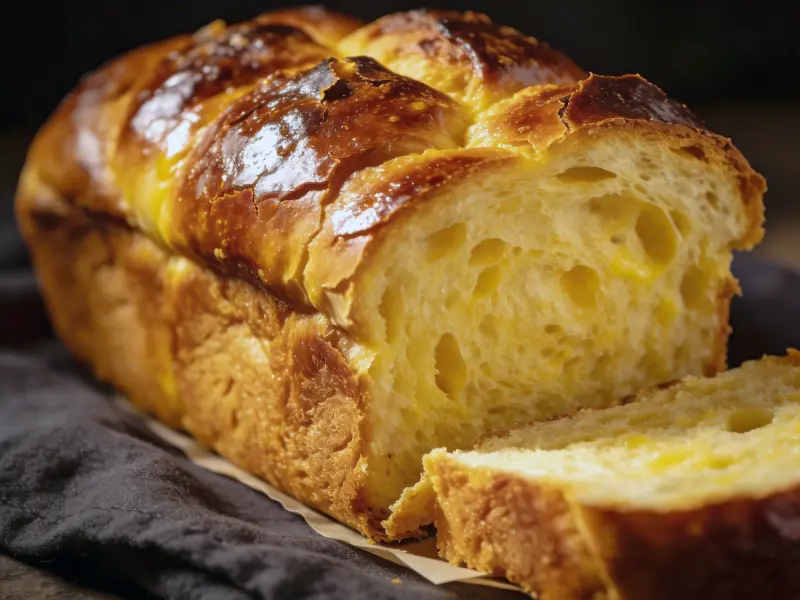
Brioche
Brioche is the defining bread of French viennoiserie — a category that sits between bread and pastry. It is an enriched dough: plain flour combined with a quantity of butter (typically 40 to 50% of the flour weight), eggs, sugar, and a small amount of milk, kneaded until the butter is fully emulsified into the dough structure. The result is a loaf with a paper-thin, deeply burnished mahogany crust that shatters when touched, and an interior crumb that is yellow from egg yolks, feather-soft, and faintly sweet — closer to a very light cake than to bread. The technique demands patience: the butter is added cold and slowly after the dough has already developed gluten strength, and the dough rests overnight in the refrigerator so that the fats firm up and the fermentation develops flavor. Brioche is eaten for breakfast in France spread with jam, used as the base for French toast, bread pudding, and croque monsieur, or sliced and toasted to serve with foie gras.
Ingredients
- 500 gplain flour
- 7 ginstant yeast
- 50 gcaster sugar
- 10 gfine salt
- 4 eggs
- 80 mlwhole milk, lukewarm
- 250 gunsalted butter, cold but pliable
- 1 tbspwhole milk
- 1 egg, for the egg wash
Method
- Build the base dough. Combine flour, yeast, sugar, and salt in the bowl of a stand mixer. Add the 4 eggs and lukewarm milk. Mix on low speed with the dough hook for 2 minutes until a shaggy dough forms, then increase to medium and knead for 8 to 10 minutes until the dough is smooth, elastic, and pulls away cleanly from the sides of the bowl. This develops the gluten structure that must later support the weight of all the butter. Do not add butter yet — fat inhibits gluten development. The dough at this stage will be firm and slightly tacky.
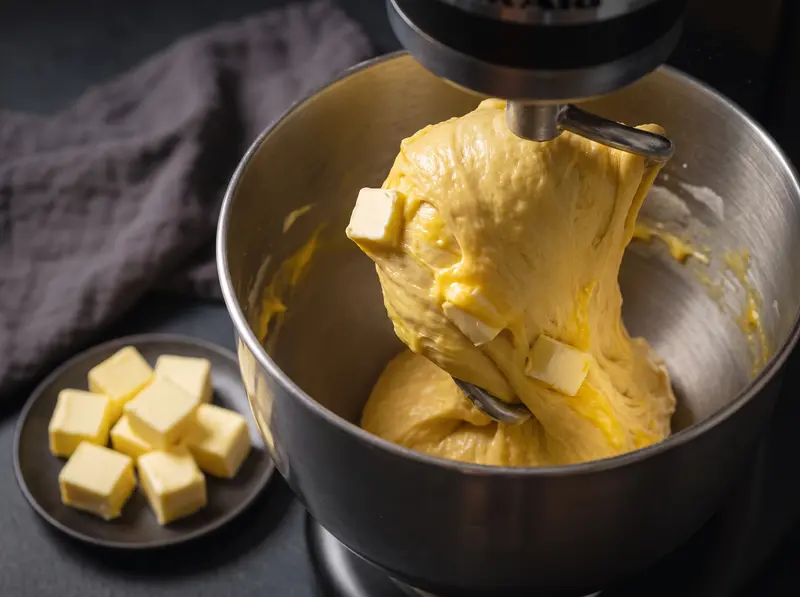
- Add the butter slowly — this is the critical step. Reduce the mixer to medium-low. Begin adding the cold butter cubes, a few pieces at a time, waiting for each addition to be fully incorporated before adding the next. This process takes 10 to 15 minutes. The dough will look greasy, broken, and unpleasant for most of this time — resist the urge to add flour. Continue adding butter patiently until all 250 g has been incorporated. Once the last of the butter is in, increase speed to medium and continue kneading for 5 more minutes until the dough is smooth, shiny, and pulls away from the bowl sides. It should pass the windowpane test: stretch a small piece — it should be thin enough to be translucent without tearing.
- First rise and refrigerate overnight. Shape the dough into a ball and place in a large lightly oiled bowl. Cover tightly with cling film and leave at room temperature for 1.5 to 2 hours until noticeably puffed (it will not fully double in this time — the butter slows fermentation). Deflate gently, cover again, and refrigerate overnight (8 to 16 hours). The cold retard serves two purposes: it chills and firms the butter-rich dough to make shaping possible, and it allows a slow fermentation to develop the complex, slightly tangy flavor that separates real brioche from bland enriched loaves.
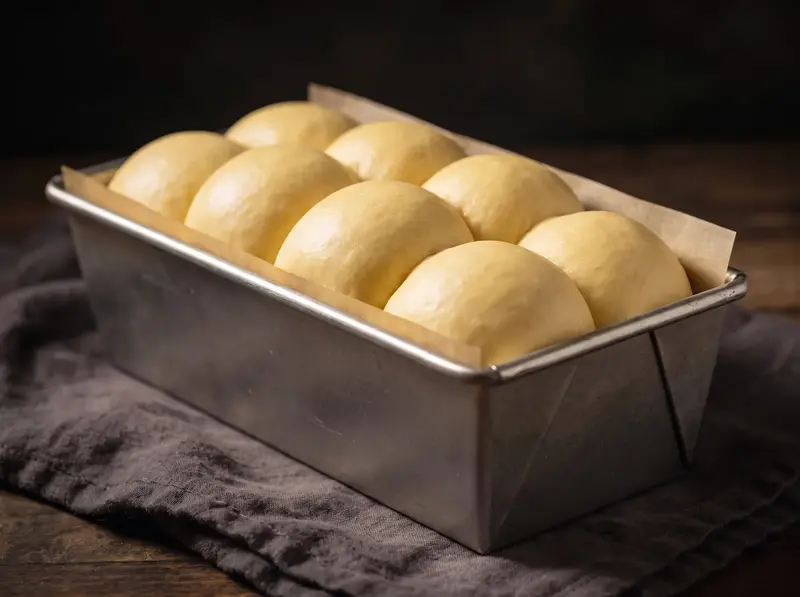
- Shape and second rise. Remove the dough from the refrigerator and work quickly while it is still cold and firm. Divide into 12 equal portions (about 80 g each) for rolls, or leave whole for a loaf. For rolls: roll each piece into a tight ball and arrange in a buttered 23 × 33 cm baking tin, spaced 1 cm apart. For a loaf: divide into 3 or 4 pieces, roll each into a cylinder, and layer in a buttered 900 g (2 lb) loaf tin. Cover loosely and prove at room temperature until doubled and visibly puffy — 2 to 3 hours depending on kitchen temperature. Do not rush this rise: an under-proved brioche will have a dense, gummy crumb.
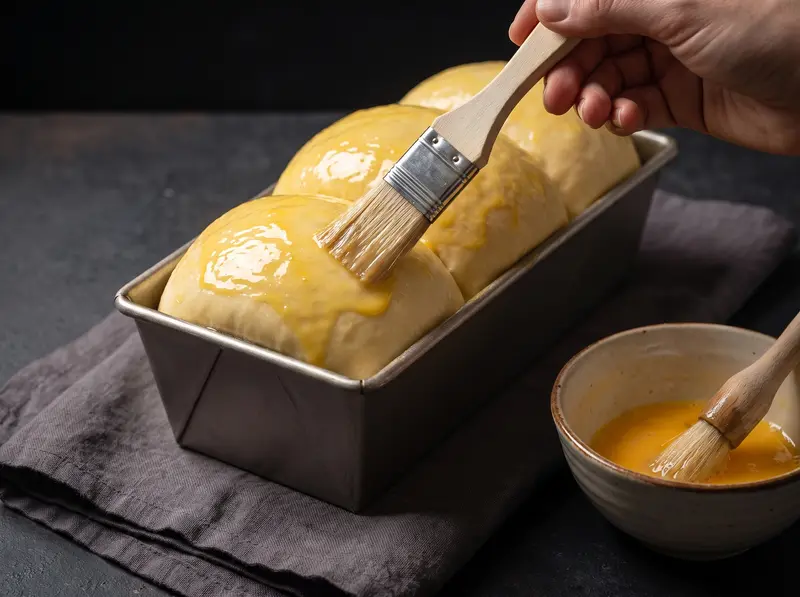
- Glaze and bake. Preheat the oven to 180°C (350°F). Beat the fifth egg (the one set aside for glazing) with 1 tbsp milk to make egg wash. Brush the risen brioche gently but thoroughly with egg wash — this gives the characteristic deep mahogany color. For rolls, bake 18 to 22 minutes; for a loaf, 30 to 35 minutes. The crust should be a deep, burnished golden-brown and the internal temperature 88 to 90°C (190°F). If the top browns too quickly, tent loosely with foil after 20 minutes. Cool in the tin for 10 minutes, then turn out onto a wire rack. Do not slice until the loaf has cooled for at least 30 minutes — the crumb sets as it cools.
FAQ
The temperature of the butter is one of the most critical variables in brioche. Cold butter (16 to 18°C) that is pliable but not greasy emulsifies into the dough gradually, coating the gluten threads and fat globules in a stable emulsion. This produces the characteristic smooth, glossy, slightly sticky dough with an even, feathery crumb structure. Warm or softened butter (22°C or above) is too fluid — it causes the water and fat phases to separate, breaking the emulsion and producing a greasy, slack dough that cannot hold its structure. If the dough becomes warm and greasy during butter incorporation, refrigerate the bowl for 10 to 15 minutes before continuing. Many professional brioche recipes specify the dough temperature must not exceed 23°C during mixing.
Yes, but it is extremely demanding by hand and Julia Child — who made it regularly — described the process as requiring determination and strong wrists. The technique is called fraisage: stretch the dough forward across the counter with the heel of your hand, fold it back on itself, rotate 90 degrees, and repeat. The butter is incorporated after the dough has been hand-kneaded for 10 to 15 minutes, then the process continues for another 20 minutes until the butter is absorbed and the dough is smooth. It helps to work on a marble counter or cold surface. The result is genuine and sometimes preferred by purists who argue that hand kneading generates less heat than a machine, keeping the butter at the ideal temperature throughout.
The windowpane test is a simple way to verify that gluten has developed sufficiently. Pinch off a small piece of dough (about the size of a walnut), stretch it gently with both hands from the center outward, working gradually toward the edges. If the dough can be stretched into a thin, nearly translucent membrane without tearing — thin enough to see light through — the gluten structure is developed. If it tears before becoming translucent, the dough needs more kneading. For brioche, the windowpane test should be performed twice: after the initial knead (before butter is added) to confirm the base gluten structure, and again after all butter has been incorporated to confirm the structure has held together through the butter addition.
Brioche improves dramatically with age in a secondary application. Fresh brioche is wonderful eaten plain or with jam, but brioche that is one to three days old — when the crumb has firmed slightly from the butter setting as it cools — makes incomparably good French toast: its density means it absorbs the egg custard deeply without falling apart, and the butter content creates a self-basting effect in the pan. It also makes exceptional bread pudding, croque monsieur, and pain perdu. Truly stale brioche can be blitzed into breadcrumbs — the richest, most flavourful breadcrumbs available for crumbing escalopes or finishing gratins.
Both brioche and challah are enriched, braided egg breads with a long history, but they are distinct in several important ways. Challah is a Jewish ceremonial bread in which all fat comes from eggs and oil — no butter or dairy is used, making it kosher and pareve (neither meat nor dairy). It has a slightly firmer, more bread-like crumb with a distinct eggy flavor. Brioche is a French viennoiserie in which a very substantial quantity of butter is added to the dough after the initial knead — butter typically constitutes 40 to 50% of the flour weight. This makes the crumb dramatically softer, richer, and more tender, with a pronounced dairy quality. Brioche also has a thinner, more shatteringly crisp crust than challah's thick, chewy exterior.
Keep browsing
More dishes from the French archive — picked by overlap with what you're cooking now.
Recipes by email
One letter a week: a recipe picked for your taste, plus whatever is new on the site. Unsubscribe in one click.
Welcome gift: Sergei's cookbook (e-book).
By subscribing you agree to the privacy policy.
Tell us what you like to cook (30 seconds) →
Join the conversation
Comments
No comments yet — be the first!