France · Flour and Confectionery Products
Canelés de Bordeaux (French Rum and Vanilla Pastries)
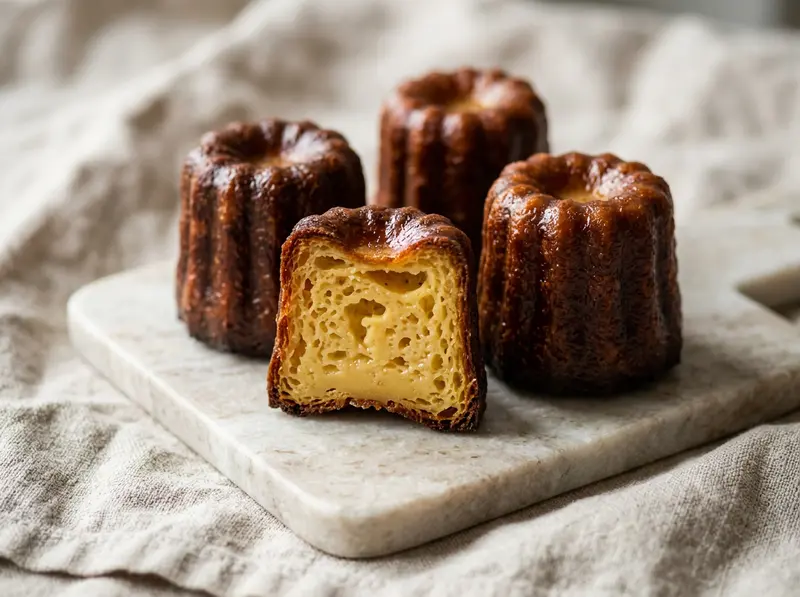
A canelé, also spelled cannelé (カヌレ, kanure, in Japanese), is a small fluted cake from Bordeaux in France.
Ingredients
- milk400 ml
- vanilla pod1
- butter40 g
- sugar200 g
- flour100 g
- egg1
- egg yolks2
- dark rum3 tbsp
Method
- 1Day 1, warm the milk. Pour 300 ml of the 400 ml of whole milk into a medium saucepan and keep the other 100 ml cold. Split the vanilla pod lengthwise, scrape the seeds into the pan with the tip of a knife and drop the pod in as well. Heat over medium heat for about 5 minutes, until the milk steams and small bubbles show at the edge, then take the pan off the heat. Add 30 g of the butter (unsalted), stir until it has melted, and pour in the 100 ml of cold milk. The milk is still too hot for the eggs at this point, because above 50 °C it starts to cook them. Leave the pan off the heat for about 15 minutes, stirring now and then, and weigh out the sugar and flour meanwhile. The milk is ready at 50 °C or below on a thermometer. Without one, wait until you can rest your palm against the side of the pan without wanting to pull it away, and a fingertip dipped in the milk feels warm and not hot.
- 2Mix the batter. In a large mixing bowl, whisk the 200 g of sugar (white granulated or caster) with the 100 g of flour. Use plain (all-purpose) wheat flour, not self-raising. Make a well in the middle and put in the egg, a large one of about 50 g without the shell, and the 2 egg yolks. Pour about a third of the warm milk into the well and stir in the centre with the whisk, drawing the flour in from the sides little by little. Add the rest of the milk in 2 more additions, then stir in the 3 tbsp of dark rum. Stir gently the whole time and do not beat, because overworked flour makes canelés climb out of the mould in the oven, and you do not want air in the batter either. The batter should be as thin as pouring cream, with no froth on top. A few small lumps do not matter at this point.
- 3Strain and rest. Pour the batter through a fine sieve, which catches the lumps, into a 1-litre jug, and put the vanilla pod back in. Press cling film directly onto the surface and put the jug in the fridge straight away, for 24 hours. Do not cut the rest below 12 hours, and bake within 48 hours, because the batter contains raw egg. The rest calms the batter so that it stays in the mould as it bakes. The batter also thickens a little, and the vanilla and rum come through more strongly. By the next day the flour and the vanilla seeds will have settled at the bottom of the jug.
- 4Day 2, check the mould and heat the oven. Take the jug out of the fridge 1 hour before you bake, so the batter comes back to room temperature. Before you switch the oven on, read the heat limit printed on your mould or its box, because the first stage of this recipe is 230 °C. Never set the oven above that limit. If the limit is 220 °C, bake the first stage at 220 °C. If it is lower than that, bake at the limit from start to finish and go by colour, which takes 45 to 70 minutes. Put a flat baking tray on the middle shelf and heat the oven to 230 °C. These temperatures are for a conventional oven without a fan. When the oven reaches temperature, let it run for 10 minutes more, because canelés need a fully hot oven from the first minute. Meanwhile, soften the remaining 10 g of butter and brush it into the 12 cavities of a nonstick metal canelé tray, each cavity about 5.5 cm across. You want a thin, even film in every flute and no pools of butter at the bottom.
- 5Fill the mould and start hot. Take the vanilla pod out of the batter and stir slowly from the bottom of the jug with a rubber spatula until the settled flour and vanilla seeds are mixed back in. Do not whisk. Divide all of the batter evenly between the 12 cavities. Each ends up about three-quarters full, which is about 70 g. A silicone mould is floppy, so fill it while it stands on a cold tray or board and slide it from there onto the hot baking tray. Wearing oven gloves, pull the oven shelf out a little, set the canelé tray on the hot baking tray, push the shelf back and shut the door quickly. Bake at 230 °C for 20 minutes. This first blast of heat sets and colours the crust. After 20 minutes the batter has puffed up to the rims and the edges are starting to brown. A little above the rim is normal, and it sinks back.
- 6Turn the heat down. Lower the oven to 190 °C without opening the door, and bake for 30 to 40 minutes more. The lower heat cooks the centre gently. Open the door only if a canelé has risen well clear of its cavity and is spreading over the rim. In that case take the canelé tray out with oven gloves, tap it once on a folded towel so the canelés drop back, and return it at once. Start looking through the door after 30 minutes. The canelés are ready when the tops are a deep chestnut brown, very dark but not black. If the tops are nearly black before that, lay a sheet of foil loosely over the tray. If your oven browns one side faster, turn the tray round once, about halfway through this stage, and do it quickly. In a silicone mould this stage takes longer, 50 to 60 minutes, so go by the colour of the tops.
- 7Unmould and cool. Leave the oven on for now. Take the canelé tray out and, wearing oven gloves, turn it over onto a wire rack straight away. Hot canelés leave a metal mould cleanly, and they stop cooking once they are out. A silicone mould is the exception: leave the canelés in it for 10 minutes, then push them out one at a time. Look at the sides, which should be the same dark brown from top to bottom. If they are pale or patchy, put the canelés back into the cavities and bake at 190 °C for 5 to 10 minutes more, until the colour is even. If only the end that sat at the bottom of the cavity is pale, put them back the other way up, with the pale end showing. Leave the canelés on the rack for about 1 hour. As they cool, the caramelised sugar hardens into a crust, and the inside stays soft, with a honeycomb of small holes.