Korea · Cereal and Pasta Dishes
Jjajangmyeon (Korean Black Bean Noodles with Pork and Vegetables)
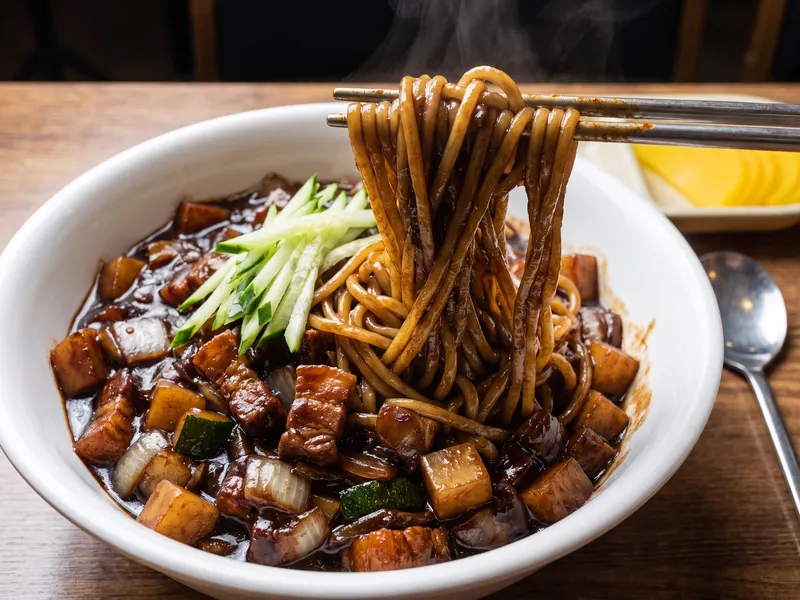
Jjajangmyeon is a Korean-Chinese noodle dish of thick chewy wheat noodles topped with a glossy black sauce of fried chunjang (Korean fermented black soybean paste), pork belly, onions, potato, zucchini, and cabbage.
Ingredients
- pork belly400 g
- chunjang75 g
- yellow onion200 g
- potato200 g
- zucchini250 g
- green cabbage150 g
- garlic cloves4 cloves
- neutral oil30 ml
- soy sauce10 ml
- sugar15 g
- water600 ml
- potato starch20 g
- toasted sesame oil5 ml
- jjajangmyeon noodles800 g
- cucumber for serving0.5 piece
Method
- 1Prep all ingredients before starting. Cut the pork belly into 1.5 cm cubes, the onion, potato, and zucchini into 1 cm cubes, and the cabbage into 2 cm pieces. Mince the garlic. Cut the cucumber into matchsticks for the garnish. Mix the potato starch with 4 tbsp cold water in a small bowl to make a slurry — set aside. This dish cooks fast once the heat is on, so all chopping must be done first.
- 2Heat a large wok or deep skillet over medium heat. Add the pork belly cubes with 1 tbsp of the neutral oil and cook for 5 to 6 minutes, stirring occasionally, until the pork edges are golden and 3 to 4 tbsp of fat have rendered out. Do not drain — that rendered pork fat is the flavour base. Push the pork to the side of the pan.
- 3Fry the chunjang. Add the remaining 1 tbsp neutral oil to the cleared centre of the wok. Spoon the chunjang into the hot oil and spread it flat with a spatula. Fry for 2 to 3 minutes, stirring every 30 seconds, until the paste turns glossy and smells strongly caramel-sweet rather than raw and sour. Critical: do not skip this step — raw chunjang tastes flat and bitter, fried chunjang is the entire flavour foundation. Do not let it burn either; burnt chunjang is more bitter than raw.
- 4Add the diced onion and minced garlic to the wok and stir everything together for 1 minute. The onion should soften slightly without browning. Add the potato cubes and stir-fry for 2 minutes — the chunjang will start coating everything in glossy black. Add the cabbage and zucchini, stir for another minute.
- 5Add the soy sauce and sugar, stir to combine. Pour in the 600 ml water, stir thoroughly to dissolve the chunjang into a uniform sauce, then bring to a gentle simmer. Cover and cook for 8 to 10 minutes over medium-low heat, until the potato is fork-tender. Stir once or twice to prevent sticking on the bottom.
- 6Stir the potato starch slurry again (it settles fast) and pour it into the simmering sauce while stirring constantly. The sauce will thicken to a glossy gravy consistency in 30 to 60 seconds. This is the signature jjajangmyeon texture — the sauce should coat the back of a spoon thickly and look glossy, not watery. Turn off the heat and stir in the toasted sesame oil for finish. Cover to keep warm.
- 7Cook the noodles. Bring a large pot of water to a rolling boil — no salt is needed. Add the fresh jjajangmyeon noodles and cook 4 to 5 minutes (or per package directions), stirring once to prevent clumping. Fresh noodles cook faster than dried; the centre should still have a slight bite, no more. Drain and rinse briefly under cold water for 10 seconds — this removes excess surface starch and makes the noodles bouncier.
- 8Assemble and serve immediately. Divide the noodles between 4 deep bowls, ladle a generous portion of the black bean sauce over each, and top with a small handful of julienned cucumber on one side. Serve at once with chopsticks and a spoon — the sauce is too thick for chopsticks alone. Traditional accompaniments: pickled yellow danmuji radish, raw onion wedges with chunjang for dipping, and a glass of cold water or barley tea. Mix the noodles thoroughly with the sauce before eating, every strand should turn black.