

Jjajangmyeon (Korean Black Bean Noodles with Pork and Vegetables)
Jjajangmyeon is a Korean-Chinese noodle dish of thick chewy wheat noodles topped with a glossy black sauce of fried chunjang (Korean fermented black soybean paste), pork belly, onions, potato, zucchini, and cabbage. The dish was developed in 1905 by Chinese immigrants at the Gonghwachun restaurant in Incheon's Chinatown, adapted from Beijing zha jiang mian to suit Korean tastes — sweeter, with caramelized chunjang and starchier vegetables. Today it is one of Korea's national comfort foods, sold in every neighbourhood and traditionally eaten on Black Day (April 14) by single people who got no Valentine's gift. Active work is 35 minutes, no long simmer needed. Serves 4 with 200 g noodles and 250 ml sauce per portion, topped with julienned cucumber for fresh contrast.
Ingredients
- 400 gpork belly
- 75 gchunjang
- 200 gyellow onion
- 200 gpotato
- 250 gzucchini
- 150 ggreen cabbage
- 4 clovesgarlic cloves
- 30 mlneutral oil
- 10 mlsoy sauce
- 15 gsugar
- 600 mlwater
- 20 gpotato starch
- 5 mltoasted sesame oil
- 800 gjjajangmyeon noodles
- 0.5 piececucumber for serving
Method
- Prep all ingredients before starting. Cut the pork belly into 1.5 cm cubes, the onion, potato, and zucchini into 1 cm cubes, and the cabbage into 2 cm pieces. Mince the garlic. Cut the cucumber into matchsticks for the garnish. Mix the potato starch with 4 tbsp cold water in a small bowl to make a slurry — set aside. This dish cooks fast once the heat is on, so all chopping must be done first.
- Heat a large wok or deep skillet over medium heat. Add the pork belly cubes with 1 tbsp of the neutral oil and cook for 5 to 6 minutes, stirring occasionally, until the pork edges are golden and 3 to 4 tbsp of fat have rendered out. Do not drain — that rendered pork fat is the flavour base. Push the pork to the side of the pan.
- Fry the chunjang. Add the remaining 1 tbsp neutral oil to the cleared centre of the wok. Spoon the chunjang into the hot oil and spread it flat with a spatula. Fry for 2 to 3 minutes, stirring every 30 seconds, until the paste turns glossy and smells strongly caramel-sweet rather than raw and sour. Critical: do not skip this step — raw chunjang tastes flat and bitter, fried chunjang is the entire flavour foundation. Do not let it burn either; burnt chunjang is more bitter than raw.

- Add the diced onion and minced garlic to the wok and stir everything together for 1 minute. The onion should soften slightly without browning. Add the potato cubes and stir-fry for 2 minutes — the chunjang will start coating everything in glossy black. Add the cabbage and zucchini, stir for another minute.
- Add the soy sauce and sugar, stir to combine. Pour in the 600 ml water, stir thoroughly to dissolve the chunjang into a uniform sauce, then bring to a gentle simmer. Cover and cook for 8 to 10 minutes over medium-low heat, until the potato is fork-tender. Stir once or twice to prevent sticking on the bottom.
- Stir the potato starch slurry again (it settles fast) and pour it into the simmering sauce while stirring constantly. The sauce will thicken to a glossy gravy consistency in 30 to 60 seconds. This is the signature jjajangmyeon texture — the sauce should coat the back of a spoon thickly and look glossy, not watery. Turn off the heat and stir in the toasted sesame oil for finish. Cover to keep warm.

- Cook the noodles. Bring a large pot of water to a rolling boil — no salt is needed. Add the fresh jjajangmyeon noodles and cook 4 to 5 minutes (or per package directions), stirring once to prevent clumping. Fresh noodles cook faster than dried; the centre should still have a slight bite, no more. Drain and rinse briefly under cold water for 10 seconds — this removes excess surface starch and makes the noodles bouncier.
- Assemble and serve immediately. Divide the noodles between 4 deep bowls, ladle a generous portion of the black bean sauce over each, and top with a small handful of julienned cucumber on one side. Serve at once with chopsticks and a spoon — the sauce is too thick for chopsticks alone. Traditional accompaniments: pickled yellow danmuji radish, raw onion wedges with chunjang for dipping, and a glass of cold water or barley tea. Mix the noodles thoroughly with the sauce before eating, every strand should turn black.
FAQ
Chunjang (춘장) is a Korean fermented black soybean paste with wheat flour and caramel sauce, developed by Chinese immigrants in Incheon in 1905 specifically for Korean tastes. It is jet black, salty, slightly bitter raw, and gently sweet after frying. This is an ingredient-specific paste for jjajangmyeon — without it the dish becomes something else. Alternatives and their compromises: Chinese tianmianjiang (sweet bean sauce) gives a decent result, but you end up with Chinese zha jiang mian, not Korean jjajangmyeon — different flavour profile, sweeter and less bitter; Lee Kum Kee Black Bean Sauce categorically does not work, it has a completely different structure and flavour (it is fermented black beans douchi, not soybean paste). Best chunjang brands: Sajo, CJ (Beksul), Sempio, Obok — all available at Korean grocers, Asian markets, or online. A 250 to 300 g tub costs 5 to 8 dollars and keeps refrigerated for 3 months after opening.
Straight from the tub, chunjang tastes raw, flat and a little bitter. Frying it in 2 tbsp of hot oil or rendered pork fat over medium heat for 2 to 3 minutes caramelizes the sugars in the paste and pulls its aroma into the fat. Spread the paste flat in the middle of the wok and stir every 30 seconds. It is ready when it turns glossy, a shade lighter, and smells of sweet caramel. Do not go past that point: scorched chunjang turns bitter, and extra sugar will not rescue it. Some brands sell pre-roasted paste that is milder from the jar, but it still needs this frying step.
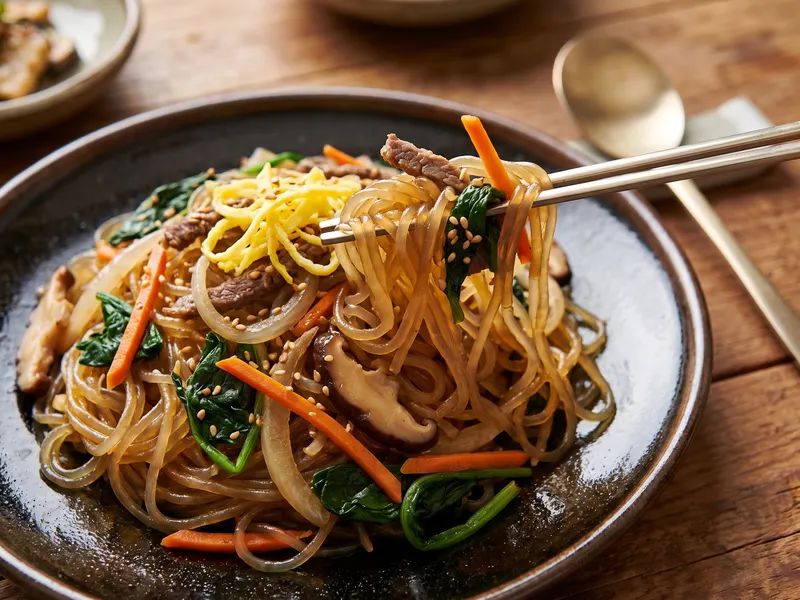
The ideal is fresh wheat jungwha-myeon (중화면) or noodles labeled jjajangmyeon, sold in the refrigerated section of Korean grocers: thick (3 to 4 mm), white, firm, with characteristic chew. Look for brands like Pulmuone, Hyundai, or Sajo. Without specialty fresh jjajangmyeon noodles, these work: fresh udon (closest match in thickness and texture, the difference is minimal), dried jjajangmyeon noodles in a pack, lo mein noodles. What does not work: ramyeon (too thin and wavy), buckwheat soba (wrong flavour), rice noodles (fragile in thick sauce), spaghetti (works only in a pinch but the chew is wrong). After cooking always rinse the noodles briefly under cold water — this removes excess surface starch and makes them bouncier. Fresh udon is the easiest fallback in most Western supermarkets, found in the Asian aisle or refrigerated section. If you want another Korean noodle dish afterwards, try japchae with sweet potato glass noodles.
These are two related but distinct dishes with shared roots. Zha jiang mian (炸醤麺, 'fried sauce noodles') is the original Chinese dish from Beijing and Shandong, with at least 600 years of history: thick wheat noodles with a sauce of fried pork, sweet bean paste (tianmianjiang) and/or fermented yellow soybean paste, served with raw fresh vegetables (cucumber, radish, soybean sprouts, garlic). The sauce is brownish, not jet black, with a saltier and slightly sharper profile. Jjajangmyeon (짜장면) is the Korean adaptation, developed in Incheon's Chinatown from 1905 at the Gonghwachun restaurant: the sauce uses chunjang (a custom-made Korean black soybean paste with caramel and wheat), sugar is added to suit Korean palates, vegetables are diced and braised in the sauce rather than served raw on top, plus potato and zucchini are part of the dish. The sauce is thick, jet black, glossy, sweet-salty, no heat. By taste: zha jiang mian is salty-oily, earthy, with a slight bitter edge; jjajangmyeon is sweet-salty, caramelized, more 'comfort' and adapted to mass appeal. Both dishes are legitimate and beloved in their cultures, no need to pick a 'correct' one.
The jjajang sauce can be made ahead, and it is actually better that way — overnight in the fridge the flavours integrate dramatically: vegetables absorb the chunjang, the paste becomes more harmonious. Sauce keeps in an airtight container in the fridge for 3 to 4 days. Noodles, however, must always be cooked fresh just before serving — pre-cooked noodles turn rubbery and bloated within 2 to 3 hours, especially sitting in hot sauce. Strategy for the work week: Sunday evening, make a double batch of sauce, cool, divide into containers. On weeknight dinners, boil 200 g noodles for 5 minutes, microwave a portion of sauce for 2 minutes, ladle over noodles in a bowl and serve immediately. Sauce freezes acceptably but not ideally: thaw in the fridge for 12 hours, stir during reheating — the starch binding may separate slightly but reforms with stirring and 1 tbsp hot water. Do not freeze the assembled dish with noodles — the noodles turn into a shapeless mass on thaw.
Rate this
Recipes by email
One letter a week: a recipe picked for your taste, plus whatever is new on the site. Unsubscribe in one click.
Welcome gift: Sergei's cookbook (e-book).
By subscribing you agree to the privacy policy.
Tell us what you like to cook (30 seconds) →Keep browsing
More dishes from the Korean archive — picked by overlap with what you're cooking now.
Join the conversation
Comments
No comments yet — be the first!