
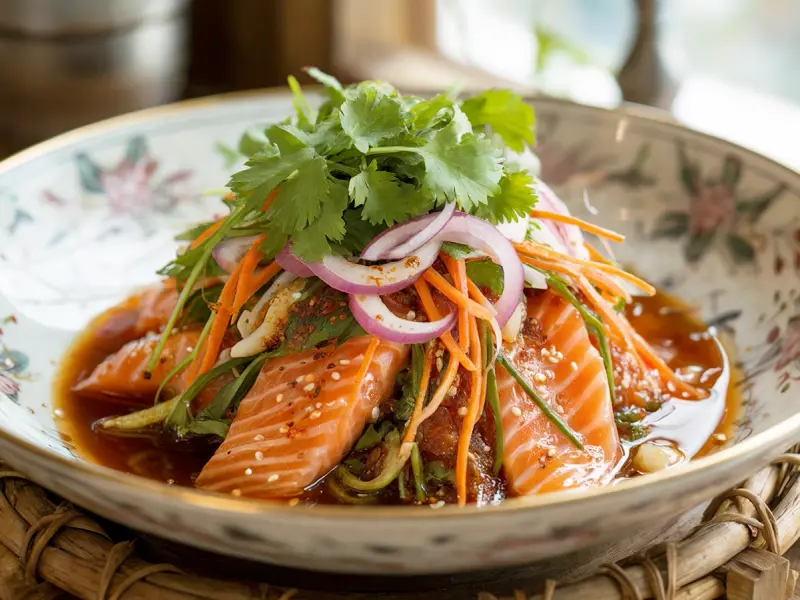
Khe (Korean Marinated Fish)
A Korean-style marinated salmon salad where fish is cured in vinegar then tossed with vegetables, garlic, chili and soy sauce. Bold, spicy and fresh — best after marinating for at least 4 hours.
Ingredients
- 1 kgsalmon fillet, previously frozen at −20 °C for at least 24 hours or sold as safe to eat raw
- 1 tspsalt
- 2-3 tbsp9% vinegar
- 3 onions
- 5-6 garlic cloves
- 1-2 tbsphot red chili pepper
- 1 tspground black pepper
- 2 tspground coriander
- 2 tspsugar
- 3 tbspsoy sauce
- 5 tbspvegetable oil
- 200 gcarrot
- 1 sweet pepper
- 1 bunchfresh cilantro
Method
- Rinse and dry the fillet, remove skin and bones. Slice across the grain into thin strips, no thicker than 3 mm, so the vinegar cures them evenly. Place in a glass or enamel container, sprinkle with salt, mix and leave for 10–15 minutes.
- Add vinegar, mix well, cover and refrigerate 20–30 minutes until the fish changes color slightly.
- Slice onions into thin half-rings. Mince garlic. Grate or julienne carrot. Slice sweet pepper into strips.
- Heat oil and fry 2/3 of the onion until golden. Remove from heat, wait 30 seconds then add garlic and chili. Cool completely.
- Drain liquid from fish. Add raw onion, carrot, sweet pepper, spices, sugar, soy sauce, cilantro and cooled oil dressing. Mix gently. Cover and refrigerate for at least 4 hours before serving.
FAQ
Acetic acid denatures fish proteins (the fish 'whitens'), but does not kill all parasites. For safe khe, use only fish that has been frozen at −20 °C for at least 24 hours (or −35 °C for 15 hours) — this reliably destroys parasites. Freshly caught river fish is absolutely unsuitable for khe. Store-bought salmon, pink salmon, and chum salmon are generally safe as they pass sanitary control. When in doubt, always use previously frozen fish.
The minimum marinating time for khe is 4 hours in the refrigerator: this allows the vinegar to 'cook' the fish on the outside and the spices to penetrate the flesh. After just 1 hour the fish will still be raw inside and barely marinated. The optimal time is 6–8 hours or overnight in the refrigerator. Maximum is 24 hours — beyond that the fish becomes too acidic and starts to fall apart. Salmon and pink salmon marinate slightly faster than denser chum salmon.
Khe is traditionally made from: pink salmon, chum salmon, sockeye salmon (firm red fish is ideal), trout, mackerel (rich flavor, fattier), and carp (river fish — must be previously frozen). Not suitable: cod and other delicate white fish — they fall apart in vinegar. The firmer the fish flesh, the better it holds its shape in khe.
Finished khe keeps in the refrigerator in a glass container with a lid for 2–3 days. The flavor deepens on the second day. After 3 days the fish becomes too soft and acidic. Do not freeze finished khe — the fish falls apart upon thawing and releases a lot of liquid. If you need to store it longer, freeze the raw fish before marinating, and marinate fresh before serving.
For milder khe, reduce red pepper to ¼ tsp or omit entirely. For less acidity, reduce vinegar to 1 tbsp and add 1 tsp sugar. For those who cannot tolerate raw fish: lightly pan-fry the fish pieces (1–2 minutes) before marinating. Traditional khe is not recommended for children due to the raw fish and vinegar — consider offering baked fish with the same spices as an alternative.
Rate this
Recipes by email
One letter a week: a recipe picked for your taste, plus whatever is new on the site. Unsubscribe in one click.
Welcome gift: Sergei's cookbook (e-book).
By subscribing you agree to the privacy policy.
Tell us what you like to cook (30 seconds) →Keep browsing
More dishes from the Korean archive — picked by overlap with what you're cooking now.

Join the conversation
Comments (1)
I cut everything for khe to bite size — nothing that requires a knife or causes an awkward moment. Appetizers should be effortless to eat so the conversation stays uninterrupted.