Italy · Flour and Confectionery Products
Libum (Ancient Roman Cheese Cake)
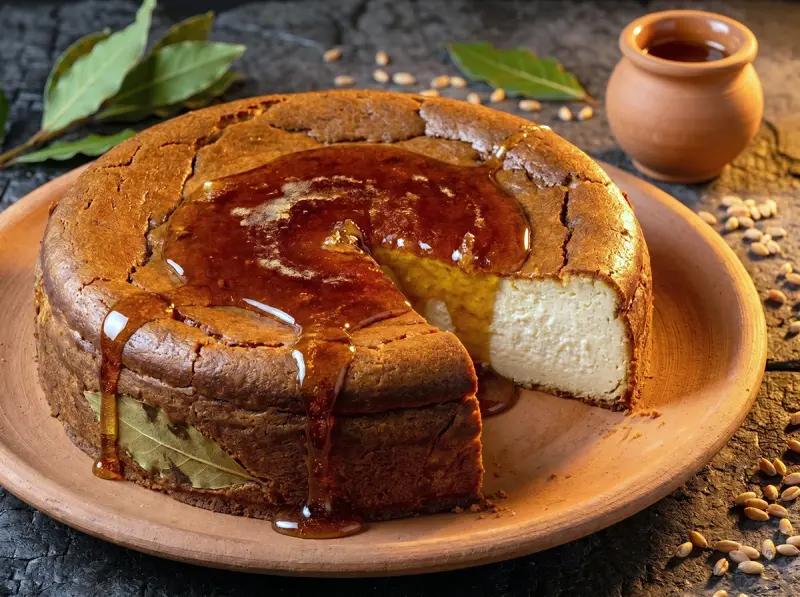
Libum is an ancient Roman cheese cake: fresh ricotta, a little flour and an egg, shaped into a flat disc, baked on bay leaves and eaten hot with honey.
Ingredients
- fresh unsalted ricotta600 g
- spelt or wheat flour150 g
- egg1
- fresh bay leaves8
- honey for serving4 tbsp
- olive oil for the pan1 tbsp
Method
- 1Drain the ricotta. If the ricotta is wet, place it in a fine-mesh sieve or wrap in cheesecloth and leave over a bowl for 30 to 60 minutes. Excess moisture makes the dough too soft to hold its shape. The ricotta should be firm enough to hold a spoon impression. This step is the most important preparation in the recipe.
- 2Work the cheese. Transfer the drained ricotta to a deep bowl or stone mortar. Following Cato's instruction — 'bray well in a mortar' — work the cheese with a pestle or the back of a wooden spoon until it becomes a completely smooth, plastic mass with no lumps. This takes 2 to 3 minutes. The cheese must be uniform before any flour is added.
- 3Make the dough. Add the spelt or wheat flour to the cheese gradually, working it in with your hands. Add the egg. Knead for 3 to 4 minutes until a cohesive, slightly sticky dough forms. The dough will be denser than bread dough and noticeably wetter. Do not add more flour to compensate: 600 g of cheese to 150 g of flour is four parts to one, Cato's more tender version (he gives one pound of flour to two pounds of cheese, or half a pound of fine flour if you want the cake more tender). That wet dough is what makes libum what it is. A drier dough produces bread, not libum.
- 4Shape. Lightly flour your hands. Turn the dough out and shape into a flat round disc approximately 14 cm in diameter and 2.5 to 3 cm thick. Libum is a flat sacrificial cake, not a loaf. Keep it low and even.
- 5Prepare and bake. Preheat the oven to 200 C. Lightly oil a baking dish or cast-iron pan with olive oil. Arrange the fresh bay leaves on the bottom — they will perfume the underside of the cake as it bakes. Place the libum on the leaves. Bake for 30 to 35 minutes until the surface is deep golden-brown and firm to the touch. The underside should carry the faint imprint of the leaves.
- 6Serve with honey. Warm the honey in a small pan or microwave until fully liquid. Remove the libum from the oven and immediately pour the warm honey over the hot surface. The hot cake absorbs honey more deeply than a cooled one. Remove and discard the bay leaves before serving. Cut into wedges and serve at once. Libum is at its best in the first 10 minutes after baking.