
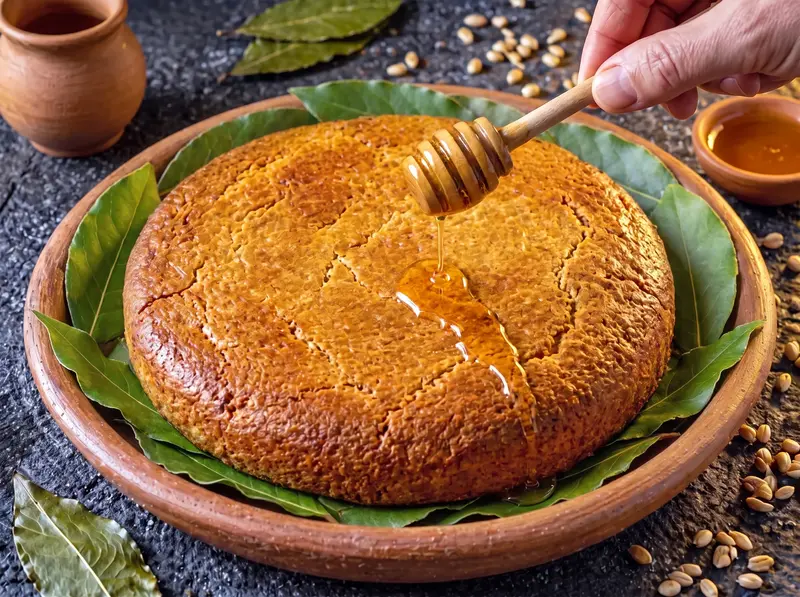
Libum (Ancient Roman Cheese Cake)
Libum is an ancient Roman cheese cake: fresh ricotta, a little flour and an egg, shaped into a flat disc, baked on bay leaves and eaten hot with honey. Cato the Elder wrote the recipe down in De Agri Cultura around 160 BCE, and it has not changed since — three ingredients, one method. Romans offered it to the household gods, the lares and penates, and ate it themselves on ordinary days. Served hot with honey, it turns from a plain dense cake into something that tastes unmistakably of antiquity. The 50 minutes cover shaping and baking; wet ricotta needs 30 to 60 minutes to drain first.
What Is Libum?
Libum is a baked cake of fresh cheese, flour and egg from the Roman Republic. Cato the Elder recorded it in De Agri Cultura around 160 BC, and his instructions still work as written: pound the cheese smooth in a mortar, work in the flour and an egg, shape a round, lay it on leaves and bake it under a cover. Cato gives two pounds of cheese to one pound of flour, or only half a pound of finer flour if you want it more tender; this recipe follows the tender version, four parts cheese to one, which is why the result is dense and dairy heavy rather than bready. Romans offered libum to the household gods, the lares and penates, and ate it as everyday food too. Whether you call it a cheese flatbread or the ancient Roman cheesecake depends on what you compare it with. It is shaped and baked like a flatbread, but the cheese-to-flour ratio and the habit of pouring warm honey over it put the flavour closer to a rustic cheesecake.
Libum vs Savillum
Cato gives two cheese cakes in the same book, and people mix them up. Libum is a firm dough shaped by hand, baked on bay leaves, with no sweetener in it; Cato's chapter on libum does not mention honey at all. Savillum is a loose batter with honey mixed in, baked in a greased dish, then glazed with more honey and poppy seeds while it is still hot.
In practice that means libum slices into wedges and can go either way, savoury with olives or sweet with honey poured over it at the table. Savillum is a dessert from the first step and gets eaten from the dish with a spoon. If you searched for a Roman cheesecake with a honey glaze, savillum is the one you want. If you want the plain ritual cake that Cato describes shaping by hand, this is it.
Ingredients
- 600 gfresh unsalted ricotta
- 150 gspelt or wheat flour
- 1 egg
- 8 fresh bay leaves
- 4 tbsphoney for serving
- 1 tbspolive oil for the pan
Method
- Drain the ricotta. If the ricotta is wet, place it in a fine-mesh sieve or wrap in cheesecloth and leave over a bowl for 30 to 60 minutes. Excess moisture makes the dough too soft to hold its shape. The ricotta should be firm enough to hold a spoon impression. This step is the most important preparation in the recipe.

- Work the cheese. Transfer the drained ricotta to a deep bowl or stone mortar. Following Cato's instruction — 'bray well in a mortar' — work the cheese with a pestle or the back of a wooden spoon until it becomes a completely smooth, plastic mass with no lumps. This takes 2 to 3 minutes. The cheese must be uniform before any flour is added.

- Make the dough. Add the spelt or wheat flour to the cheese gradually, working it in with your hands. Add the egg. Knead for 3 to 4 minutes until a cohesive, slightly sticky dough forms. The dough will be denser than bread dough and noticeably wetter. Do not add more flour to compensate: 600 g of cheese to 150 g of flour is four parts to one, Cato's more tender version (he gives one pound of flour to two pounds of cheese, or half a pound of fine flour if you want the cake more tender). That wet dough is what makes libum what it is. A drier dough produces bread, not libum.

- Shape. Lightly flour your hands. Turn the dough out and shape into a flat round disc approximately 14 cm in diameter and 2.5 to 3 cm thick. Libum is a flat sacrificial cake, not a loaf. Keep it low and even.

- Prepare and bake. Preheat the oven to 200 C. Lightly oil a baking dish or cast-iron pan with olive oil. Arrange the fresh bay leaves on the bottom — they will perfume the underside of the cake as it bakes. Place the libum on the leaves. Bake for 30 to 35 minutes until the surface is deep golden-brown and firm to the touch. The underside should carry the faint imprint of the leaves.

- Serve with honey. Warm the honey in a small pan or microwave until fully liquid. Remove the libum from the oven and immediately pour the warm honey over the hot surface. The hot cake absorbs honey more deeply than a cooled one. Remove and discard the bay leaves before serving. Cut into wedges and serve at once. Libum is at its best in the first 10 minutes after baking.
FAQ
Libum is one of the oldest surviving written recipes in Western culinary history. It was recorded by Cato the Elder in De Agri Cultura around 160 BCE, and the original Latin text has been preserved complete. This is not a reconstruction or interpretation: the recipe specifies three ingredients and one technique. The bay leaves beneath the cake and the cheese-flour-egg dough are exactly as Cato wrote them; the warm honey poured over at serving is a later, common finish, borrowed from the closely related savillum. An ancient Roman recipe from the cuisine of the Roman Republic that can be cooked at home without any adaptation to the original method.
For a strict paleo diet, libum is borderline: most paleo frameworks exclude dairy, which makes the ricotta problematic. For a gluten-free diet, the classical version with spelt or wheat flour is not suitable. However, substituting with rice flour or almond flour produces a gluten-free version with a slightly different but acceptable texture. Libum contains no sugar, no yeast, and no additives of any kind — only cheese, flour, and egg. The honey is not part of the dough: it is poured over the hot cake just before serving.
Cato does not specify the type of cheese — he writes simply 'cheese'. Based on the agricultural context and the region, this was almost certainly a fresh, unsalted sheep or goat cheese, similar in consistency to modern ricotta or fresh farmer's cheese. Ricotta is the most authentic available substitute. Well-drained cottage cheese also works. Hard or aged salted cheeses are not suitable: they do not produce the plastic dough texture that allows the libum to hold its shape, and they make the cake too salty. Goat ricotta is the closest equivalent to the Roman original.
Yes. Cato gives two pounds of cheese to one pound of flour, or half a pound of finer flour if you want a more tender cake. This recipe follows the tender version: 600 g ricotta to 150 g flour, four to one. This proportion defines the character of the dish. Libum is not bread with cheese — it is a cheese cake bound with flour. If you use more flour than cheese, you get a dense bread without cheese flavour, which is a different dish. The correct libum is dense, moist, and clearly dairy-forward, with a faint bay leaf aroma on the underside. Without honey it tastes almost neutral; with warm honey poured over the hot surface it becomes a proper dessert.
Both. Cato describes libum in the context of religious ritual — the cake was offered to the lares and penates, the household gods who protected the home. But Ovid mentions that the hot libum was shared between the faithful and the god at the altar, meaning it was eaten by people too. Horace and other authors mention libum as ordinary food. It was almost certainly both a ritual offering and everyday sustenance for Roman commoners: a cheap, filling cake made from the simplest available ingredients. Served hot with honey, pomegranate syrup, or seasonal fruit. Pine nuts and raisins are historically plausible additions.
Rate this
Recipes by email
One letter a week: a recipe picked for your taste, plus whatever is new on the site. Unsubscribe in one click.
Welcome gift: Sergei's cookbook (e-book).
By subscribing you agree to the privacy policy.
Tell us what you like to cook (30 seconds) →Keep browsing
More dishes from the Italian archive — picked by overlap with what you're cooking now.
Join the conversation
Comments (1)
Oven thermometers don't lie — your oven dial probably does. Mine runs 15°C hot, which explained years of slightly overbaked results. For libum the true 200°C matters: hotter and the bay leaves scorch before the centre sets.