Italy · Sauces and Dips
Moretum (Ancient Roman Garlic and Cheese Spread)
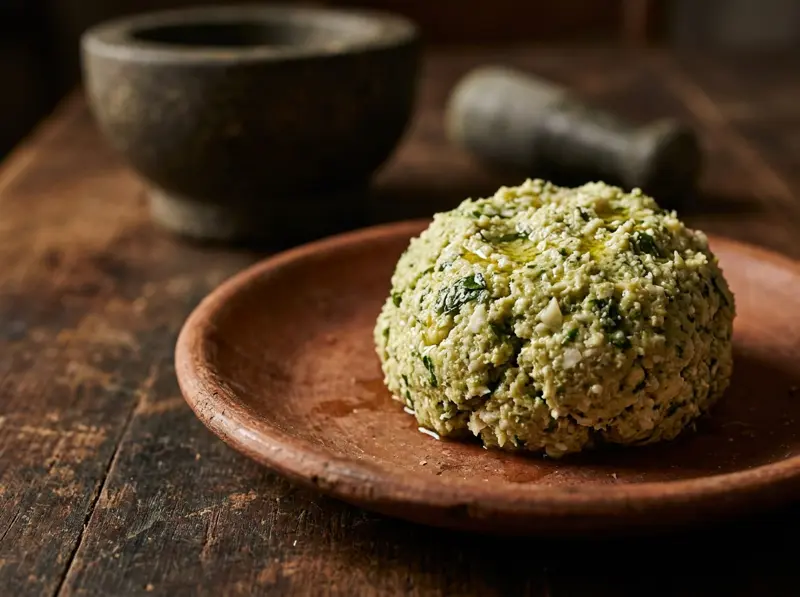
Moretum is an ancient Roman spread of salted cheese, garlic and fresh herbs, pounded together in a mortar with olive oil and a little vinegar and eaten with bread.
Ingredients
- pecorino romano200 g
- garlic6 clove
- celery leaves15 g
- cilantro10 g
- arugula20 g
- salt1 pinch
- olive oil1 tbsp
- white wine vinegar2 tsp
Method
- 1Grate the 200 g of pecorino romano on the fine side of a box grater or with a rasp grater. You want fine, fluffy shreds with no chunks left. A hard cheese only pounds smooth in the mortar when it starts out finely grated.
- 2Pull 15 g of leaves off a bunch of celery, together with the thinnest stems at the very top. Wash them with 10 g of cilantro (fresh coriander) and 20 g of arugula (rocket), then dry everything well in a clean kitchen towel and chop it roughly. The leaves should feel dry to the touch, with no drops of water on them, because water left on the herbs makes the paste wet and loose.
- 3Peel the 6 garlic cloves and put them in a large stone mortar, about 18 cm across, with a pinch of coarse salt. Pound them first, then grind with the pestle in circles for about 3 minutes, until you have a creamy garlic paste with no pieces left. The salt grains grip the garlic and help break it down. Expect the garlic to sting your eyes a little. If your mortar is smaller, make the whole recipe in two halves and press the halves together into one ball at the end.
- 4Add the chopped greens in 2 batches. Pound and grind each batch until it collapses into the garlic, about 5 minutes in all. Stop when you have a dark green, wet paste with no whole leaves. The juice from the herbs is what the cheese gets ground into next, and working in batches keeps a home mortar from overflowing.
- 5Add the grated cheese in 3 additions, grinding in circles after each one, about 7 minutes in all. At first the pestle bumps and jumps over the cheese. When it starts to move heavier, in slow, smooth circles, the mixture is ready: it looks like damp breadcrumbs, pale green and flecked with white, neither fully green nor white.
- 6Add 1 tbsp of extra virgin olive oil and 2 tsp of white wine vinegar and work the mixture again for about 2 minutes. It is ready when the paste clumps and holds together as you press it with the pestle. Oil and vinegar go in last, the same order as in the Roman poem.
- 7Run 2 fingers round the inside of the mortar and gather everything into one firm, rough ball, until the wall of the mortar is almost clean. Set the ball on a plate or in a small bowl and serve it at room temperature. Put any leftovers back in the fridge, covered, within 2 hours.