
Moretum (Ancient Roman Garlic and Cheese Spread)
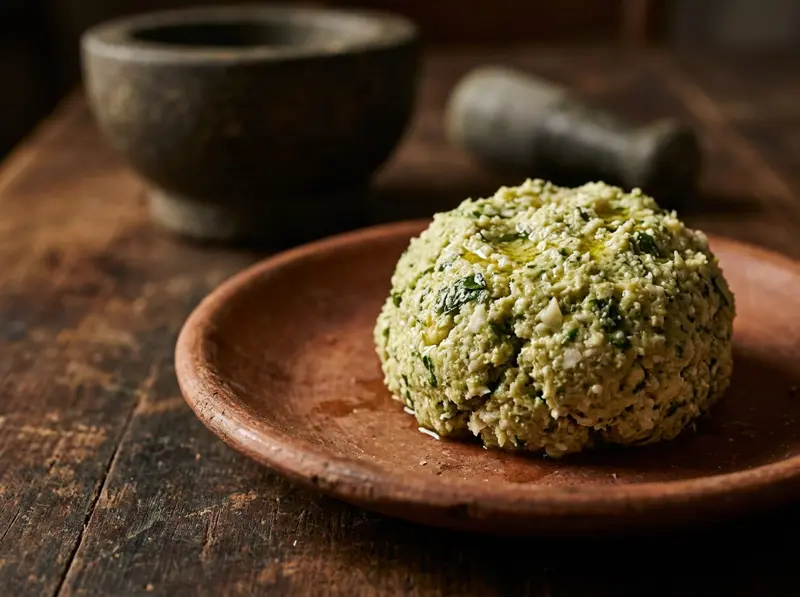
Moretum is an ancient Roman spread of salted cheese, garlic and fresh herbs, pounded together in a mortar with olive oil and a little vinegar and eaten with bread. The word is spelled the same way in German and Italian, Моретум in Russian and モレトゥム in Japanese. The best-known account is a Latin poem called Moretum, which is attributed to Virgil, although nobody is sure who wrote it. In the poem a poor farmer gets up before dawn, bakes his bread, pulls four heads of garlic from his garden and pounds them with salt, a cheese gone hard from the salt, and the herbs he picked: apium (celery or parsley, translators disagree; we use celery leaves), rue and coriander. The poem gives no weights at all, so the quantities here are a modern reconstruction. Pecorino romano stands in for the Roman cheese, and arugula (rocket) takes the place of rue, which is hard to buy. It takes about 30 minutes, all of it hands-on.
What is moretum?
Moretum is a Roman paste of cheese, garlic and herbs, and the name is usually linked to the mortar it was pounded in. The fullest account is a Latin poem of the same name, attributed to Virgil and kept with the other poems collected under his name, though nobody is sure who actually wrote it. Its hero, Simulus, is a poor farmer who gets up before dawn. He bakes a flat loaf on the hearth, and while it bakes he goes to his garden for four heads of garlic, celery or parsley, rue and coriander. He sprinkles salt over the garlic, adds a cheese gone hard from the salt and the herbs, crushes the garlic first and then grinds everything together until the color is neither fully green nor white. A few drops of olive oil and a little vinegar go in at the end. Then he runs 2 fingers round the mortar and gathers it all into one ball to eat with his bread.
The poem never gives weights, so this recipe is a reconstruction, built from the poem's ingredients and the amounts modern cooks use. It sits in the same small Roman corner of this site as Cato's cheese cakes libum and savillum. It is good on grilled bread, like the toasts for bruschetta without the tomato topping.
Moretum in the poem and in Columella
Columella, who wrote about farming in the 1st century AD, gives a different moretum. His is a green, fresh one: fresh salted cheese pounded with savory, mint, rue, coriander, apium, leek, lettuce, rocket, thyme and other herbs, seasoned with a little peppered vinegar and served in a dish with olive oil poured over the top. He adds versions with walnuts, toasted sesame, pine nuts, hazelnuts or almonds. The poem's version is the rustic one, with hard cheese and a lot of raw garlic. This page follows the poem.
Ingredients
- 200 gpecorino romano
- 6 clovegarlic
- 15 gcelery leaves
- 10 gcilantro
- 20 garugula
- 1 pinchsalt
- 1 tbspolive oil
- 2 tspwhite wine vinegar
Method
- Grate the 200 g of pecorino romano on the fine side of a box grater or with a rasp grater. You want fine, fluffy shreds with no chunks left. A hard cheese only pounds smooth in the mortar when it starts out finely grated.
- Pull 15 g of leaves off a bunch of celery, together with the thinnest stems at the very top. Wash them with 10 g of cilantro (fresh coriander) and 20 g of arugula (rocket), then dry everything well in a clean kitchen towel and chop it roughly. The leaves should feel dry to the touch, with no drops of water on them, because water left on the herbs makes the paste wet and loose.
- Peel the 6 garlic cloves and put them in a large stone mortar, about 18 cm across, with a pinch of coarse salt. Pound them first, then grind with the pestle in circles for about 3 minutes, until you have a creamy garlic paste with no pieces left. The salt grains grip the garlic and help break it down. Expect the garlic to sting your eyes a little. If your mortar is smaller, make the whole recipe in two halves and press the halves together into one ball at the end.
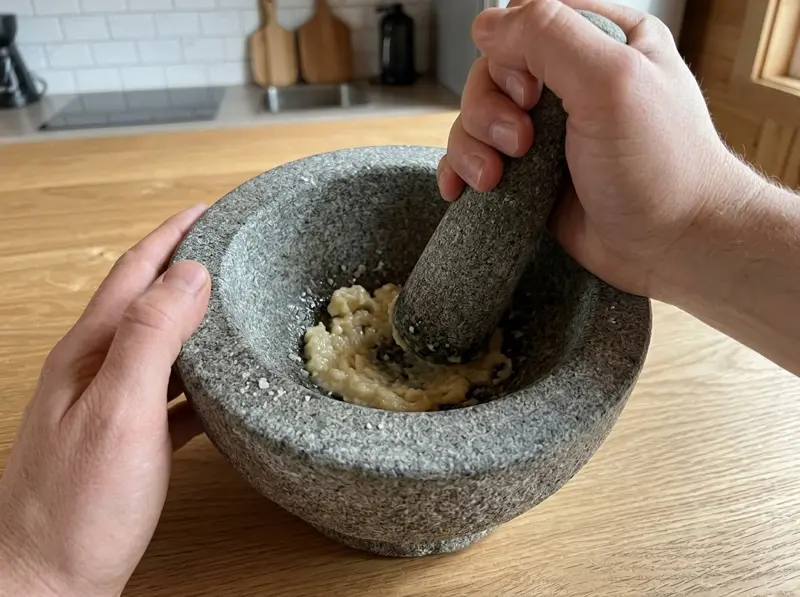
- Add the chopped greens in 2 batches. Pound and grind each batch until it collapses into the garlic, about 5 minutes in all. Stop when you have a dark green, wet paste with no whole leaves. The juice from the herbs is what the cheese gets ground into next, and working in batches keeps a home mortar from overflowing.
- Add the grated cheese in 3 additions, grinding in circles after each one, about 7 minutes in all. At first the pestle bumps and jumps over the cheese. When it starts to move heavier, in slow, smooth circles, the mixture is ready: it looks like damp breadcrumbs, pale green and flecked with white, neither fully green nor white.
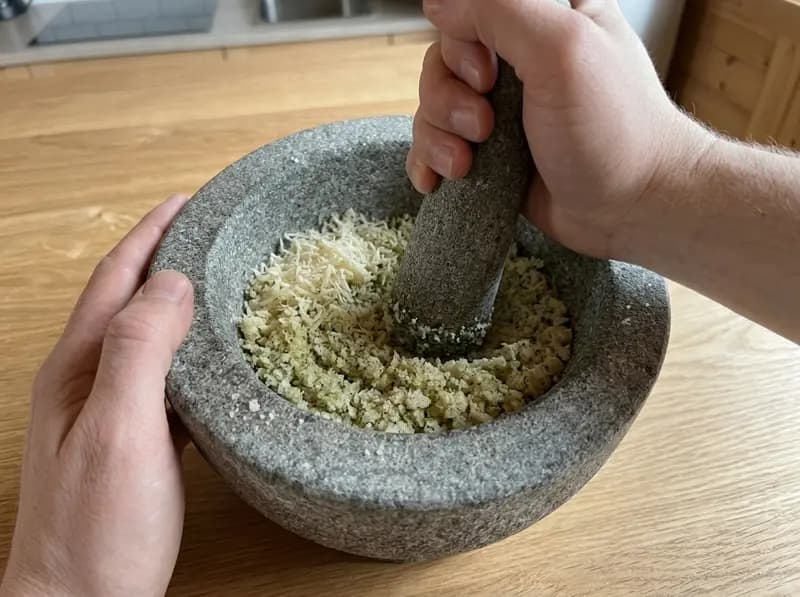
- Add 1 tbsp of extra virgin olive oil and 2 tsp of white wine vinegar and work the mixture again for about 2 minutes. It is ready when the paste clumps and holds together as you press it with the pestle. Oil and vinegar go in last, the same order as in the Roman poem.
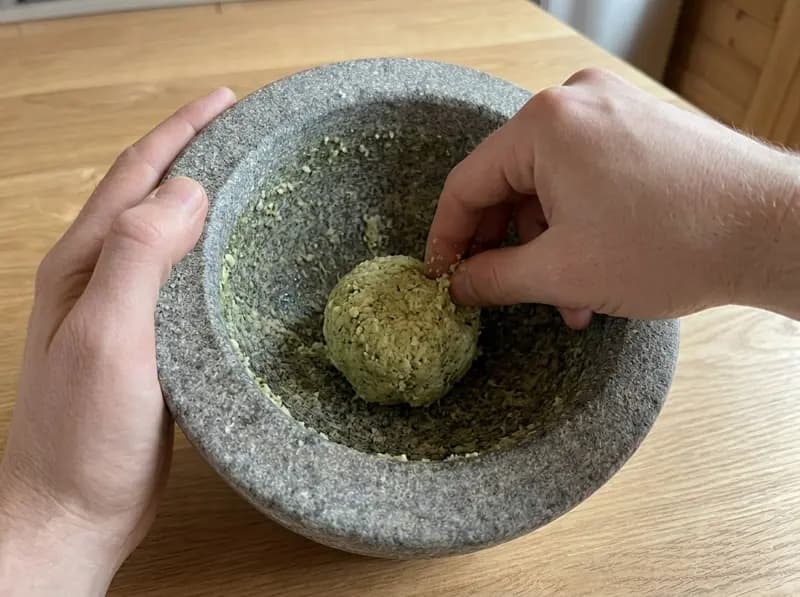
- Run 2 fingers round the inside of the mortar and gather everything into one firm, rough ball, until the wall of the mortar is almost clean. Set the ball on a plate or in a small bowl and serve it at room temperature. Put any leftovers back in the fridge, covered, within 2 hours.
FAQ
The dish is real, but the quantities are not: a Latin poem called Moretum, attributed to Virgil, describes a farmer pounding four heads of garlic with salt, a hard salted cheese, celery or parsley, rue and coriander, then adding drops of olive oil and a little vinegar. Columella, a Roman farming writer of the 1st century AD, gives his own moretum recipes too. What neither of them gives is weights, so every modern version, this one included, is a reconstruction: 200 g of pecorino romano, 6 garlic cloves and the herbs are our choice inside the range of modern cooks. If you like Roman food, try Cato's cheese cake libum.
In the poem the farmer pulls four heads of garlic from his garden, and that is the only number the poem gives for the moretum. It never says how much cheese he used, so there is no Roman garlic-to-cheese ratio to copy. Modern reconstructions range from a single clove in a recipe from the city of Valencia to four whole bulbs for about 450 g of cheese. This recipe uses 6 cloves for 200 g of pecorino, which is still very garlicky when eaten raw on bread. Start with fewer if you are unsure, and taste after the garlic paste is made.
The poem names three: apium, rue and coriander. Apium is translated as parsley in the English versions, while several German and Spanish reconstructions use celery leaves, and this recipe follows them with 15 g of celery leaves. Translators also disagree on coriander, so some read leaves and some read seeds, and we use 10 g of fresh leaves (cilantro). Rue is hard to buy, so 20 g of arugula brings the bitter edge instead. Arugula (rocket) appears in Columella's moretum, and one reconstruction swaps rue for chicory or dandelion greens.
The poem's moretum is a rough ball of hard salted cheese and a lot of garlic. Columella's main recipe has no garlic at all: fresh salted cheese is pounded with a long list of greens, including mint, rue, coriander, rocket and thyme, seasoned with a little peppered vinegar and served with olive oil poured over it. He also gives versions with walnuts, toasted sesame, pine nuts, toasted hazelnuts or almonds. Modern Columella-style versions use ricotta; a German university flyer, for example, takes 400 to 500 g of it. If you like soft ricotta in Roman food, try savillum.
Moretum tastes best the day it is made, when the raw garlic and the herbs are still sharp, so make it shortly before you serve it. It is a fresh cheese spread, so do not leave it out at room temperature for more than 2 hours. Wrap leftovers tightly or press a sheet of cling film onto the surface and keep them in the fridge. The herbs darken and the garlic gets stronger as it sits, so eat leftovers soon rather than saving them for later in the week.
Keep browsing
More dishes from the Italian archive — picked by overlap with what you're cooking now.
Recipes by email
One letter a week: a recipe picked for your taste, plus whatever is new on the site. Unsubscribe in one click.
Welcome gift: Sergei's cookbook (e-book).
By subscribing you agree to the privacy policy.
Tell us what you like to cook (30 seconds) →
Join the conversation
Comments
No comments yet — be the first!