
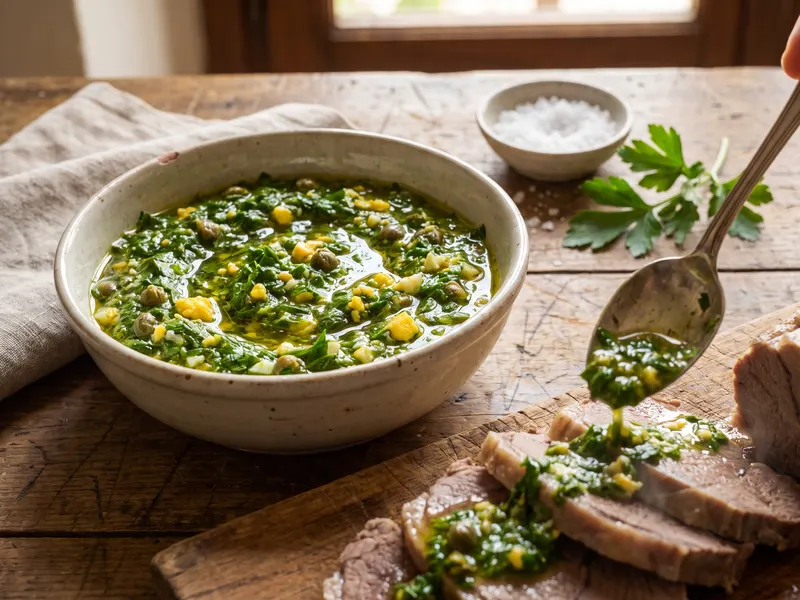
Italian Salsa Verde (Piedmontese Bagnet Verd Green Sauce)
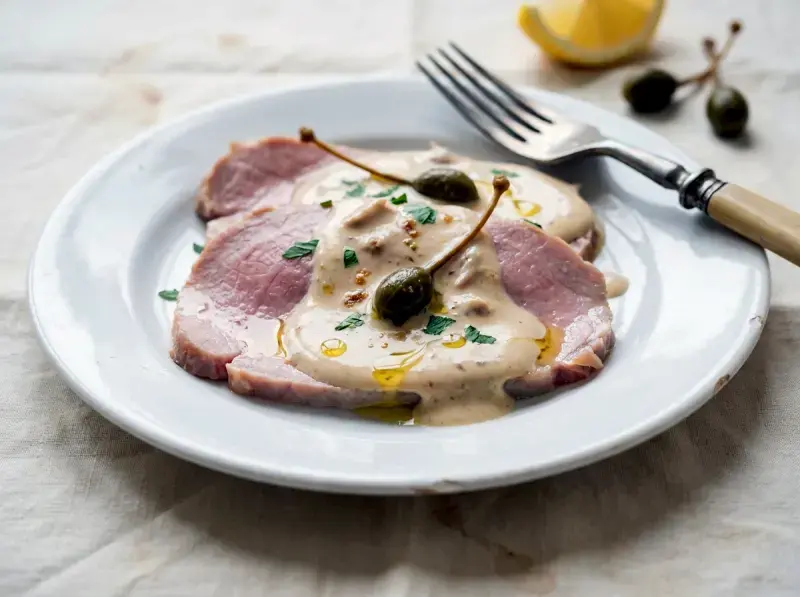
Italian salsa verde — known as bagnet verd in Piedmontese dialect — is the punchy raw green sauce of Northern Italy. Built on flat-leaf parsley, anchovies, capers, garlic, hard-boiled egg yolk, vinegar-soaked bread, and olive oil, it is the obligatory condiment for bollito misto (mixed boiled meats), the wintertime ceremony of Piedmont. It is listed among Piedmont's traditional food products (P.A.T.); local tradition places its birth at the Savoy court of King Carlo Alberto in the 19th century. Bright, salty, sharp, herbaceous — designed to cut through the richness of long-cooked meat. Versatile far beyond bollito: spoon over grilled fish, roasted vegetables, soft cheese, hard-boiled eggs, or crostini. About 30 minutes of work by hand, less with a food processor, plus about 1 hour of resting for the flavours to integrate. Yields about 250 ml, serves 8 as a condiment (about 2 tablespoons each).
Ingredients
- 60 gflat-leaf parsley
- 4 anchovy fillets
- 2 tbspcapers
- 2 clovesgarlic
- 2 hard-boiled egg yolks
- 30 gstale white bread
- 30 mlwhite wine vinegar
- 100 mlextra virgin olive oil
Method
- Hard-boil the eggs first, and do the next steps while they cook. Cover 2 eggs with cold water by 2 cm in a small saucepan, bring to a boil, then reduce to a gentle simmer for 10 minutes — this is full hard-boiled, with a pale yellow yolk that crumbles dry, exactly what you want for salsa verde. Cool under running cold water for 2 minutes to stop the cooking. Peel and separate the yolks; discard or keep the whites for another use. The yolks add body and a faint mayonnaise-like roundness to the sauce.
- Soak the bread in vinegar. Trim the crust off the stale white bread (day-old country bread, ciabatta, or any rustic loaf); you need 30 g of crumb. Tear the crumb into rough chunks and place in a small bowl. Pour 30 ml of white wine vinegar over the bread and squeeze gently with your fingers to ensure full absorption. Let sit for 5–10 minutes — the bread should be fully saturated and slightly soft, but not falling apart. This is the Piedmontese thickener; it absorbs vinegar and oil and gives the sauce structure.
- Prep the anchovies and capers. If using salt-packed anchovies (the traditional choice): rinse 4 fillets under cold water for 30 seconds, then soak in cold water or milk for 15 minutes to soften and reduce harshness; lay flat, run a finger along the spine to remove it, lift out the bones. If using oil-packed: pat 4 fillets dry with paper towel. For capers: if salt-packed, rinse 2 tbsp under water for 30 seconds and soak in cold water for 15 minutes; if brined, drain and rinse briefly. Salt-packed versions give the best flavour but oil-packed and brined work too.
- Prep parsley and garlic. Wash a large bunch of flat-leaf parsley (about 150 g) and dry thoroughly in a salad spinner — water dilutes the sauce and oxidizes the parsley faster. Pick 60 g of leaves only, discard the stems entirely (stems are bitter and darken the sauce). Peel 2 garlic cloves, cut each in half lengthwise, remove the green germ from the centre with a knife tip — this takes away the harsh, lingering bite. Roughly chop the cloves to start the breakdown.
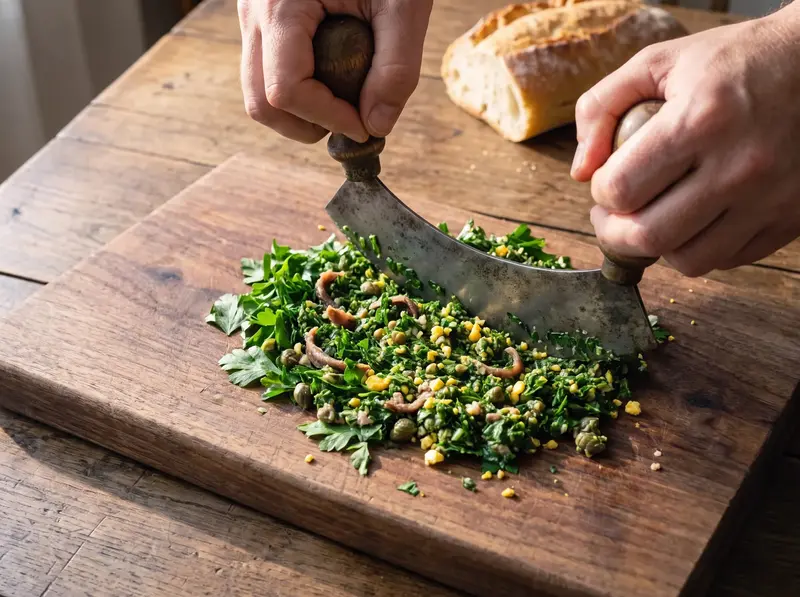
- Chop by hand (authentic method). Pile parsley, anchovy fillets, drained capers, garlic, and hard-boiled yolks together on a large cutting board. Using a mezzaluna or sharp chef's knife, chop in a rocking motion for 8–10 minutes, repeatedly gathering the pile back to the centre. Squeeze out the soaked bread (discard liquid) and add to the pile, chop another 2–3 minutes until everything is reduced to a fine but textured mince. The result has identifiable specks of green and is not a paste — this is the proper texture of bagnet verd.
- Or use a food processor (modern method). Place anchovies, drained capers, garlic, yolks, and squeezed-out bread in a food processor. Pulse 4–5 times for 2–3 seconds each, scraping down the sides between pulses, until reduced to a coarse paste. Add the parsley leaves and pulse 5–6 more times for 2 seconds each — total processing should not exceed 30 seconds. Long continuous blending heats the parsley, kills the chlorophyll, and turns the sauce bitter and olive-coloured.
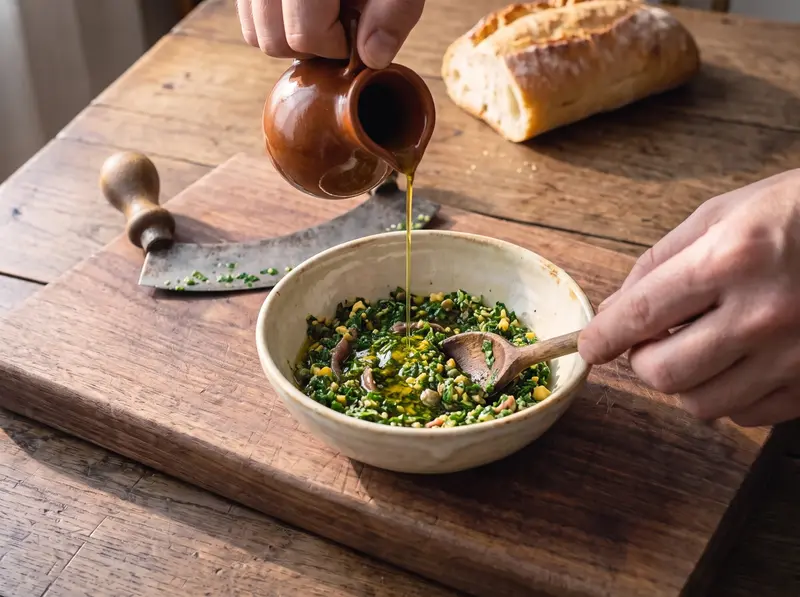
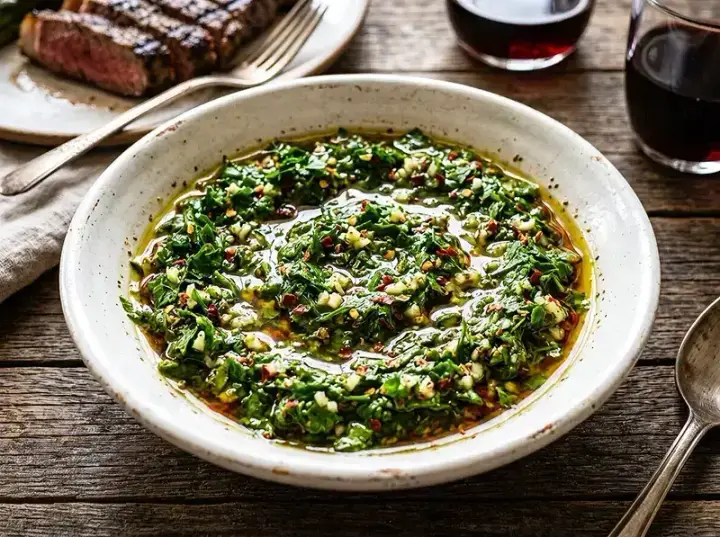
- Stir in the olive oil. Transfer the chopped mixture to a bowl. Slowly drizzle in 100 ml of extra virgin olive oil while stirring with a wooden spoon until you have a thick but spoonable sauce, somewhere between pesto and chimichurri in consistency. Taste — salt is rarely needed, but adjust if the anchovies are mild. If too thick, add more oil; if too loose, more chopped parsley or a small piece of soaked bread. Authentic salsa verde is not smooth purée — visible flecks of green and beige are correct.
- Rest before serving (critical). Cover and let the salsa verde rest at room temperature for about 1 hour before serving — this allows the garlic to mellow, the parsley to release its oils into the olive oil, and all flavours to integrate. Stir before serving as oil tends to separate. Serve at room temperature rather than cold from the fridge — cold dulls the anchovy and parsley aromatics — but do not leave it out for more than 2 hours in total: it contains egg yolk and anchovy. For a longer rest, keep it in the fridge and take it out 30 minutes before serving. Spoon over bollito misto, grilled fish, roasted vegetables, hard-boiled eggs, or soft fresh cheese (tomini).
FAQ
Italian salsa verde is a Piedmontese classic (called bagnet verd in local dialect, literally 'green sauce'), a raw emulsion-style sauce of flat-leaf parsley, anchovies, capers, garlic, olive oil, wine vinegar, and often bread + hard-boiled yolk. It is a traditional product of Piedmont, where it is the obligatory condiment for bollito misto (boiled mixed meats). Mexican salsa verde is a completely different dish: tomatillo, cilantro, serrano or jalapeño, onion, lime — boiled or charred, much fresher and spicier, used with enchiladas and tacos. French sauce verte is usually mayonnaise-based with herbs, and no anchovies. Argentinian chimichurri is conceptually related (raw herb sauce with meat) and is also built on parsley, but it has no anchovies, capers, or egg yolk and adds oregano, chili, and red wine vinegar. The Italian version stands apart on three pillars: parsley's grassy freshness, anchovy and caper umami salt, and the vinegar's acidity that cuts through the fat of boiled meat. Without anchovies and capers it is no longer a Piedmontese salsa verde — it is just a parsley sauce.
Salsa verde stands or falls on its anchovies and capers, and salt-packed (cured in salt) versions outperform oil and brine on intensity and flavour purity — but require preparation. Salt-packed anchovies (sold whole in jars or tins at Italian and Mediterranean shops) are silvery fish tightly packed in coarse salt. Rinse under cold water for 30–60 seconds to remove surface salt, soak in cold water or milk for 15–30 minutes (milk softens the harshness), then lay on a cutting board and use your finger to lift out the central spine starting from the tail — it pulls cleanly if soaked properly. You get two clean fillets. Salt-packed capers (those from Pantelleria and Salina are well regarded) — rinse under water for 30 seconds, soak in cold water for 15 minutes, pat dry. They are firmer and more aromatic than brined capers. Oil-packed anchovies are a working alternative (especially good Italian ones in glass jars), just pat them dry with a paper towel. Brined capers are the weakest in aroma but workable — rinse and taste for salt. What to avoid: anchovy paste in tubes (one-dimensional flavour, oversalted), capers in marinade, supermarket no-name brands. If you only have oil-packed and brined versions the sauce will still be good, just not Piedmontese restaurant level. Salt-packed costs more, but you use less and a jar lasts months in the fridge across many dishes.
The authentic Piedmontese technique uses a mezzaluna (curved double-handled knife) on a large cutting board: parsley, anchovies, capers, garlic and yolk are piled together and chopped, and the squeezed bread goes in at the end. The advantage of hand chopping is that the sauce stays bright green, does not heat up, does not oxidize and does not turn bitter; the texture is uneven and interesting. Food processor works, with rules: 1) Use the pulse function, never continuous max — several short pulses (4–5 times for 2–3 seconds each), pause to scrape the sides, then a few more pulses. 2) Do not blend more than 30 seconds total — extended blade work heats the parsley, kills the green colour (turns olive), and starts to make it bitter. 3) Process the firm ingredients first (garlic, anchovies, capers), then add parsley separately and process briefly — this gives the best texture. 4) Keep the oil out of the processor: tip the chopped mixture into a bowl and stir the oil in by hand with a wooden spoon, a little at a time, until it is spoonable, the same as in the recipe steps. Immersion blender is even worse than food processor — too easy to over-process into a purée. Mortar and pestle is an excellent alternative to mezzaluna, especially for the garlic + anchovies + capers + yolk first step, then mix with hand-chopped parsley. A standard high-power blender on full speed is a hard no — parsley turns into a bitter slime. Verdict: hand mezzaluna for the best result (10–13 minutes), food processor with the rules above for busy weeknights (under a minute of actual processing).
Fresh salsa verde keeps in the fridge in an airtight glass container for 2–3 days at its best and no longer than 4 days: it contains cooked egg yolk and anchovy. The main enemy is parsley oxidation — exposure to oxygen turns bright green into dull olive-brown and damages flavour. Main storage rule: cover the surface of the sauce with a thin layer of olive oil (the same trick as pesto genovese) — oil creates a protective seal against oxygen. Use a narrow glass container that minimizes the surface area exposed to air. For the brightest green colour at the moment of preparation: 1) Use only parsley leaves without stems — stems are bitter and darker, and they will tint the whole sauce. 2) A brief blanch of parsley (5–10 seconds in boiling water followed by an ice bath) fixes the chlorophyll and holds the bright green for as long as the sauce keeps — but it removes some aroma, so it is not the classic technique. 3) The vinegar-soaked bread goes in from the start, as is traditional; any extra vinegar or lemon juice to sharpen the taste goes in just before serving, since acid dulls the green over time. Freezing is possible for 1–2 months, best in ice cube trays: portion into cells, freeze, transfer to a zip-bag. Useful for adding to soups, pasta, and vegetables in single servings. Texture after thawing is slightly watery (parsley releases water during crystallization) but the flavour holds well. Do not freeze the version with egg yolk — yolk does not survive freezing, the texture breaks. The yolk-free version (more rustic) is optimal for freezing. Before serving the thawed sauce, add 1–2 tsp of fresh oil and stir briefly to recover texture.
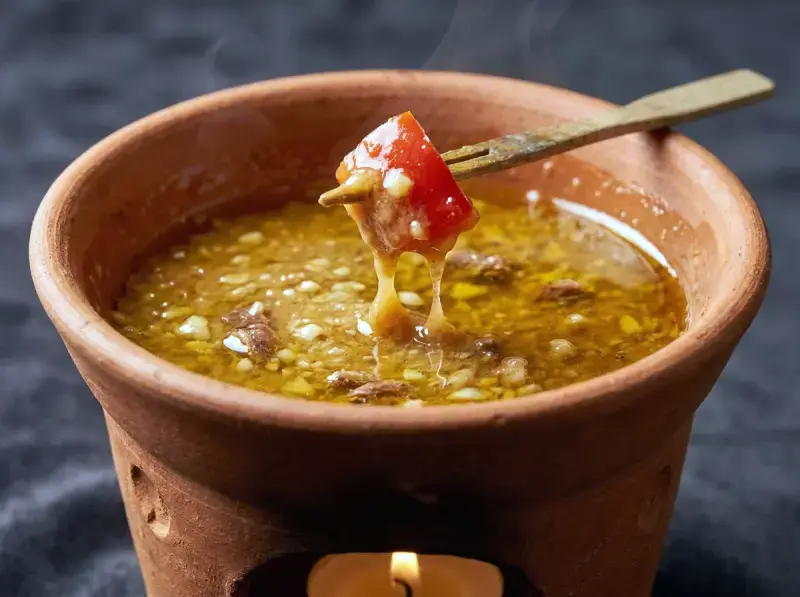
Salsa verde is one of the most versatile Italian sauces, going far beyond its native partner bollito misto. Classic Piedmontese pairings: bollito misto (boiled mixed meats — veal, beef, chicken, calf's head, cotechino, tongue — the #1 partner); tomini (soft Piedmontese goat or cow's milk cheese, grilled and dressed with salsa); boiled potatoes and asparagus; halved hard-boiled eggs as antipasto; crostini as a simple aperitif snack. Wider Italian uses: pan-seared or sous-vide white fish (sea bass, cod, sole) — a classic; grilled or roasted vegetables (artichokes, asparagus, zucchini, beets, bell peppers); ribollita (stir into the finished soup); pasta in bianco (fresh pasta with butter + a spoon of salsa verde — a simple supper); over white pizza bianca; on poached eggs with soft yolk; as a spread on white bread for panini; with roasted chicken or turkey instead of gravy. Modern uses: bowl of minestrone; roasted carrots or cauliflower; Tuscan-style grilled steak (ribeye or strip under salsa verde and olive oil); as a salsa for burrata with toasted bread; on grilled portobello mushrooms; in modern bistro bowl menus. What does not work: sweet dishes (obviously); very spicy food (anchovies and capers do not mesh with chili); heavy cream sauces; Japanese or East Asian cuisines; desserts. Wine: red Piedmontese — Barbera d'Asti, Dolcetto, Nebbiolo (for bollito); white — Arneis (Roero), Gavi di Gavi, Cortese (for fish); if salsa is made with lemon instead of vinegar, sauvignon blanc. Service: in a small ceramic or glass sauce boat next to the main, at room temperature (not straight from the fridge — cold dulls the aromatics) and on the table for no more than 2 hours in total, and spooned over by the diner — let each person dose to taste. Italian restaurants put salsa verde on the table as a universal seasoning. Salsa verde also sits well beside bagna cauda on a Piedmontese antipasti table: one sauce is cool and green, the other hot and garlicky.
Rate this
Recipes by email
One letter a week: a recipe picked for your taste, plus whatever is new on the site. Unsubscribe in one click.
Welcome gift: Sergei's cookbook (e-book).
By subscribing you agree to the privacy policy.
Tell us what you like to cook (30 seconds) →Keep browsing
More dishes from the Italian archive — picked by overlap with what you're cooking now.
Join the conversation
Comments
No comments yet — be the first!