
Savillum (Ancient Roman Cheesecake)
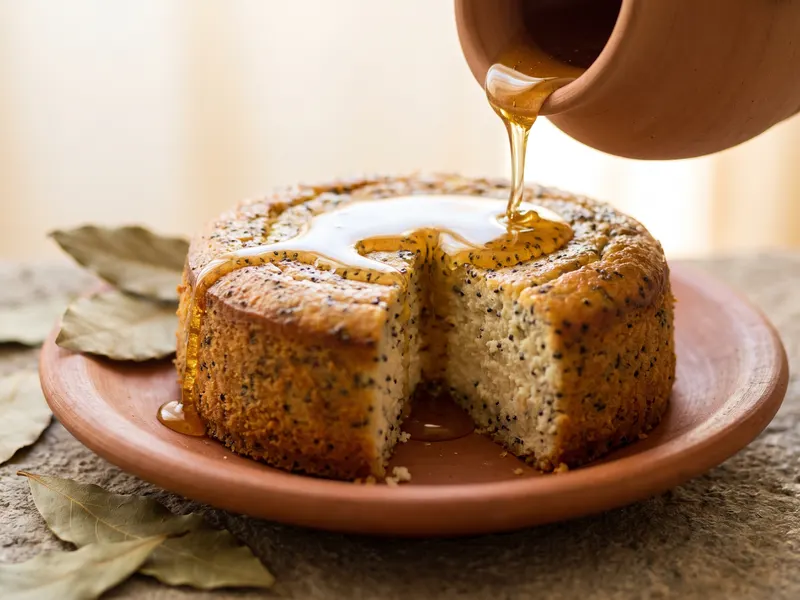
The oldest cheesecake recipe in the world: an ancient Roman cheesecake of ricotta, flour, honey and one egg, written down by Cato around 160 BC. It bakes for about 45 minutes, then gets glazed while still hot with more honey and a scattering of poppy seeds. The texture sits between a baked cheesecake and a dense honey pudding — nothing like the cream-cheese version, and far better than a 2,200-year-old recipe has any right to be. The hour covers mixing and baking; the ricotta needs at least 30 minutes of draining before that.
What Is Savillum?
Savillum is a baked cheese and honey dish from the Roman Republic. Cato the Elder wrote it down in De Agri Cultura, his farming manual from around 160 BC, in a short chapter that sits between advice on vines and livestock. His version needs four things: fresh cheese, flour, honey and one egg, mixed into a batter and baked in a greased earthenware dish. When it comes out, you pour more honey over the hot surface, scatter poppy seeds on top and put it back for a few minutes so the glaze sets. That finishing step is what makes savillum recognisable. People call it the ancient Roman cheesecake because the method is close to a modern baked cheesecake: soft cheese bound with egg and a little flour, cooked until set. There is no crust and no cream cheese, and honey is the only sweetener, so expect something denser and less sweet than a bakery cheesecake.
Savillum vs Libum
Both come from the same book and the same three basics, cheese, flour and egg, so they get confused a lot. The difference is in the proportions and in what happens with the honey. Savillum has honey in the batter and honey poured on top, plus poppy seeds, and it bakes as a loose batter in a dish. Libum is a stiffer dough with twice as much cheese as flour, shaped by hand into a flat round and baked on bay leaves.
Cato's text for libum does not mention honey at all. It was a plain cake, offered to the household gods and eaten with whatever was at hand. Serving it with warm honey is a later habit that makes it taste like a cousin of savillum. Savillum was sweet from the start, which is why it counts as the dessert of the two.
If you are choosing between them: savillum is softer, sweeter and eaten with a spoon from the dish. Libum holds its shape, slices into wedges and works as bread with cheese or as a base for honey and fruit. Making both from one batch of drained ricotta is the easiest way to taste the difference.
Ingredients
- 850 gricotta, well-drained
- 110 gflour, whole wheat or spelt
- 90 ghoney
- 90 ghoney, for glaze
- 1 egg
- 1 tbspolive oil
- 3 tbsppoppy seeds
Method
- Drain the ricotta through a fine sieve for at least 30 minutes. Press it gently — the drier it is, the better the final texture.

- Combine the drained ricotta and flour in a large bowl. Mix until no dry streaks remain.

- Add the egg and 90 g honey. Stir until you have a thick, slightly sticky batter.

- Brush a round baking dish (20–24 cm) generously with olive oil. Pour in the batter — it should sit about 4–5 cm deep.

- Bake at 175°C (no fan) for 35–50 minutes. The center must be fully set. A skewer inserted in the middle should come out with just a few moist crumbs.

- Take the dish out of the oven. Immediately pour the remaining 90 g honey (warmed slightly) over the hot surface.

- Scatter the poppy seeds evenly over the honey glaze. Return to the oven for 5–7 minutes.

- Serve warm or at room temperature directly from the baking dish, with a spoon.

FAQ
The most likely cause is insufficiently drained ricotta. Fresh store-bought ricotta often holds a lot of whey — leave it in a sieve for at least 30 minutes, ideally an hour. If the batter still looks very loose, add another 1–2 tablespoons of flour. The second culprit is underbaking: the center must be fully set, and a skewer should come out with only a few moist crumbs. Let the savillum rest 15 minutes in the pan before serving — it is always softer straight from the oven.
Full-fat cottage cheese (9–15%) is the closest substitute. Push it through a sieve or blend it smooth first to remove the grainy texture. A mix of 500 g cottage cheese and 350 g ricotta works well — the result is slightly firmer and more tangy. Mascarpone also works but makes the savillum richer. Low-fat cottage cheese is not recommended — the texture turns rubbery and the flavor flat.
Cato’s original uses just one egg, and its only role is to bind the batter. For vegan recipes, 1 tablespoon of chia seeds soaked in 3 tablespoons of water for 10 minutes works well as a replacement. The ricotta can be swapped for cashew cheese (200 g cashews blended with 100 ml water and 1 tsp lemon juice) or firm coconut curd. The vegan savillum is slightly less cohesive, but the flavor — sweet, honeyed, with poppy seeds — stays.
Savillum is best the day it is made — the honey glaze is still soft and the poppy seeds have crunch. Covered tightly with plastic wrap, it keeps in the refrigerator for 2–3 days. On the second day it firms up and tastes good cold, especially with an extra drizzle of honey. Freezing is not recommended: ricotta releases water when thawed and the texture suffers.
Honey does two jobs here: in the batter it adds moisture and aroma, in the glaze it caramelizes and forms a crust. A strongly aromatic floral or linden honey works best. Neutral acacia honey gives sweetness without flavor. Maple syrup is a workable 1:1 substitute with a different but not worse result. Agave makes the batter too runny. Date syrup is a good option for a refined-sugar-free version and pairs well with dairy-free plant-based variations.
Rate this
Recipes by email
One letter a week: a recipe picked for your taste, plus whatever is new on the site. Unsubscribe in one click.
Welcome gift: Sergei's cookbook (e-book).
By subscribing you agree to the privacy policy.
Tell us what you like to cook (30 seconds) →Keep browsing
More dishes from the Italian archive — picked by overlap with what you're cooking now.
Join the conversation
Comments (3)
Готовил. Чета немного не получилось как на кртинке, но в целом неплохо. ел такое в Италии, там было вкусно!
палео-диета, в курсе. Надо приготовить. Хороший сайт
Ingredient temperature matters enormously for savillum. Unless the recipe says otherwise, everything should be at room temperature. Cold ricotta doesn't cream properly, and the texture suffers throughout.