Japan · Flour and Confectionery Products
Napoleon Pie (Japanese Strawberry Mille-Feuille)
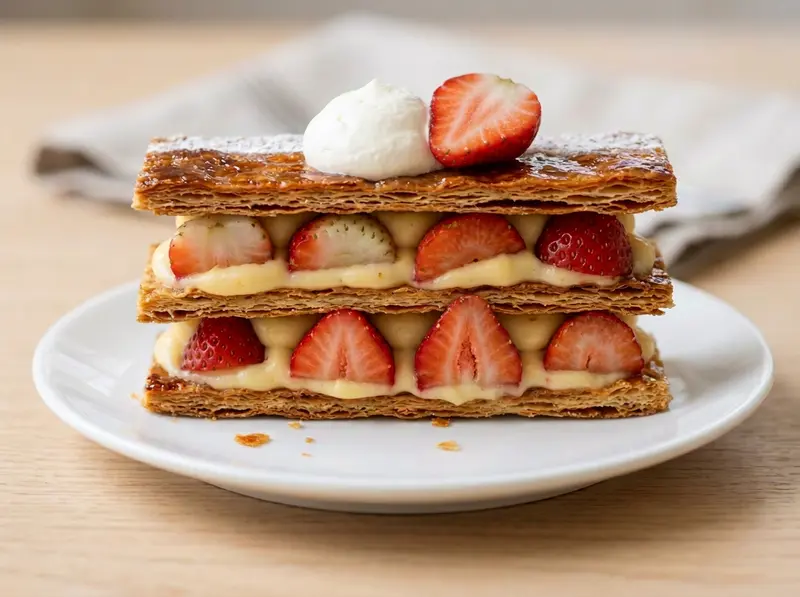
Napoleon pie (ナポレオンパイ) is the Japanese name for a strawberry mille-feuille: three layers of crisp puff pastry stacked with cold custard, whipped cream and fresh strawberries.
Ingredients
- milk200 ml
- egg yolks2
- sugar50 g
- flour20 g
- vanilla extract0.5 tsp
- puff pastry150 g
- icing sugar10 g
- heavy cream100 ml
- strawberries150 g
Method
- 1Cook the custard. In a medium mixing bowl, whisk the 2 egg yolks with 40 g of the sugar until pale, then sift in the 20 g of flour and whisk it in. Heat the 200 ml of milk in a small saucepan over medium heat until it steams and small bubbles show at the edge. Pour the hot milk into the yolks a little at a time, whisking as you go, so the yolks warm up gradually and do not scramble. Strain the mixture back into the saucepan and cook it over medium heat, whisking without stopping, until it is thick and large bubbles break the surface, then whisk for 1 minute more so the eggs are cooked through. The custard is done when it is glossy, the whisk leaves tracks that hold, and it drops from the whisk in a heavy blob and not in a stream. Take the saucepan off the heat and stir in the ½ tsp of vanilla extract.
- 2Chill the custard. Scrape it into a shallow dish of about 15 × 20 cm, press cling film directly onto the surface and put the dish in the fridge for 1 hour. The film touching the custard stops a skin from forming, and a thin layer chills fast and sets firm. It is ready when it is cold to the touch and firm enough to hold the mark of a spoon. Turn the oven on to 200 °C now, so it heats up while you cut the pastry.
- 3Cut the pastry and start baking. Line a baking tray of about 30 × 40 cm with parchment. Leave the frozen puff pastry, one sheet of about 18 × 18 cm, out of the freezer for 5 to 10 minutes, until it bends without cracking but is still cold. Prick it all over with a fork and cut it raw: first in half, then each half across into 6, which gives 12 strips of 9 × 3 cm. Lay the strips on the tray in 3 columns and 4 rows with gaps of 1.5 to 2 cm. If the oven has not reached 200 °C yet, keep the tray of strips in the fridge until it has. Bake for 8 minutes, until the strips have puffed up and are still pale.
- 4Press the pastry flat. Take the tray out of the oven, cover the strips with a second piece of parchment, set a second flat baking tray on top and press down gently. A flat ovenproof dish that covers all the strips does the same job. Put everything back in the oven at 200 °C with the second tray still on and bake for 15 minutes, until each strip is pale golden all the way to the centre with no white streak in the middle. If the centre is still white, put the tray straight back for up to 5 minutes more. Pastry baked under a weight turns into a thin, dense, crisp layer that can carry the custard cream without collapsing.
- 5Glaze the pastry. Lift off the second tray and the top parchment and turn the strips over so the underside faces up; it is the flatter side and colours evenly. Sift 1 tbsp (7.5 g) of the icing sugar over the strips in a thin, even layer and bake at 200 °C for about 5 minutes (4 to 6), until the sugar has melted into a clear, glossy, deep-golden glaze and no white powder is left. Stay by the oven for the last 2 minutes, because the glaze goes from glossy to burnt quickly. The glaze gives the pastry its colour, its shine and a caramel taste. Move the strips to a wire rack and let them cool completely, about 20 minutes.
- 6Whip the cream and make the custard cream. In a second bowl, whip the 100 ml of cold heavy cream with the remaining 10 g of sugar with a hand mixer to firm peaks: a peak should stand up and not flop over. Scrape the cold custard into the washed mixing bowl and beat it with the whisk until smooth. Fold in half of the whipped cream (about 55 g, roughly 4 heaped tbsp) in two additions. The first, smaller addition loosens the custard so the rest goes in without knocking the air out. Stop when the custard cream is smooth, pale yellow and holds its shape on a spoon, because over-mixing makes it too soft to stack. Hull the strawberries. You need 32 pieces for the layers and 4 halves for the tops: from about 10 medium strawberries, cut 8 lengthwise into quarters and 2 in half. If your strawberries are larger, cut them into more pieces so that you still get 32.
- 7Assemble 4 pieces on serving plates. The custard cream has to make 16 roughly equal spoonfuls, two for each filled layer, so share it out evenly as you go; one spoonful is about 20 g, or 1 heaped tbsp. For each piece, lay down a pastry strip with the glazed side up, spread on one spoonful of custard cream, set 4 strawberry pieces in a row along the strip and cover them with a second spoonful. Add a second strip, glazed side up, and repeat: custard cream, 4 strawberry pieces, custard cream. Finish with a third strip, glazed side up. The custard cream on both sides of the fruit glues the layers together. Keep the strawberries level with the custard cream so the next strip lies flat; the custard cream should reach the edges but not squeeze out when you press the strip lightly. Sift the remaining 1 tsp (2.5 g) of icing sugar over the four top strips first, so it does not land on the whipped cream and the cut fruit, then top each piece with a spoonful (about 14 g) of the whipped cream and a strawberry half. Serve the pieces soon after assembling, while the pastry is still crisp.