Japan · Soups
Ozoni (Japanese New Year Mochi Soup)
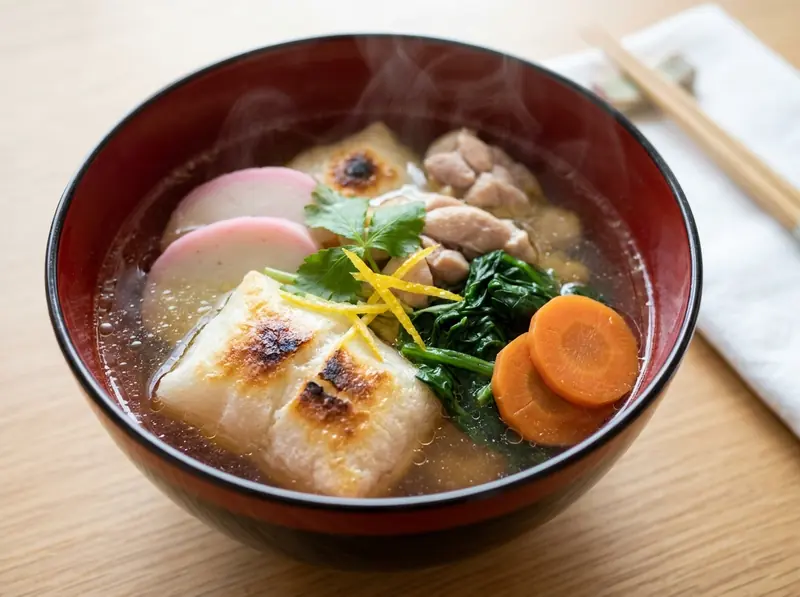
Ozoni (お雑煮, also written ozōni or zōni) is the soup Japanese families eat on the morning of New Year's Day.
Ingredients
- water2100 ml
- kombu10 g
- bonito flakes15 g
- chicken thighs200 g
- sake2 tbsp
- salt1 tsp
- spinach100 g
- carrot40 g
- kamaboko80 g
- mitsuba4 sprig
- yuzu zest4 strip
- soy sauce1 tbsp
- kirimochi4 piece
Method
- 1Cut the 200 g of boneless, skinless chicken thighs into 2.5 cm pieces and put them in a small bowl. Add ¼ tsp of the salt and 1 tbsp of the sake and mix with your hands until every piece is coated. Leave the chicken for 15 minutes while you make the dashi, so the salt and sake can season it.
- 2Put the 10 g of kombu and 1100 ml of cold water in a 20 cm saucepan and heat it slowly on medium-low, about 10 minutes. When small bubbles start rising from the bottom of the pan, just before it boils, take the kombu out: left in boiling water it makes the stock slimy and bitter. Bring the water to the boil, turn off the heat, scatter in the 15 g of bonito flakes and leave them for 5 minutes, until they have sunk. Line a fine sieve with a paper towel, set it over a large bowl and pour the dashi through without pressing the flakes. You should have about 900 ml of clear, pale golden broth.
- 3While the kombu heats, bring 1000 ml of water to the boil in a small saucepan with ¼ tsp of the salt. Put in the 100 g of spinach, stems first, and cook for about 1 minute, until the stems bend and the leaves are bright green. Lift it into a bowl of cold water, squeeze out the water with your hands and cut it into 3 cm lengths. Cooking it in its own pan keeps it bright green and keeps its taste out of the broth.
- 4Prepare the toppings. Peel the 40 g of carrot and slice it into 3 mm rounds. Cut the 80 g of kamaboko into 8 slices about 5 mm thick. Cut the 4 mitsuba sprigs into 3 cm lengths, leaves and all. Peel 4 strips of yuzu zest, cut away the white pith from the back and slice the zest into very thin strands.
- 5Rinse the 20 cm saucepan, pour the dashi back in and bring it to the boil on medium heat. Add the chicken with its liquid and the carrot, and skim off the grey foam that rises, so the broth stays clear. Put the lid on, turn the heat down to a gentle simmer and cook for 5 to 7 minutes. The chicken is done at 74 °C in the thickest piece. Without a thermometer, cut one open: it should be white all the way through with no pink. The carrot should be soft to the tip of a knife. Stir in the remaining 1 tbsp of sake, the 1 tbsp of soy sauce and the remaining ½ tsp of salt, then keep the soup hot on the lowest heat with the lid on.
- 6While the chicken simmers, break or cut each of the 4 kirimochi in half along the line pressed into the block, pressing down with a large knife rather than sawing. For young children and older people, divide their blocks into quarters along the pressed lines instead, because Japanese safety advice is to cut mochi small before it is eaten. Kirimochi are hard and dry and cannot be eaten raw. Put the pieces in a dry 26 cm non-stick frying pan, leaving space between them because they swell, and toast them on medium heat for 6 to 8 minutes, turning them now and then. They are ready when both sides have golden-brown patches, the pieces have puffed up and they feel soft when you press one. If they stick, line the pan with a sheet of foil. A toasted, browned crust on the mochi is the mark of Tokyo ozoni.
- 7Put one block's worth of toasted mochi (2 halves or 4 quarters) in each of 4 soup bowls. Divide the chicken and carrot between them, add 2 slices of kamaboko and a quarter of the spinach to each bowl, and pour about 200 ml of hot broth over. Top with the mitsuba and a few strands of yuzu zest and serve straight away, while the mochi is still just soft. Mochi is sticky and hard to bite through, and people choke on it every New Year in Japan. For young children and older people, cut the softened mochi into small, bite-sized pieces in the bowl before they start. Everyone should take a sip of soup before the first bite, put only a little in the mouth at a time, chew slowly and swallow it before taking more. Never use tea or soup to force down a piece you are struggling to swallow, and keep an eye on young children and older people while they eat.