
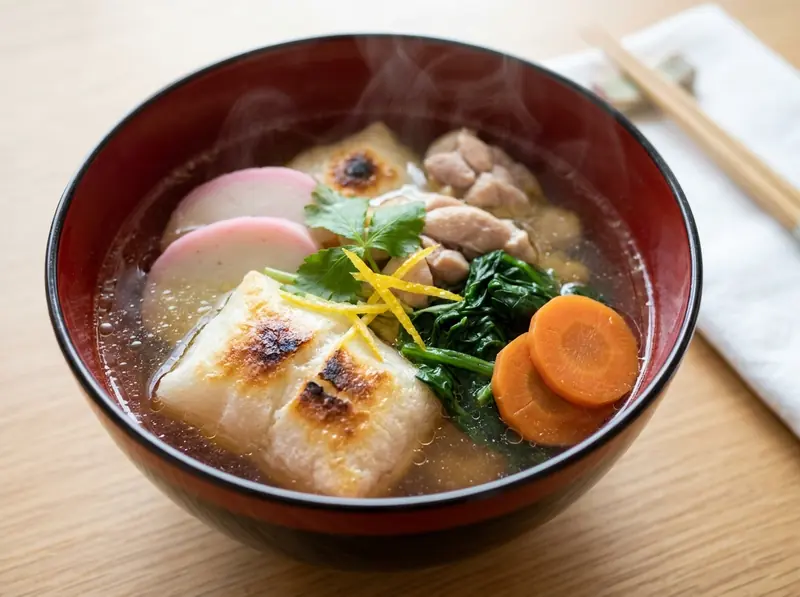
Ozoni (Japanese New Year Mochi Soup)
Ozoni (お雑煮, also written ozōni or zōni) is the soup Japanese families eat on the morning of New Year's Day. It usually has mochi in it, and nearly everything else depends on the region and the household. This is the Tokyo, or Kanto, version: toasted kirimochi (square blocks of cut mochi), chicken and greens in a clear broth of kombu and bonito dashi seasoned with soy sauce. In Kyoto and the rest of the Kansai region the soup is made with white miso instead, and the mochi is round and boiled rather than toasted. Tokyo cooks often use komatsuna, a Japanese mustard green; we use spinach, which some parts of Tokyo use too and which is easier to find outside Japan. The chicken cooks right in the dashi, so the soup comes together in one pot. From cold water to the table it takes about 35 minutes, dashi included.
What ozoni is
Ozoni is the soup at the start of the Japanese New Year: mochi in a broth, eaten on the morning of the first of January. Japan's agriculture ministry, MAFF, says there are several theories about where it began, the leading one being Kyoto in the Muromachi period, and that it is said to have spread across the country as a New Year dish between the late 1700s and the early 1800s.
Tokyo's version, which MAFF calls Edo zoni, is toasted mochi with chicken and greens under a clear broth of kombu and bonito dashi. According to MAFF, Edo first ate its ozoni with miso too. Once soy sauce brewing grew in Noda and Chōshi in the Genroku era, the city settled on a clear soup seasoned with soy sauce. MAFF thinks square mochi caught on in the east because cutting a flat slab into pieces was so convenient. The kombu and bonito dashi is the same base used for oden.
Tokyo ozoni and Kyoto ozoni
Each family has its own ozoni, but the big split is between east and west. In Kanto the broth is clear, the mochi is square and toasted, and chicken, komatsuna or spinach, kamaboko, mitsuba and yuzu go in. Some families add dried shiitake or a carrot cut into a flower. In Kansai, sweet white miso goes into a kombu dashi, and round mochi is boiled and served with taro, daikon and carrot. Tokyo varies too: in some areas spinach replaces komatsuna and naruto replaces kamaboko.
Mochi and choking
Tokyo's fire department and Japan's government both publish warnings about mochi for the New Year. Over five years (2020 to 2024), 338 people in the Tokyo Fire Department's area were taken to hospital by ambulance after choking on mochi and similar foods, about nine in ten of them aged 65 or older, and January was the worst month with 135 cases. Cut the mochi small, sip some soup before the first bite, chew slowly and keep an eye on children and older people at the table.
Ingredients
- 2100 mlwater
- 10 gkombu
- 15 gbonito flakes
- 200 gchicken thighs
- 2 tbspsake
- 1 tspsalt
- 100 gspinach
- 40 gcarrot
- 80 gkamaboko
- 4 sprigmitsuba
- 4 stripyuzu zest
- 1 tbspsoy sauce
- 4 piecekirimochi
Method
- Cut the 200 g of boneless, skinless chicken thighs into 2.5 cm pieces and put them in a small bowl. Add ¼ tsp of the salt and 1 tbsp of the sake and mix with your hands until every piece is coated. Leave the chicken for 15 minutes while you make the dashi, so the salt and sake can season it.
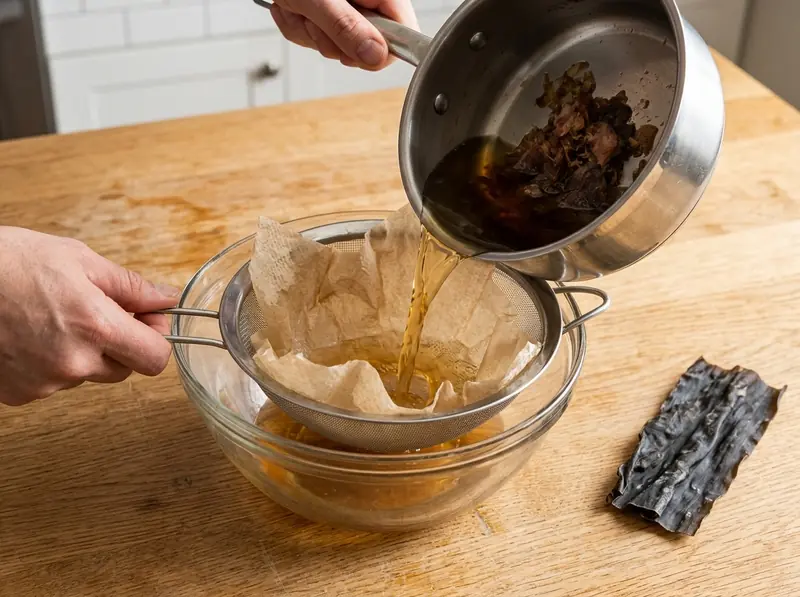
- Put the 10 g of kombu and 1100 ml of cold water in a 20 cm saucepan and heat it slowly on medium-low, about 10 minutes. When small bubbles start rising from the bottom of the pan, just before it boils, take the kombu out: left in boiling water it makes the stock slimy and bitter. Bring the water to the boil, turn off the heat, scatter in the 15 g of bonito flakes and leave them for 5 minutes, until they have sunk. Line a fine sieve with a paper towel, set it over a large bowl and pour the dashi through without pressing the flakes. You should have about 900 ml of clear, pale golden broth.
- While the kombu heats, bring 1000 ml of water to the boil in a small saucepan with ¼ tsp of the salt. Put in the 100 g of spinach, stems first, and cook for about 1 minute, until the stems bend and the leaves are bright green. Lift it into a bowl of cold water, squeeze out the water with your hands and cut it into 3 cm lengths. Cooking it in its own pan keeps it bright green and keeps its taste out of the broth.
- Prepare the toppings. Peel the 40 g of carrot and slice it into 3 mm rounds. Cut the 80 g of kamaboko into 8 slices about 5 mm thick. Cut the 4 mitsuba sprigs into 3 cm lengths, leaves and all. Peel 4 strips of yuzu zest, cut away the white pith from the back and slice the zest into very thin strands.
- Rinse the 20 cm saucepan, pour the dashi back in and bring it to the boil on medium heat. Add the chicken with its liquid and the carrot, and skim off the grey foam that rises, so the broth stays clear. Put the lid on, turn the heat down to a gentle simmer and cook for 5 to 7 minutes. The chicken is done at 74 °C in the thickest piece. Without a thermometer, cut one open: it should be white all the way through with no pink. The carrot should be soft to the tip of a knife. Stir in the remaining 1 tbsp of sake, the 1 tbsp of soy sauce and the remaining ½ tsp of salt, then keep the soup hot on the lowest heat with the lid on.
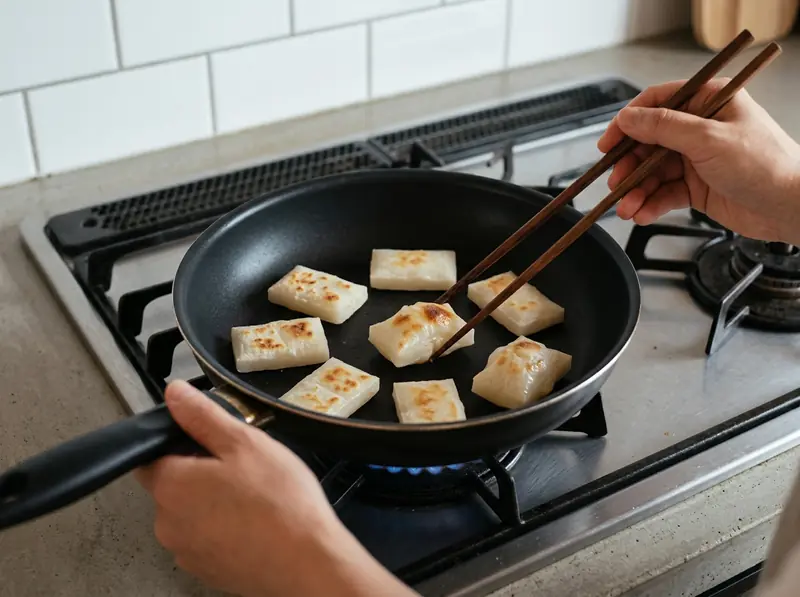
- While the chicken simmers, break or cut each of the 4 kirimochi in half along the line pressed into the block, pressing down with a large knife rather than sawing. For young children and older people, divide their blocks into quarters along the pressed lines instead, because Japanese safety advice is to cut mochi small before it is eaten. Kirimochi are hard and dry and cannot be eaten raw. Put the pieces in a dry 26 cm non-stick frying pan, leaving space between them because they swell, and toast them on medium heat for 6 to 8 minutes, turning them now and then. They are ready when both sides have golden-brown patches, the pieces have puffed up and they feel soft when you press one. If they stick, line the pan with a sheet of foil. A toasted, browned crust on the mochi is the mark of Tokyo ozoni.
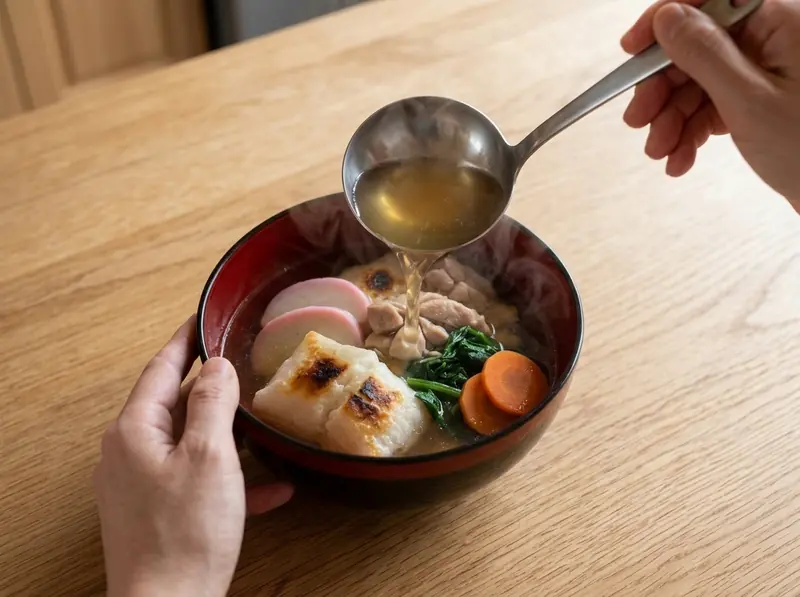
- Put one block's worth of toasted mochi (2 halves or 4 quarters) in each of 4 soup bowls. Divide the chicken and carrot between them, add 2 slices of kamaboko and a quarter of the spinach to each bowl, and pour about 200 ml of hot broth over. Top with the mitsuba and a few strands of yuzu zest and serve straight away, while the mochi is still just soft. Mochi is sticky and hard to bite through, and people choke on it every New Year in Japan. For young children and older people, cut the softened mochi into small, bite-sized pieces in the bowl before they start. Everyone should take a sip of soup before the first bite, put only a little in the mouth at a time, chew slowly and swallow it before taking more. Never use tea or soup to force down a piece you are struggling to swallow, and keep an eye on young children and older people while they eat.
FAQ
Kanto (Tokyo) ozoni is a clear broth of kombu and bonito dashi seasoned with soy sauce, with square mochi that is toasted first, plus chicken, greens and kamaboko. Kansai (Kyoto) ozoni adds sweet white miso to a kombu dashi, and the mochi is round and boiled instead of toasted. A survey on the shape found square mochi in the east of Japan and round mochi in the west, with the border said to run near Sekigahara. Some regions go further still, and parts of Tottori make it with azuki bean soup. For an everyday Japanese soup made on dashi, try miso soup.
Look for kirimochi (切り餅), sold as hard, dried square blocks in Japanese grocery shops and online. One block is about 50 g, and many have a line pressed into them so you can break or cut them in half or in quarters. Sweet dessert mochi is a different thing: the mochi on this site, for example, is a sweet dessert of steamed glutinous rice with sugar and fruit, and it does not belong in a savoury soup. Kirimochi cannot be eaten raw and always has to be toasted or cooked first.
In a dry non-stick frying pan, toast the halves on medium heat for 6 to 8 minutes, turning them now and then, until both sides have golden-brown patches and they puff up. If they stick, put a sheet of foil in the pan. In a toaster oven of about 1000 W, toast them for 3 to 4 minutes until browned, then leave them inside with the door closed for 2 more minutes so the middle softens. Set them on a sheet of non-stick foil so they do not stick to the tray. Take the mochi out as soon as it has puffed, because mochi left to swell too long goes hollow inside and loses its shape. Put it in the bowl just before the broth goes in.
Mochi is sticky and hard to bite through, and older people and small children, who chew and swallow with less strength, are most at risk. The Tokyo Fire Department counted 338 people taken to hospital by ambulance after choking on mochi and similar foods over five years (2020 to 2024), about nine in ten of them aged 65 or older, with 135 cases in January and 42 in December. Looking at 2018 and 2019, Japan's Consumer Affairs Agency found that 43 % of older people's deaths from choking on mochi happened in January and 14 % in December, most in the first three days of the year. The official advice is to cut mochi into small pieces beforehand (for children and older people, quarter each block before toasting and cut the softened pieces smaller still in the bowl), take a sip of tea or soup first, put small amounts in your mouth and chew slowly, and watch young children and older people while they eat. Never use a drink to force down a piece you cannot swallow. If someone suddenly cannot speak or breathe, call the emergency number and act at once: Japanese government advice is back blows first, then abdominal thrusts (not for babies or pregnant women), and it is worth learning these before New Year.
Yes. Make the dashi, cook the chicken and carrot in it, blanch the spinach and cut the toppings the day before, and keep them covered in the fridge. Leave the mochi out and toast it fresh: mochi left sitting in the soup turns very soft. On the morning, bring the broth to a full boil, which takes it past 74 °C, toast fresh mochi and assemble the bowls. Leftover soup without the mochi keeps in the fridge for up to 3 days, and it should go back into the fridge within 2 hours of serving.
Keep browsing
More dishes from the Japanese archive — picked by overlap with what you're cooking now.
Recipes by email
One letter a week: a recipe picked for your taste, plus whatever is new on the site. Unsubscribe in one click.
Welcome gift: Sergei's cookbook (e-book).
By subscribing you agree to the privacy policy.
Tell us what you like to cook (30 seconds) →
Join the conversation
Comments
No comments yet — be the first!