
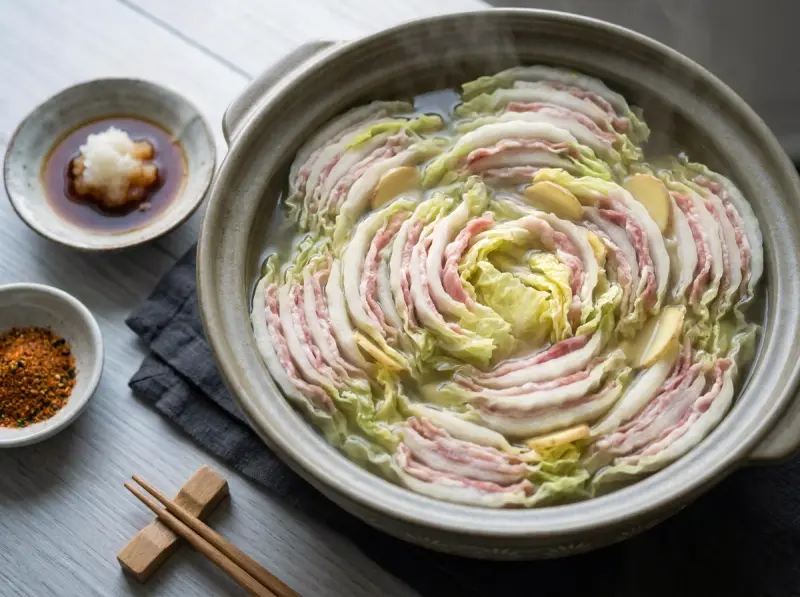
Mille-Feuille Nabe (Japanese Cabbage and Pork Hot Pot)
Mille-feuille nabe borrows its name from the French pastry of a thousand leaves, but here the layers are napa cabbage and paper-thin pork belly, packed upright into a pot so the cut edges spiral outwards like a flower. A clear dashi broth is poured over and everything simmers for twenty minutes until the cabbage collapses into sweetness and the pork melts. It looks like far more work than it is, and the leftover broth makes the best bowl of udon you'll have all winter.
Ingredients
- 1 pcsnapa cabbage
- 500 gpork belly
- 800 mldashi
- 100 mlsake
- 2 tbsplight soy sauce
- 1 tbspmirin
- 30 gginger
- 100 mlponzu
- 150 gdaikon
- 3 pcsspring onion
Method
- Cut the napa cabbage into quarters lengthwise and rinse between the leaves. Separate the leaves, keeping them whole.
- Lay a cabbage leaf flat, cover it with a single layer of thinly sliced pork belly, top with another leaf, more pork, and repeat to build a stack four or five leaves high.
- Cut each stack crosswise into pieces about 5–6 cm long, the height of your pot. Repeat with the remaining cabbage and pork.
- Stand the pieces upright in a wide pot with the cut layers facing up, packing them tightly from the outside in towards the centre. Pack them closer than looks necessary, as everything shrinks as it cooks.

- Slice the ginger thinly and tuck the slices between the layers. Mix the dashi with the sake, light soy sauce, and mirin, and pour it over.
- Cover, bring to a boil, then lower the heat and simmer 20 minutes until the cabbage is tender and the pork is cooked through.

- Grate the daikon and slice the spring onion, and serve them alongside the ponzu for dipping. Eat straight from the pot, and cook noodles in the remaining broth at the end.
FAQ
The name is borrowed from the French pastry mille-feuille, meaning a thousand leaves, which is built from many thin layers of puff pastry. Here the layers are cabbage and pork rather than pastry and cream, but the visual effect of stacked leaves is the same, especially once the pieces are stood on end and the cut edges face upwards. The dish is relatively modern in Japan, spreading widely after a dashi commercial popularised it around 2010.
Thinly sliced pork belly is the standard choice, since its fat renders into the broth and keeps the meat tender. Aim for slices around 2–3 mm — the packs sold in Japanese and Asian markets for shabu-shabu or hot pot are exactly right. Pork shoulder or loin work for something leaner. If you can only find a block, freeze it for about an hour until firm and slice it as thinly as you can with a sharp knife.
Yes. Layer the cabbage with thinly sliced shiitake or king oyster mushrooms, aburaage, or slices of firm tofu instead of the pork, and use kombu or shiitake dashi rather than a bonito-based one. The layered structure still works, though it cooks a little faster without the meat. Add a splash of sesame oil to the broth for richness, since you lose what the pork fat would have contributed.
Ponzu is the standard dipping sauce, usually with grated daikon and sliced spring onion stirred in, and shichimi togarashi or yuzu kosho on the side for heat. The finish, called shime, is the best part: once the cabbage and pork are gone, cook udon, ramen, or rice in the remaining broth, which by then has absorbed the sweetness of the cabbage and the fat of the pork.
Yes, and it's a good dish for entertaining because of it. Layer the cabbage and pork, cut them, and pack them tightly into the pot several hours ahead, then cover and refrigerate. Don't add the broth until you're ready to cook, or the cabbage sits in liquid and softens unevenly. From the fridge it needs only the twenty minutes of simmering, so you can bring it to the table and cook it there on a portable burner.
Rate this
Recipes by email
One letter a week: a recipe picked for your taste, plus whatever is new on the site. Unsubscribe in one click.
Welcome gift: Sergei's cookbook (e-book).
By subscribing you agree to the privacy policy.
Tell us what you like to cook (30 seconds) →Keep browsing
More dishes from the Japanese archive — picked by overlap with what you're cooking now.

Join the conversation
Comments
No comments yet — be the first!