
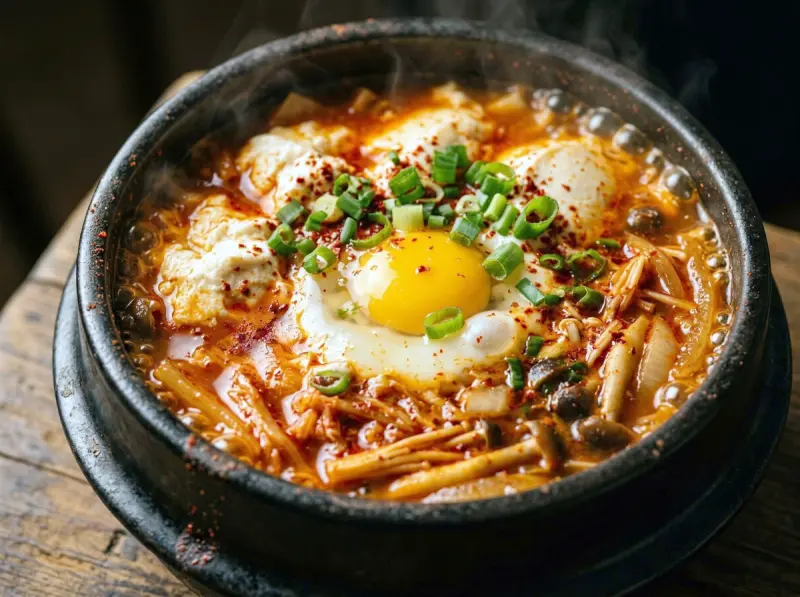
Sundubu Jjigae (Korean Soft Tofu Stew)
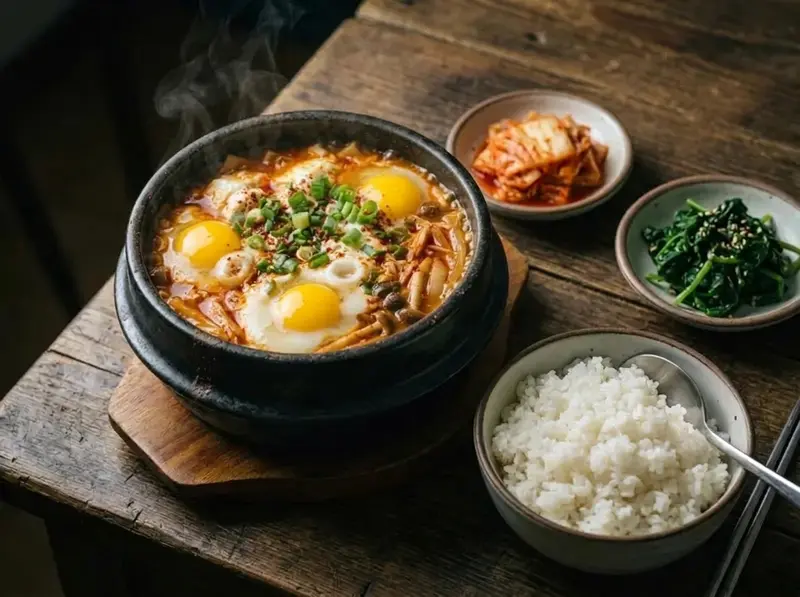
One of the most popular Korean stews: silky unpressed soft tofu (sundubu) spooned in large chunks into a fiery gochugaru-and-anchovy broth with kimchi, pork belly, zucchini, and mushrooms. Eggs are cracked into the gently boiling stew at the end and soft-set in the bubbling broth in a minute or two. The stew arrives bubbling in a clay pot (ttukbaegi), surrounded by rice and banchan. Jjigae means stew in Korean; sundubu is unpressed, extra-soft tofu. The tofu gives no flavor of its own — it is a soft, silent canvas that absorbs the intensely seasoned broth and contrasts its silkiness against the spice and the chew of pork and vegetables.
Ingredients
- 400 gsundubu
- 150 gpork belly
- 150 gwell-fermented kimchi
- 2 tbspgochugaru
- 1 tbspsesame oil
- 4 garlic cloves
- 0.5 small onion
- 1 tbspfish sauce
- 600 mlanchovy-kelp stock
- 1 small zucchini, sliced into half-moons
- 100 gmushrooms
- 4 eggs
- 2 scallions
- 1 tsptoasted sesame oil
Method
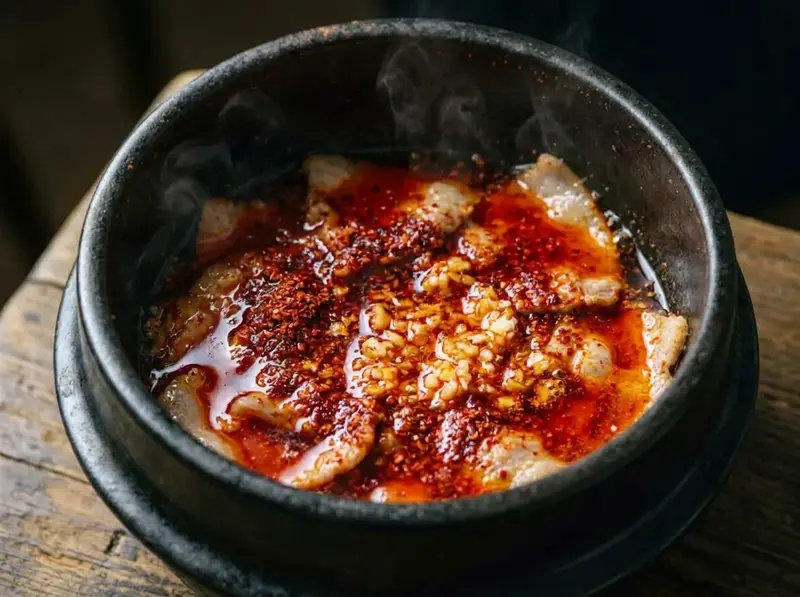
- Build the flavor base. Cut everything first: slice the pork belly into thin bite-size pieces 3–4 cm long, mince the garlic, finely chop the onion, slice the mushrooms and chop the scallions. Heat the sesame oil in a small heavy pot or ttukbaegi (earthenware pot) over medium heat. Add the pork belly and cook 2 to 3 minutes, stirring, until the fat begins to render. Add the garlic and onion and stir-fry 1 minute until fragrant. Add the gochugaru and stir vigorously for 30 seconds — the red pepper flakes bloom in the hot oil, deepening their color and flavor without burning. This step creates the characteristic red-oil base of Korean jjigae.
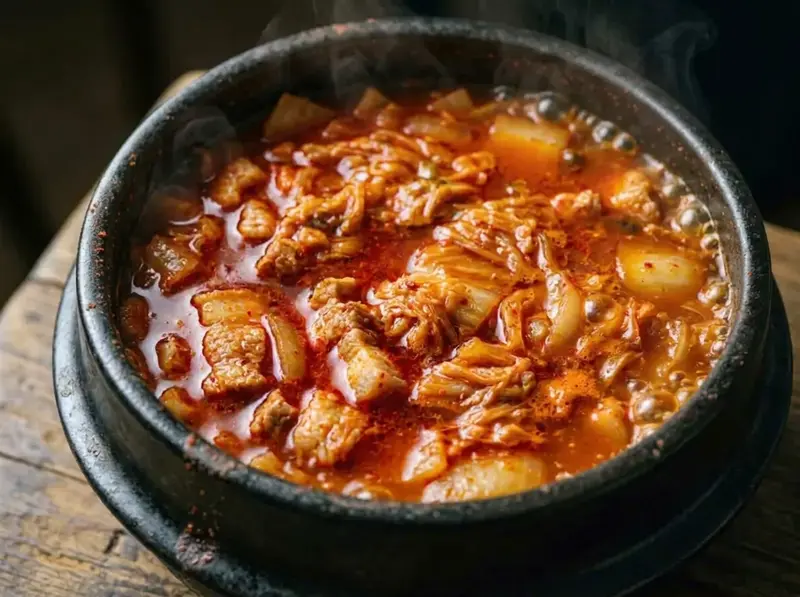
- Add kimchi and build the broth. Add the chopped kimchi and its juice. Stir and cook 2 minutes until the kimchi softens slightly and the juice evaporates. Pour in the anchovy-kelp stock. Add the fish sauce. Bring to a rolling boil over high heat. Taste the broth — it should be spicy, salty, and savory with a clear sour note from the kimchi. This is the flavor foundation; adjust fish sauce for salt.
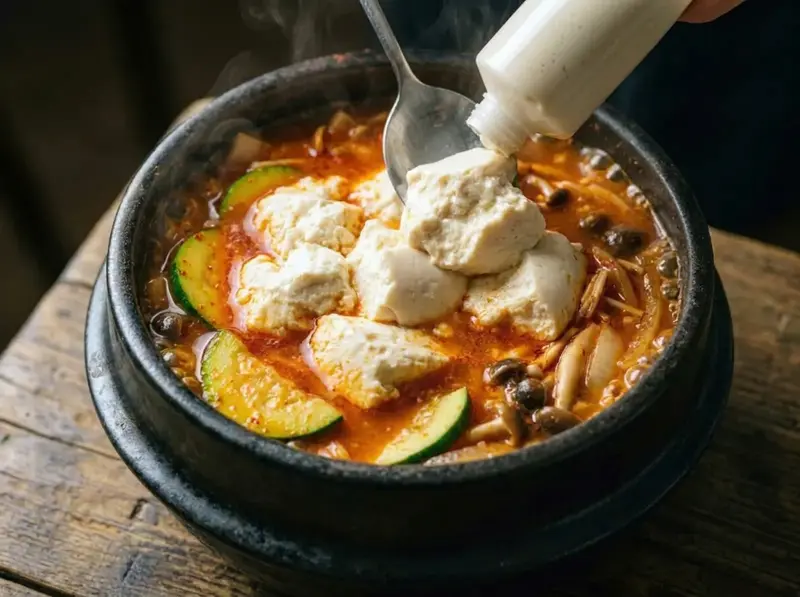
- Add vegetables and tofu. Add the zucchini and the sliced mushrooms. Simmer 3 minutes. Spoon the soft tofu directly from its container in large chunks — do not cut it in advance, and do not stir after adding. The tofu must stay in intact pieces. Simmer gently 3 to 4 minutes until the tofu is heated through. It will quiver when you shake the pot — this is correct.
- Crack the eggs and finish. Keep the stew at a gentle boil — do not take it off the heat. Crack the eggs straight into the pot, one per diner, spaced apart. Let them bubble 1 to 2 minutes without stirring, until the whites are opaque and set; the yolks stay soft. For children, pregnant women and anyone who avoids soft eggs, simmer 3 to 4 minutes, until the yolks are firm too. Scatter the chopped scallions over the top and drizzle with the toasted sesame oil. Do not stir — serve at once, eggs intact, so each diner breaks the yolk themselves.

- Serve. Bring the pot directly to the table bubbling. Serve with steamed short-grain rice alongside — jjigae is not eaten alone. Spoon the tofu and broth over rice and break the egg yolk into the broth. Eat from the shared pot, or ladle into bowls, giving each person one of the eggs.
FAQ
Sundubu (순두부) is unpressed, extra-soft tofu — the curds are never pressed or shaped into a block. It is the softest, most custardy form of tofu, with a very high water content and an almost pudding-like texture. Regular silken tofu is slightly firmer and has been set into a block form. Sundubu comes in soft, moist tubes or boxes specifically labelled 'soon tofu' or 'extra soft tofu' at Korean grocery stores. For this dish, sundubu is strongly preferred — it absorbs the broth more readily and provides the characteristic silky texture that gives the dish its name. Firm silken tofu is an acceptable substitute; firm or extra-firm tofu is not appropriate.
Kimchi is a living fermented food — over weeks and months of fermentation, the lactic acid bacteria produce more and more organic acids, dramatically increasing sourness and flavor complexity. In sundubu jjigae, that fermentation acid is what creates the characteristic tangy-sour undertone in the broth. Fresh or young kimchi (less than 2 weeks old) tastes mainly of garlic and gochugaru without the sour depth. The rule in Korean cooking: use old kimchi to cook with, young kimchi to eat fresh alongside. If you only have young kimchi, add a small splash of rice vinegar to the broth to approximate the missing acidity.
Yes. Replace the anchovy-kelp stock with dried mushroom stock (simmer dried shiitake and a piece of dried kelp in water for 20 minutes). Omit the pork belly and replace with extra mushrooms — king oyster mushrooms and shiitake are both excellent. Use soy sauce instead of fish sauce for seasoning. The kimchi must be vegan kimchi (traditional kimchi often contains fermented shrimp — vegan kimchi is made without it). The egg at the end is traditional but optional. Vegetarian sundubu jjigae made with good vegan kimchi, mushroom stock, and kelp is genuinely excellent.
Anchovy-kelp stock (myeolchi-dashima yuksu) is the standard savory base for most Korean soups and stews. To make it: remove the guts from 10 dried anchovies (flat, small silver-dried fish from Korean markets), combine with a 10 cm piece of dried kelp and 700 ml water, bring to a boil, simmer 10 minutes, and strain. It does not taste strongly of fish — it tastes savory, clean, and deep. Shortcuts: Korean anchovy stock sachets, brewed as the packet says, taste very close to homemade; Korean anchovy soup powder (myeolchi-garu) added to water; or plain water, which works but produces a noticeably thinner-tasting stew.
The egg goes in at the very end, into the still-boiling stew, so that its white sets in 1 to 2 minutes while the yolk stays soft. A soft yolk, broken into the broth and mixed with the tofu and rice, adds richness and rounds the acidity of the kimchi. An egg boiled in the stew from the start loses this effect — the white turns rubbery and the yolk dissolves into the broth instead of sitting on top of it. If you are cooking for children, pregnant women or anyone who avoids soft eggs, simmer it 3 to 4 minutes until the yolk is firm. The whole eggs arriving in the still-bubbling pot are also part of how jjigae is served.
Rate this
Recipes by email
One letter a week: a recipe picked for your taste, plus whatever is new on the site. Unsubscribe in one click.
Welcome gift: Sergei's cookbook (e-book).
By subscribing you agree to the privacy policy.
Tell us what you like to cook (30 seconds) →Keep browsing
More dishes from the Korean archive — picked by overlap with what you're cooking now.
Join the conversation
Comments (2)
The anchovy-kelp stock is what separates homemade sundubu from the restaurant-grade version. It takes 20 minutes to make and the umami it provides is irreplaceable — water or chicken stock will give you a thin, flat-tasting stew. I use about 8 dried anchovies and a palm-sized piece of kelp simmered for 15 minutes. Strain, and that broth becomes the base. The egg cracked in at the end is not decoration — stir it through and it enriches the whole bowl.
Der Eintopf ist solide, aber ich finde die Angabe "Schweinbauch oder Meeresfrüchte" zu vage. Ich habe beides probiert — mit Schweinbauch ist es deftiger und besser für den Winter, mit Garnelen leichter für den Sommer. Die Schärfe vom Gochugaru ist anders als normales Chilipulver, nicht einfach austauschen.