


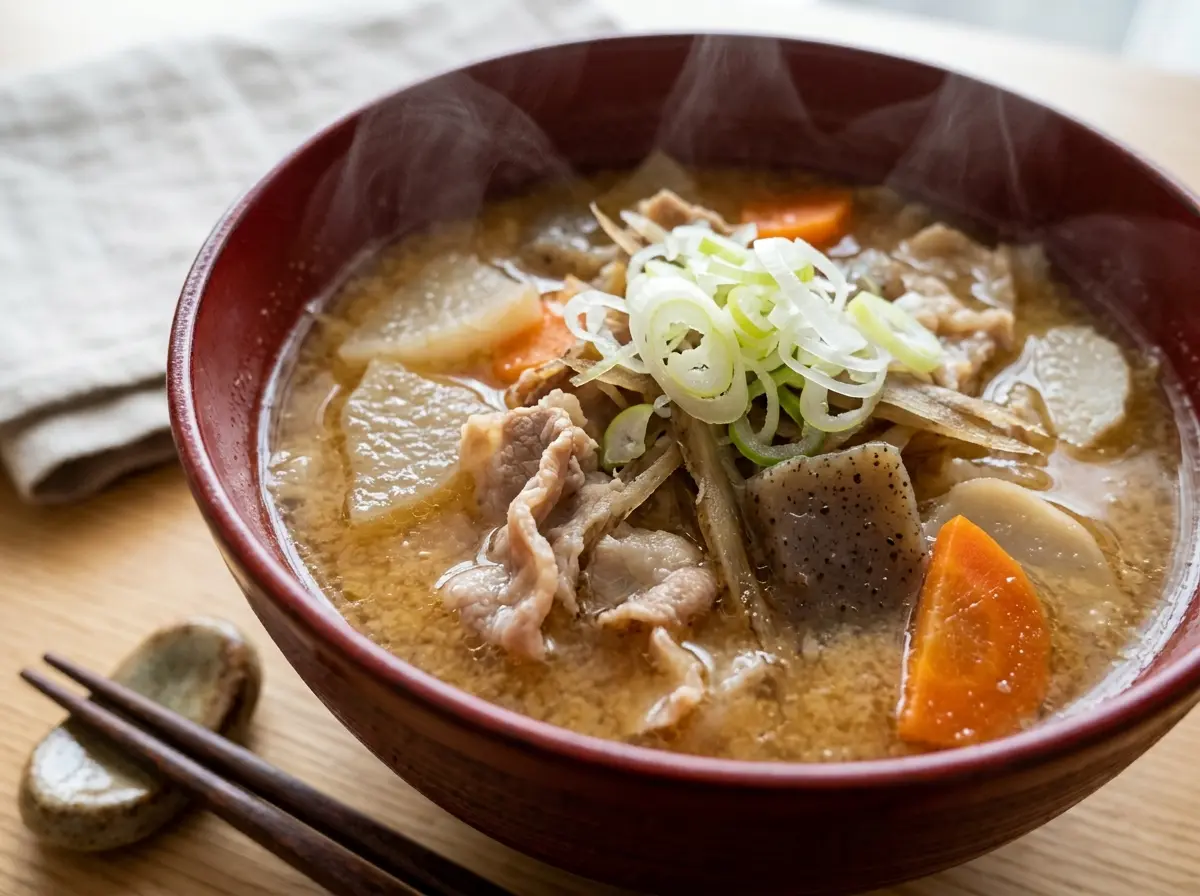
Tonjiru (Japanese Pork and Vegetable Miso Soup)
Tonjiru (豚汁, also read butajiru) is a Japanese miso soup made with pork, usually thin slices of belly, and plenty of root vegetables such as daikon, carrot, burdock root and taro, plus konnyaku and negi. The vegetables go into the pot first with a little sesame oil, the pork is laid on top, and everything simmers in dashi until a skewer slides into the taro. The miso goes in at the very end, and the pot comes off the heat before it boils. It takes about 45 minutes, 15 of them spent cutting vegetables.
What tonjiru is
Tonjiru (豚汁) is miso soup with pork and a lot of vegetables. The same characters are also read butajiru: ton and buta both mean pork, and jiru is soup. Thinly sliced pork belly is the usual meat. Daikon, carrot and burdock root turn up in every Japanese recipe we compared, negi in most of them, and konnyaku and taro in about half.
Japanese food media call it a winter staple: Gendai Business notes that beef-bowl chains and set-meal restaurants push it in the cold months. It is eaten all year, though. Pork and this many vegetables make it filling: as Just One Cookbook puts it, you only need steamed rice next to it for dinner.
Why the miso goes in last
Miso is fermented, and much of its smell comes from that. DELISH KITCHEN explains that these aroma compounds escape once miso soup boils, above about 90 °C. So Japanese cooks stir the miso in at the end and take the pot off just before it bubbles. Japanese cooks call that moment niebana.
The rule only starts once the miso is in. Before that, the vegetables and pork can boil as long as they need. Shirogohan.com, NHK's Kyou no Ryouri and Ajinomoto split the miso, half before the vegetables simmer and half at the end, so the vegetables take on its taste. This recipe adds all of it at the end.
Tonjiru, miso soup and nikujaga
Tonjiru starts from the same dashi and miso as everyday miso soup and then adds pork and root vegetables. Nikujaga works with thin-sliced beef, potato, onion and carrot, but simmers them under a drop lid in dashi with soy sauce, mirin and sugar and comes to the table as a stew in a shallow bowl with only a little broth.
Ingredients
- 80 gburdock root
- 125 gkonnyaku
- 0.5 tspsalt
- 150 gdaikon
- 60 gcarrot
- 150 gtaro
- 50 gnegi
- 160 gpork belly
- 1 tbspsesame oil
- 900 mlwater
- 1 tspdashi granules
- 4 tbspmiso paste
Method
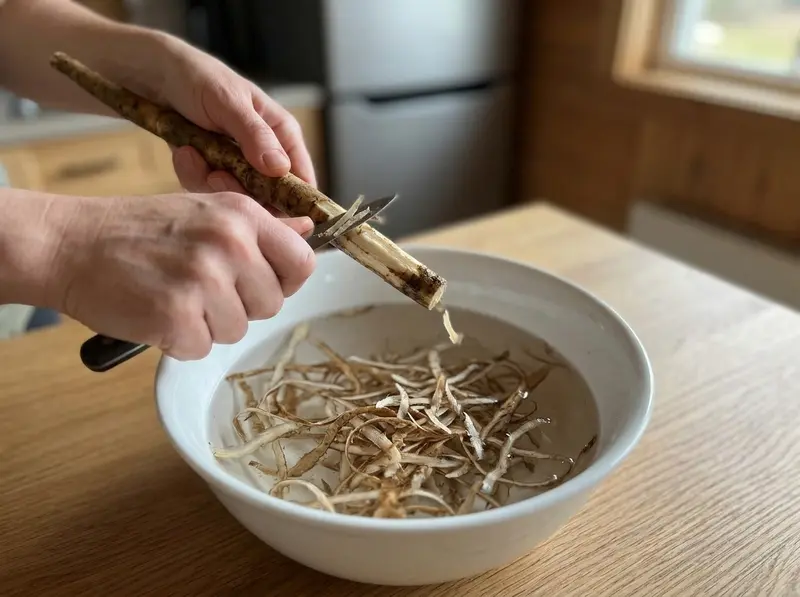
- Scrub 80 g burdock root under running water and scrape the skin off with the back of a knife instead of peeling it, because much of its flavour sits just under the skin. Shave it into thick shavings, turning the root as if you were sharpening a pencil with a knife (this cut is called sasagaki). Drop the shavings straight into a bowl of cold water so they don't darken, leave them for 5 minutes, change the water once and drain.
- Cut 125 g konnyaku into thin bite-size pieces about 5 mm thick, rub them with ¼ tsp of the salt and leave for 5 minutes, then boil for 2–3 minutes in a small saucepan of water and drain. The salt and the boiling take away its smell. While it stands, peel 150 g daikon and 60 g carrot, cut both lengthwise into quarters and slice them 5 mm thick into quarter-moons. Peel 150 g taro, slice it 1 cm thick, rub with the remaining ¼ tsp salt and rinse until it no longer feels slippery, then pat dry: slime left on the taro makes the broth slimy and the vegetables cook unevenly. Slice 50 g negi diagonally 1 cm wide and cut 160 g thinly sliced pork belly into 3 cm pieces.
- Heat 1 tbsp sesame oil in a 20 cm saucepan over medium heat. Stir-fry the burdock, drained and patted dry so it doesn't spit in the hot oil, for 2 minutes, until it smells nutty: it is the slowest vegetable to cook, and its aroma flavours the whole soup. Add the daikon, carrot and konnyaku and stir for 2 minutes until everything looks glossy with oil. Add the taro last, because it sticks, and stir for 1 more minute.
- Turn the heat down to medium-low. Lay the pork over the vegetables, pulling the slices apart, and stir gently for 2–3 minutes until the slices have turned white. Resting on the vegetables rather than on the hot bottom of the pot, the pork doesn't stick and heats slowly, so it stays tender.
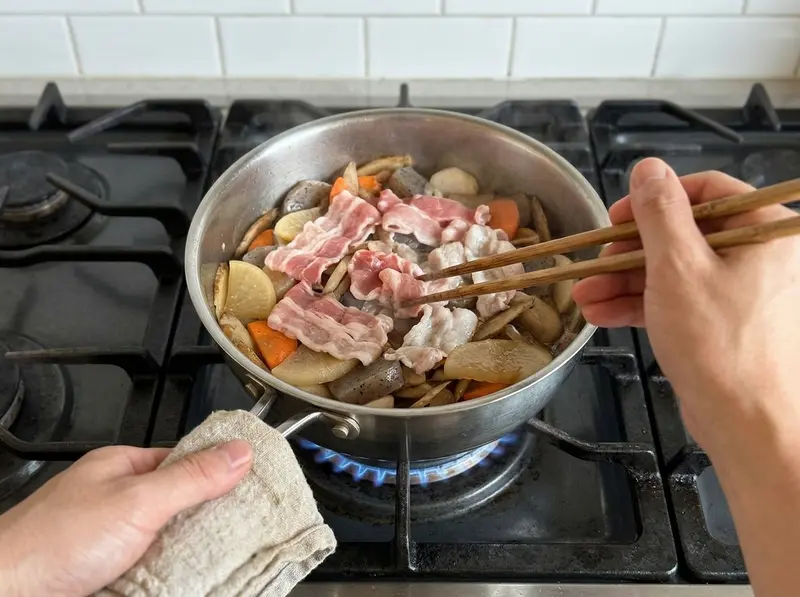
- Pour in 900 ml water, add 1 tsp dashi granules and bring to a boil over high heat, about 5 minutes. Skim off the grey foam that rises, because it spoils the taste. Turn the heat to low, set the lid ajar and simmer for 12 minutes, until a bamboo skewer slides easily into a piece of taro and a piece of daikon. By then the thin pork slices have simmered for 12 minutes and are cooked through.
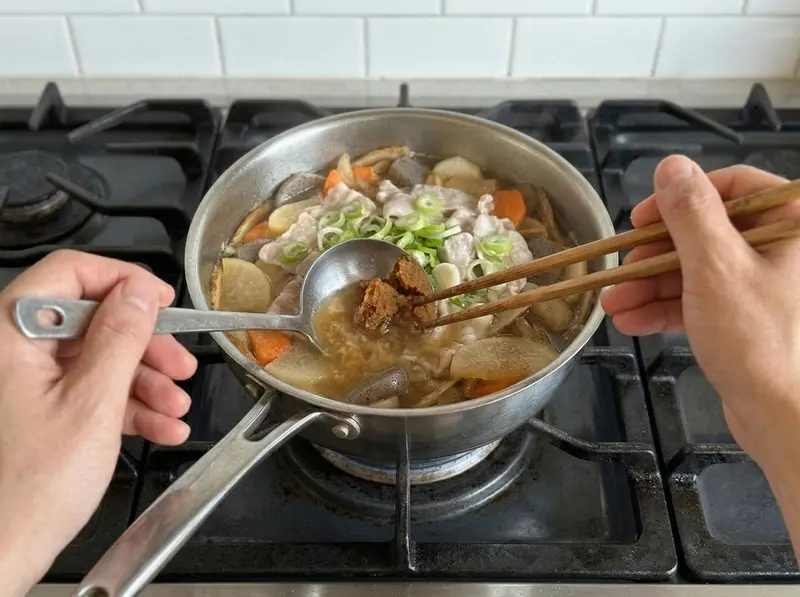
- Add the negi and simmer for 1 minute, then turn the heat to the lowest setting. Put 4 tbsp miso in a ladle, dip the ladle into the soup and break the miso up with chopsticks until it dissolves, then stir it in. Taste, and add up to 1 tbsp more if your miso is mild. Heat until the surface just starts to tremble and turn the heat off before it bubbles, because once the soup boils, the miso's aroma goes off with the steam.
- Ladle the tonjiru into 4 large soup bowls and serve at once.
Cooked it? Rate the recipe
FAQ
Both are dashi seasoned with miso. Everyday miso soup has two or three light ingredients, such as tofu and wakame, and is ready in about 15 minutes. Tonjiru adds pork belly and a pot full of root vegetables, which simmer for 12 minutes after the boil until they are soft. A bowl of tonjiru with rice is a meal, while plain miso soup sits beside one.
Both readings are right and mean the same soup. Ton and buta are two readings of the character for pork, and jiru means soup. Which one you hear depends on where you are. A map the Zenrin map company built from posts on X in December 2023 shows tonjiru across most of eastern Japan except Hokkaido and Aomori, and butajiru mainly in western Japan around Kyushu, and also in Hokkaido. Toyama and Mie also lean towards butajiru, although their neighbours say tonjiru.
For the taro, Japanese cooks often use potato. Take the same 150 g, slice it 1 cm thick, skip the salt rub and add it in step 3 where the taro goes. If you can't find burdock root, leave it out: Shirogohan.com says three or four of the vegetables are enough. It also suggests shimeji or shiitake mushrooms, added with the daikon in step 3. Kikkoman's recipe uses shiitake alongside the burdock.
Here all 4 tbsp go in at the end, the way Just One Cookbook, Kikkoman and the miso maker Marukome do it. Much of miso's aroma comes from fermentation and escapes once the soup boils, above about 90 °C, so after the miso is in, the pot is heated only until the surface trembles. Some Japanese cooks, among them Shirogohan.com, NHK's Kyou no Ryouri and Ajinomoto, stir in half the miso before the vegetables simmer so they take on its taste, and add the rest at the end. Either way, the last of the miso should not boil.
Cool it and put it in the fridge within 2 hours of cooking, then eat it within 3–4 days. Reheat only what you need: bring the leftovers just to a boil, take the pot off the heat and stir in a spoonful of fresh miso to bring the aroma back. It freezes for up to 1 month. Just One Cookbook advises taking out the konnyaku first, and the potatoes if you used them instead of taro, because their texture changes. Thaw it overnight in the fridge.
Keep browsing
More dishes from the Japanese archive — picked by overlap with what you're cooking now.




Recipes by email
One letter a week: a recipe picked for your taste, plus whatever is new on the site. You can stop the letters in one click.
Welcome gift: Sergei's cookbook (e-book).
By signing up for the newsletter you agree to the privacy policy.
Tell us what you like to cook (30 seconds) →
Join the conversation
Comments
No comments yet — be the first!