Thailand · Cereal and Pasta Dishes
Pad Thai
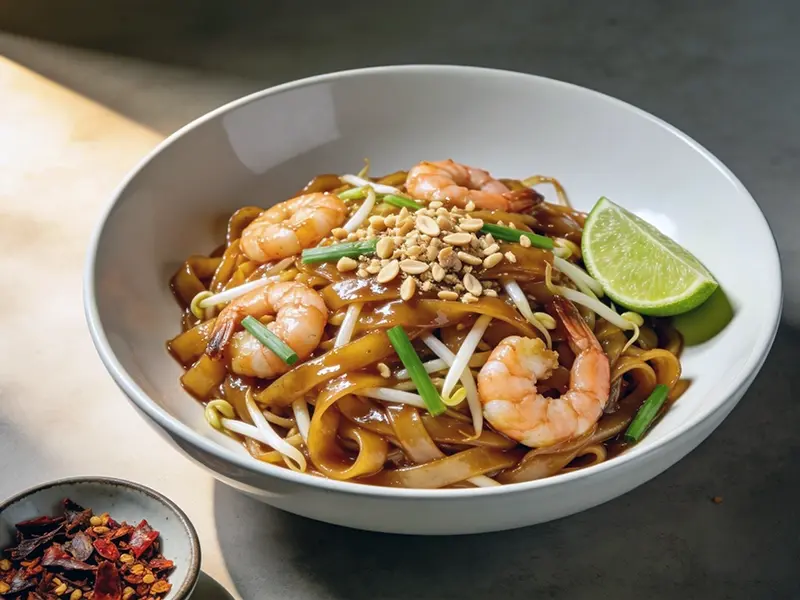
Stir-fried rice noodles with egg, bean sprouts, peanuts, and your choice of protein — shrimp, chicken, or tofu — in a sauce built on tamarind, fish sauce, and palm sugar.
Ingredients
- dried flat rice noodles, medium-width200 g
- protein: raw shrimp, chicken breast, or firm tofu200 g
- large eggs2
- bean sprouts100 g
- scallions, cut into 3 cm lengths3
- neutral oil3 tbsp
- garlic cloves3
- shallot1
- tamarind concentrate / paste3 tbsp
- fish sauce2 tbsp
- palm sugar or light brown sugar1 tbsp
- roasted peanuts40 g
- lime1
- dried chilli flakes or ground dried chilli1 tsp
Method
- 1Prepare the sauce and noodles. Mix the tamarind concentrate, fish sauce, and palm sugar together in a small bowl. Stir until the sugar dissolves. Taste: it should be intensely sour, salty, and sweet simultaneously — not balanced in a mild way, but aggressively so. This is correct: it will dilute once it hits the noodles. Adjust to taste, adding more tamarind for sour, fish sauce for salty, or sugar for sweet. Set aside. Soak the rice noodles in room-temperature water for 20 to 30 minutes until pliable but not fully soft — they should still have some resistance when bent. Drain well. Do not boil them or soak in hot water — they continue softening in the wok and overcooked noodles are the most common Pad Thai problem.
- 2Cook the protein. Heat 1.5 tablespoons of oil in a wok or large heavy pan over high heat until just smoking. Add the protein in a single layer and cook without stirring until it colors on the first side — 30 to 60 seconds for shrimp, 60 to 90 seconds for chicken. Then toss and cook until done: shrimp pink and opaque right through, chicken white throughout and 74°C in the thickest piece on a thermometer, tofu golden on both sides. Remove from the wok and set aside. The wok must be extremely hot for Pad Thai: if the protein stews rather than sears, the whole dish will be steam-cooked and flat. If your wok is small, cook the protein in two batches rather than overloading.
- 3Stir-fry aromatics and noodles. Add the remaining oil to the hot wok. Add the garlic and shallot and stir for 20 seconds until fragrant. Add the drained noodles and toss. Pour the sauce over the noodles and toss continuously for 1 to 2 minutes over high heat, letting the sauce caramelize slightly and coat the noodles. The noodles should soften completely at this stage, absorbing the sauce. If they are still too firm, add a tablespoon or two of water and toss more. If the sauce looks dry and the noodles are sticking, a small splash of water loosens everything.
- 4Add eggs and scramble. Push the noodles to one side of the wok. Add the eggs to the cleared space and leave for 10 to 15 seconds until the edges begin to set, then break them up with a spatula, scrambling them loosely — they should remain in larger, soft pieces rather than fine crumbles. Before they are fully set, fold the noodles back over the eggs and toss everything together. The egg should coat the noodles in soft, golden streaks rather than cooking into a solid omelette. Return the protein to the wok and toss to combine.
- 5Finish and serve. Remove from heat. Fold in the bean sprouts and most of the spring onions — they go in off the heat so they stay crisp. Divide into bowls. Serve immediately with chopped peanuts scattered over the top, remaining spring onions, lime wedges on the side, and dried chilli flakes in a small dish at the table. The lime is not optional — squeezing it over just before eating is part of the dish, not a garnish. Pad Thai is always served with the table condiments on the side so each person can adjust sweet, sour, salty, and heat to their own taste.