
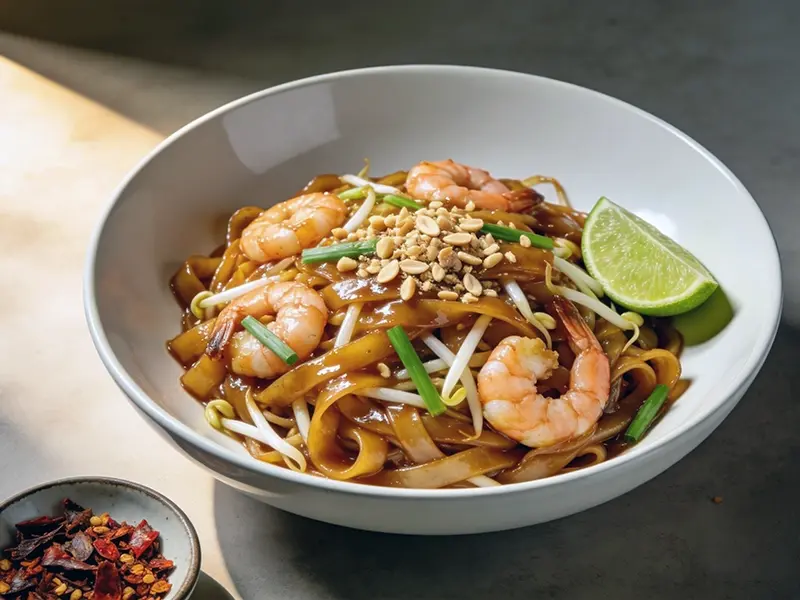
Pad Thai
Stir-fried rice noodles with egg, bean sprouts, peanuts, and your choice of protein — shrimp, chicken, or tofu — in a sauce built on tamarind, fish sauce, and palm sugar. The three-part balance of sour, salty, and sweet is what makes Pad Thai distinct from any other noodle dish in the world. It is one of Thailand's most iconic street foods, eaten at vendors across Bangkok and virtually every Thai restaurant globally. The sauce is the whole recipe — get the sauce right and the rest is quick. Two rules matter most: cook in small batches so the wok stays hot enough to caramelize the sauce, and never overcook the noodles.
Ingredients
- 200 gdried flat rice noodles, medium-width
- 200 gprotein: raw shrimp, chicken breast, or firm tofu
- 2 large eggs
- 100 gbean sprouts
- 3 scallions, cut into 3 cm lengths
- 3 tbspneutral oil
- 3 garlic cloves
- 1 shallot
- 3 tbsptamarind concentrate / paste
- 2 tbspfish sauce
- 1 tbsppalm sugar or light brown sugar
- 40 groasted peanuts
- 1 lime
- 1 tspdried chilli flakes or ground dried chilli
Method
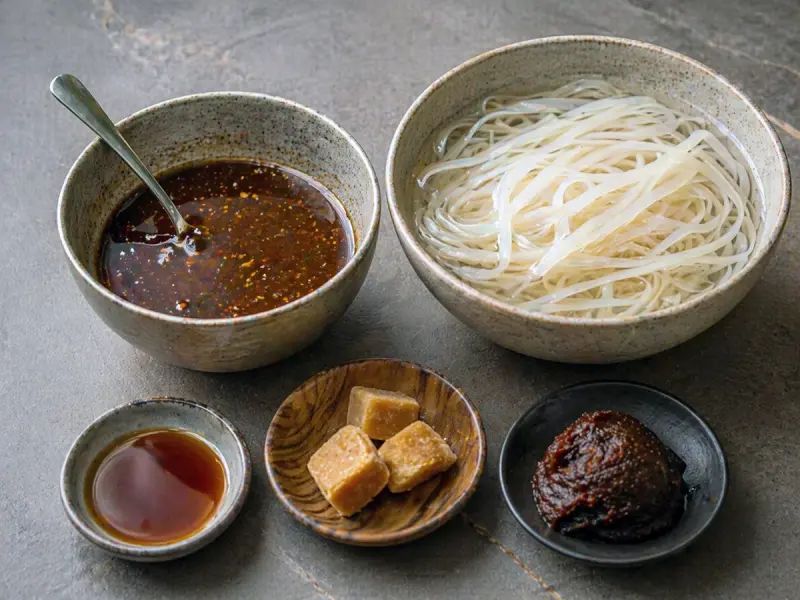
- Prepare the sauce and noodles. Mix the tamarind concentrate, fish sauce, and palm sugar together in a small bowl. Stir until the sugar dissolves. Taste: it should be intensely sour, salty, and sweet simultaneously — not balanced in a mild way, but aggressively so. This is correct: it will dilute once it hits the noodles. Adjust to taste, adding more tamarind for sour, fish sauce for salty, or sugar for sweet. Set aside. Soak the rice noodles in room-temperature water for 20 to 30 minutes until pliable but not fully soft — they should still have some resistance when bent. Drain well. Do not boil them or soak in hot water — they continue softening in the wok and overcooked noodles are the most common Pad Thai problem.
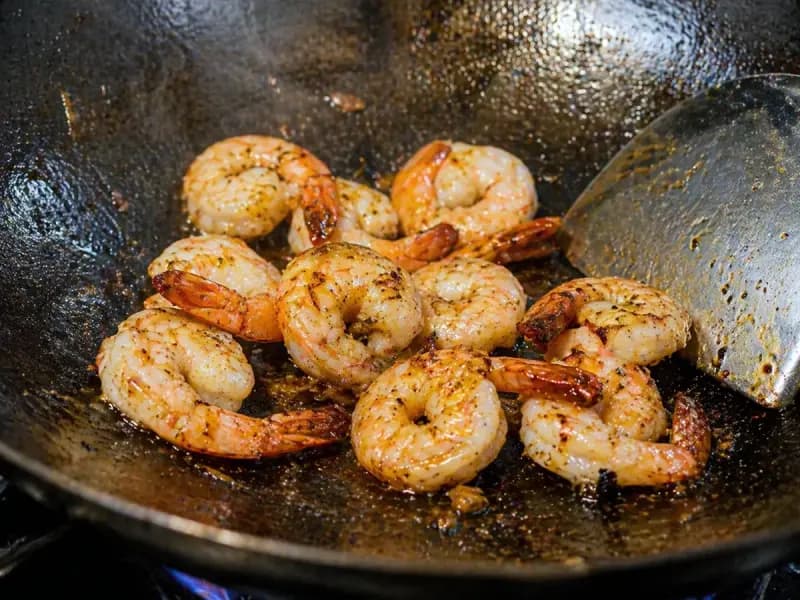
- Cook the protein. Heat 1.5 tablespoons of oil in a wok or large heavy pan over high heat until just smoking. Add the protein in a single layer and cook without stirring until it colors on the first side — 30 to 60 seconds for shrimp, 60 to 90 seconds for chicken. Then toss and cook until done: shrimp pink and opaque right through, chicken white throughout and 74°C in the thickest piece on a thermometer, tofu golden on both sides. Remove from the wok and set aside. The wok must be extremely hot for Pad Thai: if the protein stews rather than sears, the whole dish will be steam-cooked and flat. If your wok is small, cook the protein in two batches rather than overloading.
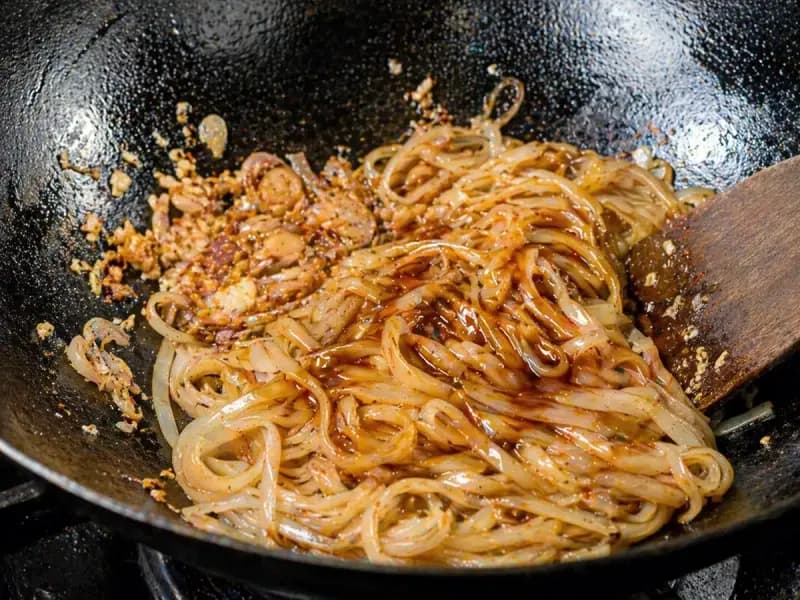
- Stir-fry aromatics and noodles. Add the remaining oil to the hot wok. Add the garlic and shallot and stir for 20 seconds until fragrant. Add the drained noodles and toss. Pour the sauce over the noodles and toss continuously for 1 to 2 minutes over high heat, letting the sauce caramelize slightly and coat the noodles. The noodles should soften completely at this stage, absorbing the sauce. If they are still too firm, add a tablespoon or two of water and toss more. If the sauce looks dry and the noodles are sticking, a small splash of water loosens everything.
- Add eggs and scramble. Push the noodles to one side of the wok. Add the eggs to the cleared space and leave for 10 to 15 seconds until the edges begin to set, then break them up with a spatula, scrambling them loosely — they should remain in larger, soft pieces rather than fine crumbles. Before they are fully set, fold the noodles back over the eggs and toss everything together. The egg should coat the noodles in soft, golden streaks rather than cooking into a solid omelette. Return the protein to the wok and toss to combine.
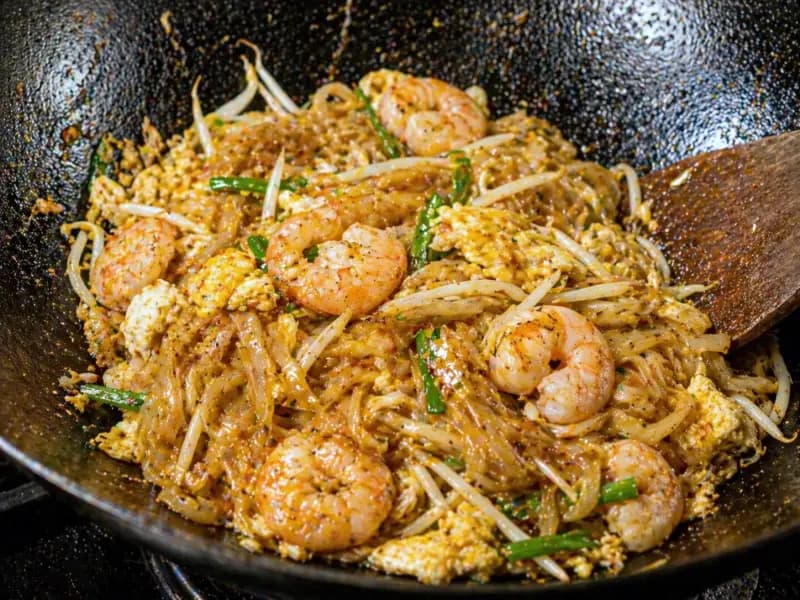
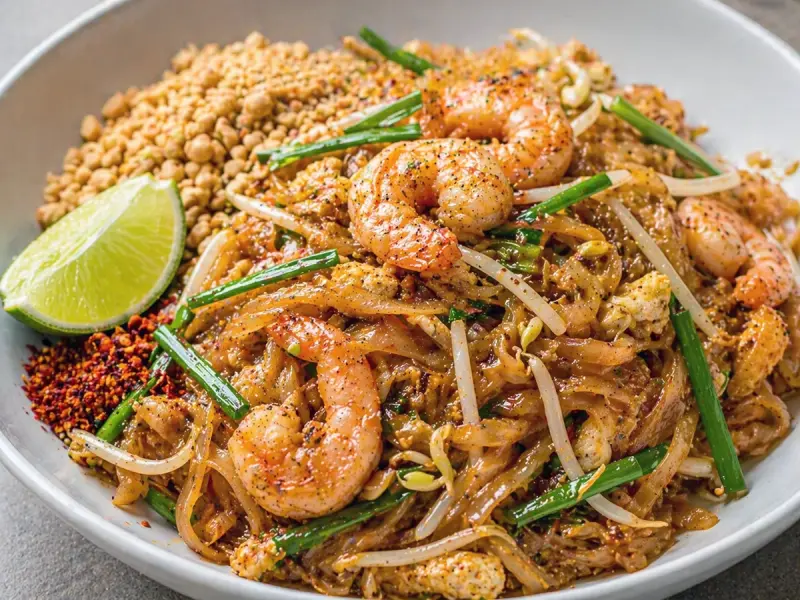
- Finish and serve. Remove from heat. Fold in the bean sprouts and most of the spring onions — they go in off the heat so they stay crisp. Divide into bowls. Serve immediately with chopped peanuts scattered over the top, remaining spring onions, lime wedges on the side, and dried chilli flakes in a small dish at the table. The lime is not optional — squeezing it over just before eating is part of the dish, not a garnish. Pad Thai is always served with the table condiments on the side so each person can adjust sweet, sour, salty, and heat to their own taste.
FAQ
Three ingredients in balance: tamarind (sour), fish sauce (salty and umami), and palm sugar (sweet). Each must be present and the balance must be intense — not subtly flavoured but aggressively so. The sauce should taste too strong by itself; it is designed to season the noodles, not to be eaten alone. The most common mistake is making the sauce too mild, resulting in bland noodles. Palm sugar has a deeper, slightly caramel flavor compared to white sugar; light brown sugar is the best substitute. Thai tamarind concentrate (from Thailand or Vietnam) is a pourable brown liquid, different from Indian tamarind concentrate which is thicker and stronger.
The noodles were either oversoaked before cooking or the wok was not hot enough. Soak dried rice noodles in room-temperature water, not boiling, until just pliable — they should still have some resistance. They continue softening in the wok. If the wok temperature is too low, the noodles steam instead of frying, becoming sticky and clumped. The fix: higher heat and smaller batches. If they clump during cooking, add a small splash of water and toss vigorously — this breaks them up.
Yes. Replace fish sauce with soy sauce (use slightly less as soy is less complex) or a dedicated vegan fish sauce made from seaweed. Replace shrimp or chicken with extra-firm tofu, pressed and cubed, pan-fried until golden before adding to the wok. The egg can be omitted for a vegan version. The resulting dish is slightly less umami-rich but still excellent, particularly with good tofu that has been properly seared.
Medium-width flat rice noodles, approximately 3 to 5 mm wide — sometimes labelled 'rice stick noodles' or 'banh pho'. These are thick enough to hold the sauce without falling apart and thin enough to cook quickly in the wok. Wider noodles (pad see ew width, around 1 to 2 cm) produce a different texture. Very thin rice vermicelli will not work for Pad Thai — too delicate and will break down completely.
Traditionally Pad Thai is served with a standard table condiment set: a small dish of dried chilli flakes, white sugar, fish sauce, and sometimes white vinegar with fresh chilli. Each person adjusts their own bowl at the table. This is standard at every Pad Thai stall in Thailand. At home: set out lime wedges (essential), dried chilli flakes, extra peanuts, and fresh coriander or Thai basil if available. The dish is complete as cooked but the lime particularly should always be added at the table.
Rate this
Recipes by email
One letter a week: a recipe picked for your taste, plus whatever is new on the site. Unsubscribe in one click.
Welcome gift: Sergei's cookbook (e-book).
By subscribing you agree to the privacy policy.
Tell us what you like to cook (30 seconds) →Keep browsing
More dishes from the Thai archive — picked by overlap with what you're cooking now.

Join the conversation
Comments (3)
タイ料理だけどこのレシピは本格的。ナンプラーの量は好みで調整した方がいいです。最初は少なめがおすすめ
Люди жарят пад тай в сковороде на средней мощности и жалуются, что получилось не как в Бангкоке. Конечно не как в Бангкоке — там вок раскалён до адских температур. Дома жарьте маленькими порциями на максимальном огне. И тамаринд — это не кетчуп, не надо его заменять.
I tested this recipe with 6 different brands of tamarind paste and the results varied wildly. The thick, dark block tamarind you soak and strain yourself gives the best flavour — the ready-made concentrate in a jar works but needs about 30% more to get the same sourness. If your pad thai tastes flat, it almost always needs more tamarind, not more fish sauce.