France · Breakfast and Brunch
French Pain au Chocolat (Authentic Yeasted Laminated Chocolate Pastry)
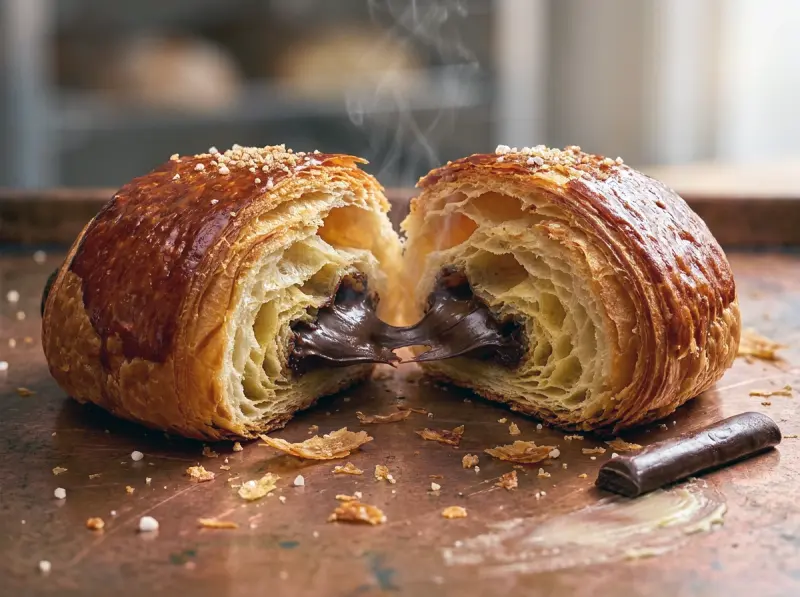
Pain au chocolat (literally 'chocolate bread' in French) is the classic French viennoiserie: a rectangle of yeasted laminated dough wrapped around two dark chocolate batons, baked until deep golden with a flaky exterior…
Ingredients
- bread flour250 g
- whole milk125 ml
- water25 ml
- instant yeast5 g
- granulated sugar25 g
- honey10 g
- salt5 g
- eggs2
- unsalted butter165 g
- dark chocolate batons80 g
Method
- 1Day 1 evening — make the base dough (détrempe). In the bowl of a stand mixer with dough hook, combine 250 g bread flour, 25 g sugar, 5 g salt, 5 g instant yeast, 10 g honey, 125 ml cold whole milk, 25 ml cold water, and 1 egg (reserve the second egg for egg wash on Day 3). Mix on low speed until ingredients form a shaggy mass, about 3 minutes. Add 15 g softened unsalted butter and increase to medium speed. Knead 8-10 minutes until smooth, elastic, and pulling away from the bowl. The dough should be slightly tacky but not sticky. Cover with plastic and let rest at room temperature for 1 hour for bulk fermentation. Then transfer to refrigerator overnight (8-16 hours) — this cold ferment develops flavor and makes the dough easier to laminate.
- 2Day 2 morning — prepare the butter block (beurre de tourage). Take 150 g cold unsalted butter (preferably 82-84% fat European-style: Lurpak, Plugrá, Kerrygold, Président, Isigny, or Échiré) from the fridge. Place between two sheets of parchment paper. Pound with a rolling pin until pliable, then roll into a 15×15 cm square, about 1 cm thick. Square edges with a bench scraper. Wrap and return to fridge for 15 minutes — the butter should be cold but still pliable (10-15°C), not rigid. If too hard, it will crack during lamination; if too soft, it will melt into the dough.
- 3Lock the butter in (envelope method). Take the rested dough from the fridge and roll into a 22×22 cm square on a lightly floured surface. Place the butter square at a 45-degree angle in the center (like a diamond inside the square). Fold each of the four dough corners to meet in the center, completely enclosing the butter. Pinch seams to seal. The dough now looks like a square envelope with butter inside. Rotate 90 degrees and roll gently into a rectangle 20×40 cm, working from the center outward, keeping the butter even.
- 4First and second folds (tours simples). Perform a letter fold: bring the bottom third up, then fold the top third down over it (like folding a letter). You now have three layers. Rotate 90 degrees so the open seam is on the right. Wrap in plastic and rest in the fridge for 30 minutes — this lets gluten relax and butter re-solidify, critical for clean layers. Roll out again to a 20×40 cm rectangle, perform a second letter fold, rotate 90 degrees, wrap, and rest 30 minutes in the fridge.
- 5Third fold and shape. Roll the dough out once more to a 20×40 cm rectangle and perform the third letter fold (81 layers total — 3³ = 27 butter layers across 3 dough layers). Rest 30 minutes in the fridge. Now roll the laminated dough into a rectangle of about 30×42 cm, 5 mm thick. Trim the edges with a sharp knife or pizza wheel to a clean 28×40 cm. Cut it across the middle into two strips of 20×28 cm, then cut each strip into 4 pieces 7 cm wide — 8 rectangles of 7×20 cm. Place 1 chocolate baton at the short edge of each rectangle, roll forward 2 cm, place a second baton, then continue rolling until the pastry forms a tight log with the seam underneath. Place seam side DOWN on a parchment-lined baking sheet, with 5 cm space between each. Cover loosely with plastic and refrigerate overnight (8-12 hours) for slow cold proof.
- 6Day 3 morning — final proof. Remove the baking sheet from the fridge and let the pastries proof at 24-26°C for 1,5-2 hours, until almost doubled in size and visibly puffy. Test: gently press the side — the dough should slowly spring back, not bounce fast (under-proofed) or stay indented (over-proofed). If your kitchen is cool, use the oven with the light on (no heat) and a cup of just-boiled water on the bottom rack to create a warm humid environment. Around 30 minutes before baking, preheat the oven to 190°C (375°F) — convection mode if available.
- 7Egg wash and bake. Whisk the remaining egg with 1 tablespoon milk and a pinch of salt in a small bowl. Using a soft pastry brush, lightly coat each pain au chocolat — including the spiral end, but avoid the cut layers (egg wash on cut edges glues layers together, preventing rise). Don't let egg wash puddle. Bake on the middle rack at 190°C for 18 minutes, rotating the sheet halfway through. The pastries are done when deeply golden brown all over, with visible flaky 'ear' patterns and a hollow sound when tapped underneath. Internal temperature 88-93°C confirms doneness.
- 8Cool and serve. Transfer pastries to a wire rack and cool for at least 10 minutes — chocolate inside is molten, eating immediately can burn the mouth. Best eaten warm within 4-6 hours of baking. Serve with café au lait, espresso, hot chocolate, or a glass of Champagne brut for special brunch. Pain au chocolat is a French breakfast staple but also a beloved afternoon snack (goûter). Store leftovers at room temperature wrapped loosely in paper for up to 2 days; freeze baked or unbaked (shaped) for longer storage.