
French Pain au Chocolat (Authentic Yeasted Laminated Chocolate Pastry)
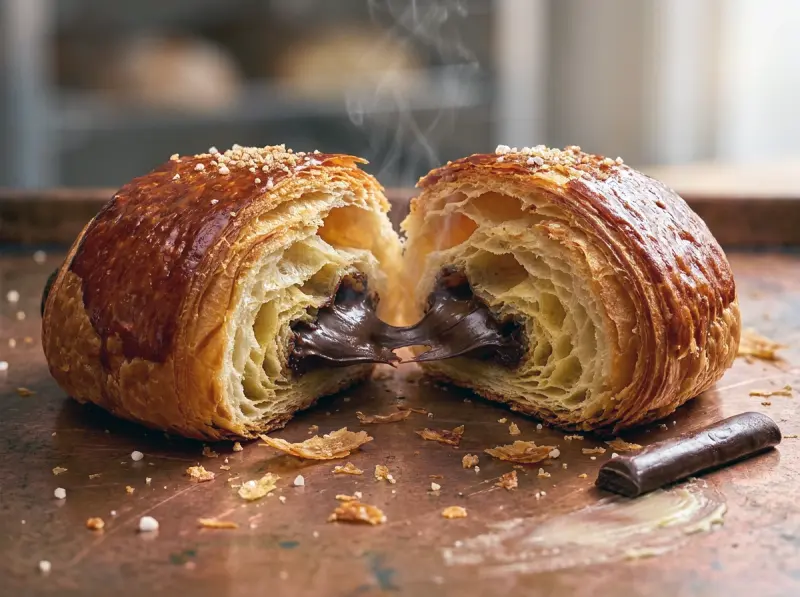
Pain au chocolat (literally 'chocolate bread' in French) is the classic French viennoiserie: a rectangle of yeasted laminated dough wrapped around two dark chocolate batons, baked until deep golden with a flaky exterior and soft bread-like interior with visible honeycomb structure. One of the most iconic French pastries, alongside the croissant — same dough, different shape. History: Austrian officer August Zang and aristocrat Ernest Schwarzer opened Boulangerie Viennoise at 92 rue de Richelieu in Paris in 1839, introducing Viennese pastries to France. The pastry started life on brioche dough, evolving to today's pâte feuilletée levée (yeasted laminated dough) by the late 19th century. Naming controversy: pain au chocolat (north and central France) versus chocolatine (southwestern France — Bordeaux, Toulouse, Pays Basque, also Quebec). Never called 'chocolate croissant' in France — that's an English misnomer. Active prep 60 minutes, total timeline 24-48 hours with overnight rests. Makes 8 pastries. Best eaten warm, the same morning, with café au lait or espresso.
Ingredients
- 250 gbread flour
- 125 mlwhole milk
- 25 mlwater
- 5 ginstant yeast
- 25 ggranulated sugar
- 10 ghoney
- 5 gsalt
- 2 eggs
- 165 gunsalted butter
- 80 gdark chocolate batons
Method
- Day 1 evening — make the base dough (détrempe). In the bowl of a stand mixer with dough hook, combine 250 g bread flour, 25 g sugar, 5 g salt, 5 g instant yeast, 10 g honey, 125 ml cold whole milk, 25 ml cold water, and 1 egg (reserve the second egg for egg wash on Day 3). Mix on low speed until ingredients form a shaggy mass, about 3 minutes. Add 15 g softened unsalted butter and increase to medium speed. Knead 8-10 minutes until smooth, elastic, and pulling away from the bowl. The dough should be slightly tacky but not sticky. Cover with plastic and let rest at room temperature for 1 hour for bulk fermentation. Then transfer to refrigerator overnight (8-16 hours) — this cold ferment develops flavor and makes the dough easier to laminate.
- Day 2 morning — prepare the butter block (beurre de tourage). Take 150 g cold unsalted butter (preferably 82-84% fat European-style: Lurpak, Plugrá, Kerrygold, Président, Isigny, or Échiré) from the fridge. Place between two sheets of parchment paper. Pound with a rolling pin until pliable, then roll into a 15×15 cm square, about 1 cm thick. Square edges with a bench scraper. Wrap and return to fridge for 15 minutes — the butter should be cold but still pliable (10-15°C), not rigid. If too hard, it will crack during lamination; if too soft, it will melt into the dough.
- Lock the butter in (envelope method). Take the rested dough from the fridge and roll into a 22×22 cm square on a lightly floured surface. Place the butter square at a 45-degree angle in the center (like a diamond inside the square). Fold each of the four dough corners to meet in the center, completely enclosing the butter. Pinch seams to seal. The dough now looks like a square envelope with butter inside. Rotate 90 degrees and roll gently into a rectangle 20×40 cm, working from the center outward, keeping the butter even.

- First and second folds (tours simples). Perform a letter fold: bring the bottom third up, then fold the top third down over it (like folding a letter). You now have three layers. Rotate 90 degrees so the open seam is on the right. Wrap in plastic and rest in the fridge for 30 minutes — this lets gluten relax and butter re-solidify, critical for clean layers. Roll out again to a 20×40 cm rectangle, perform a second letter fold, rotate 90 degrees, wrap, and rest 30 minutes in the fridge.
- Third fold and shape. Roll the dough out once more to a 20×40 cm rectangle and perform the third letter fold (81 layers total — 3³ = 27 butter layers across 3 dough layers). Rest 30 minutes in the fridge. Now roll the laminated dough into a rectangle of about 30×42 cm, 5 mm thick. Trim the edges with a sharp knife or pizza wheel to a clean 28×40 cm. Cut it across the middle into two strips of 20×28 cm, then cut each strip into 4 pieces 7 cm wide — 8 rectangles of 7×20 cm. Place 1 chocolate baton at the short edge of each rectangle, roll forward 2 cm, place a second baton, then continue rolling until the pastry forms a tight log with the seam underneath. Place seam side DOWN on a parchment-lined baking sheet, with 5 cm space between each. Cover loosely with plastic and refrigerate overnight (8-12 hours) for slow cold proof.

- Day 3 morning — final proof. Remove the baking sheet from the fridge and let the pastries proof at 24-26°C for 1,5-2 hours, until almost doubled in size and visibly puffy. Test: gently press the side — the dough should slowly spring back, not bounce fast (under-proofed) or stay indented (over-proofed). If your kitchen is cool, use the oven with the light on (no heat) and a cup of just-boiled water on the bottom rack to create a warm humid environment. Around 30 minutes before baking, preheat the oven to 190°C (375°F) — convection mode if available.
- Egg wash and bake. Whisk the remaining egg with 1 tablespoon milk and a pinch of salt in a small bowl. Using a soft pastry brush, lightly coat each pain au chocolat — including the spiral end, but avoid the cut layers (egg wash on cut edges glues layers together, preventing rise). Don't let egg wash puddle. Bake on the middle rack at 190°C for 18 minutes, rotating the sheet halfway through. The pastries are done when deeply golden brown all over, with visible flaky 'ear' patterns and a hollow sound when tapped underneath. Internal temperature 88-93°C confirms doneness.

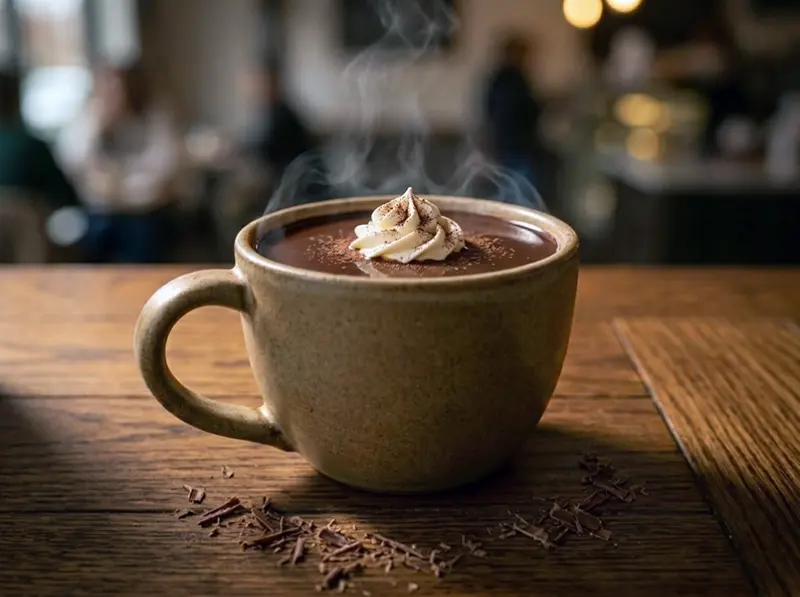
- Cool and serve. Transfer pastries to a wire rack and cool for at least 10 minutes — chocolate inside is molten, eating immediately can burn the mouth. Best eaten warm within 4-6 hours of baking. Serve with café au lait, espresso, hot chocolate, or a glass of Champagne brut for special brunch. Pain au chocolat is a French breakfast staple but also a beloved afternoon snack (goûter). Store leftovers at room temperature wrapped loosely in paper for up to 2 days; freeze baked or unbaked (shaped) for longer storage.
FAQ
Pain au chocolat (literally 'chocolate bread' in French) is a classic French viennoiserie: a rectangle of yeasted laminated dough wrapped around two dark chocolate batons. One of the most iconic French pastries, alongside the croissant. History: the concept of laminated viennoiserie came from Austria, not France. The Austrian kipferl (crescent-shaped bread) had been on Viennese tables for centuries. In 1839 Austrian officer August Zang and aristocrat Ernest Schwarzer opened Boulangerie Viennoise at 92 rue de Richelieu in Paris — the first Viennese bakery in France. They brought the technique of dough enriched with butter and milk. French bakers quickly adopted it and added lamination (folding butter into dough through repeated turns), giving birth to both the croissant and pain au chocolat. Originally (mid-19th century) both pastries were made from brioche dough — enriched yeast dough without lamination. By the late 19th to early 20th century the form evolved to today's pâte feuilletée levée (yeasted laminated dough). The term viennoiserie literally means 'things from Vienna' — applied to buttery breakfast pastries: croissant, pain au chocolat, pain aux raisins, chausson aux pommes, brioche, kouign-amann (though the last is Breton, not Viennese in origin). Croissant vs pain au chocolat: same dough, different shapes. Croissant is cut into triangles and rolled into a crescent; pain au chocolat is cut into 7×20 cm rectangles and wrapped around two chocolate batons. NEVER call pain au chocolat a 'chocolate croissant' in France — a common foreigner mistake. Cédric Grolet, top Parisian pâtissier (Le Meurice, Opéra), Vogue France essay: 'If you ask for a chocolate croissant in a boulangerie, the baker will gently correct you to pain au chocolat.' Naming controversy — pain au chocolat versus chocolatine: regional standoff in France. Northern France (Paris, Lyon, Lille, Marseille): pain au chocolat — mainstream. Southwestern France (Bordeaux, Toulouse, Bayonne, Pays Basque, Aquitaine, Gascogne, Béarn): chocolatine — local tradition. Theory 1: 'chocolatine' from Anglo-French — in the 14th century the Black Prince Edward of Woodstock ruled Aquitaine, English speakers asked for 'chocolate in' (with chocolate inside) → French ear heard 'chocolatine'. Theory 2: Spanish/Portuguese influence via Bordeaux trade. In 2019 a bill was even proposed in the Assemblée Nationale (rejected) to recognize 'chocolatine' as southwestern French heritage food. Modern popularity: pain au chocolat is a staple French breakfast (petit-déjeuner), often with café au lait or espresso. Also popular as goûter (afternoon snack at 4 PM, especially with schoolchildren). Entered brunch culture in the US, UK, Australia in the 2000s-2010s. Equivalents: Belgian pain au chocolat identical; Italian cornetto al cioccolato — related (but cornetto is sweet enriched, slightly different from croissant); American 'chocolate croissant' — incorrect term, often refers to puff-pastry shortcut (NOT authentic).
This question has history, regional politics, and technical nuance. Short answer: in France it's either pain au chocolat (mainstream) or chocolatine (southwestern French regional). 'Chocolate croissant' is an English mistake, not used in France. Technically all three names describe one and the same pastry — rectangular yeasted laminated dough with two dark chocolate batons. Regional distribution in France: (1) Pain au chocolat: dominant in northern and central France — Paris, Lille, Lyon, Marseille, Nantes, Strasbourg, Normandy, Brittany, most of the country. About 75-80% of France uses this name. (2) Chocolatine: dominant in southwestern France — Bordeaux, Toulouse, Bayonne, Pays Basque, Aquitaine, Gascogne, Béarn, parts of Limousin. Also Quebec, Canada — French colonial heritage. (3) Also: Belgian French — pain au chocolat; Switzerland — pain au chocolat; Languedoc-Roussillon has pockets of 'croissant au chocolat' (an outdated usage). How 'chocolate croissant' differs: this is an English-language convention for tourists and Anglophones that does NOT exist in France. When an American or British speaker asks for 'chocolate croissant', the French baker corrects to pain au chocolat. However in American bakeries 'chocolate croissant' is often sold — it can mean: (a) authentic pain au chocolat — same recipe, wrong name; (b) shortcut with puff pastry (NOT authentic) — laminated dough without yeast, gives crispy without soft interior; (c) modification with chocolate chips instead of batons — uneven distribution, harden after cooling. Etymology of 'chocolatine': Theory 1 (popular): in the 14th century Aquitaine was ruled by the Black Prince Edward of Woodstock (Anglo-Aquitaine governor under King Edward III). English speakers asked for 'chocolate in' → French ear heard 'chocolatine'. Romantic story but unverifiable. Theory 2: from Spanish 'chocolatín' or Portuguese 'chocolatinho' (small chocolate) via Bordeaux trade routes. Theory 3: simple diminutive — 'chocolat' + suffix '-ine', a French naming pattern for small chocolate-containing food. Political importance: chocolatine = southwestern French identity and pride. Ordering pain au chocolat in a Toulouse boulangerie is taken as slightly dismissive — locals insist on chocolatine. In Bordeaux you may hear: 'c'est une chocolatine, monsieur, pas un pain au chocolat'. In 2019 deputy Aurélien Pradié from Lot proposed a bill recognizing 'chocolatine' as southwestern French regional heritage food — rejected by the Assemblée Nationale, but cultural debate continues. Correct term for a recipe: French-authentic recipe — 'pain au chocolat' or 'chocolatine' depending on regional audience. English-language recipes: 'pain au chocolat' is international standard and most accurate. 'Chocolate croissant' is for clarifying that the pastry has chocolate (informal use), but technically wrong. In Quebec — chocolatine is the standard. Summary: in France — pain au chocolat (north) or chocolatine (southwest); outside France (English-speaking) — pain au chocolat correct, 'chocolate croissant' informal misnomer; in Quebec — chocolatine.
Lamination is the defining technique of authentic pain au chocolat, and understanding it separates the real thing from shortcut impostors. What lamination is: the process of incorporating a butter block (beurre de tourage) into a base dough (détrempe) through repeated folds and rolling. Each fold creates a layer of butter + a layer of dough. After 3 folds (standard) you get 81 layers (3³ = 27 butter layers across 3 dough layers per fold). Each layer is about 0.1-0.2 mm thick. What yeasted laminated dough (pâte feuilletée levée) is: a unique combination of two techniques: (1) Lamination (like puff pastry — layered butter) + (2) Yeast leavening (like bread). This gives a two-stage rise in the oven: (a) Yeast creates CO2 → bubbles inside dough → soft bread-like interior; (b) Butter melts in layers → steam escapes → puffs layers up → crispy flaky exterior. Critical distinction — yeasted laminated vs puff pastry: Puff pastry = laminated dough WITHOUT yeast. Contains only flour + butter + water + salt. Result: crispy flaky shell, hollow internal layers, NO soft bread interior. Used for vol-au-vents, tarte tatin tops, palmiers. Yeasted laminated dough (croissant/pain au chocolat dough) = laminated dough WITH yeast. Result: flaky outside + soft bread-like inside — the honeycomb structure visible on the cross-section. What happens if you use puff pastry for pain au chocolat: you get a flaky shell around chocolate, but no soft bread interior. Wrong texture — too crispy throughout, no 'melting' middle, dries out fast. Shortcut recipes with store-bought puff pastry are NOT authentic pain au chocolat, as The Flavor Bender and other French-trained bakers emphasize. Butter temperature is critical: butter must be cold but pliable (10-15°C) — too hot melts into dough (butter leaking during baking); too cold shatters during rolling (uneven layers). Sweet spot: butter out of fridge for 15-30 minutes at room temperature before locking in. Fold technique — three schools: (1) Letter fold (tour simple): rectangle divided into 3 parts, fold top third over → bottom third under → like a letter in an envelope. Multiplies layers ×3 per fold. 3 single folds → 81 layers. Standard for pain au chocolat. (2) Book fold (tour double): ends folded to center → folded in half → like a closed book. Multiplies layers ×4 per fold. 2 book + 1 single = 96 layers. Used when more layers are needed. (3) Combination: 2 single + 1 book for balance. Rest between folds — critical: 30 minutes in fridge between each fold — lets gluten relax (dough less stretchy on next roll) AND butter re-solidify (no melting and leaking). Skip rest = poor lamination. 3 folds vs 4 folds: 3 folds = 81 layers — Cédric Grolet, classic French boulangerie. Balance of flakiness and lift. 4 folds = 256 layers — King Arthur, even more flaky, but thinner layers, can be slightly drier. Most home bakers stick with 3 folds. Visual signs of good lamination after baking: (a) Cross-section shows honeycomb pattern — many small irregular air pockets with distinct butter layers between. (b) Surface — golden brown with visible 'ear' pattern (concentric layer lines). (c) Texture — peels apart in distinct flaky shards (you can 'shatter' the layer). (d) Interior — soft, bread-like, slightly chewy, NOT hollow. Common lamination mistakes: (1) Butter leaking: during rolling butter pushes through dough → tear → leak during baking. Fix: rest longer in fridge, roll evenly. (2) Butter breaking: cold rigid butter shatters → uneven layers → tough texture. Fix: warm butter slightly before lock-in. (3) Squished layers: over-rolled or too thin → layers merge → dense interior, no rise. Fix: roll gently, don't go thinner than 5 mm before fold. (4) Lost honeycomb structure: under-proofed, over-proofed, or butter melted into dough. Fix: proof carefully (judge by volume, not time alone). Pro lamination tips: work in cool kitchen (below 22°C ideal); marble counter holds cold well; refrigerate dough between folds even if it seems firm — 30 min minimum; use high-fat butter 82-84%+ (European/dry butter), 80% butter has more water = leaking; final proof temperature 24-26°C critical — too cold = under-proof, too warm = butter melts.
Pain au chocolat is one of the most technical viennoiseries, and home baker failures are common. Full diagnostic guide: (1) Butter leaking during baking — most common failure: butter escapes from dough and creates a pool on the baking sheet. Cause: (a) Butter too soft/warm during lamination — melted into dough instead of staying separate. (b) Butter too cold/rigid — shattered during rolling, created gaps. (c) Uneven butter distribution — some spots torn. (d) Over-proofed — butter melted from excessive warmth. Fix: butter temperature 10-15°C during lamination; rest 30 min in fridge after each fold; use high-fat butter 82-84%+ (European-style: Lurpak, Plugrá, Kerrygold, Président, Isigny, Échiré); roll gently, don't press through; proof at controlled 24-26°C, not warmer. (2) Dense interior / no honeycomb structure: cross-section shows solid dense dough instead of distinct layers with air pockets. Cause: lost lamination (butter merged with dough); over-rolled (layers compressed); insufficient folds (1-2 instead of 3); under-proofed final proof; tear in dough during lamination. Fix: maintain butter integrity — keep cold, work fast; don't roll thinner than 5 mm before each fold; complete 3 folds with proper rest; final proof until doubled and puffy — judge by sight, not time (usually 1.5-2 hours at 26°C). Gentle press — dough should slowly spring back, not bounce fast (under) or stay indented (over). (3) Pale color — no golden top: bake looks anemic, no golden brown shine. Cause: egg wash too sparse or forgotten; oven temperature too low; no honey in dough (honey aids Maillard reaction); wrong rack position. Fix: egg wash properly: 1 egg + 1 tbsp milk + pinch of salt, brush lightly, no puddles. Salt aids browning. Bake at 190°C minimum, 220°C for aggressive crisp. Add 10 g honey to dough (Cédric Grolet trick). Middle rack or slightly upper third for top browning. (4) Soggy bottom: top golden but underside damp/pale. Cause: underbaked; silicone mat insulates; cold oven at start; too much steam. Fix: bake longer (additional 3-5 minutes); parchment paper on light-colored baking sheet — not silicone mat; preheat oven fully (15-20 minutes); don't crowd oven — air circulation important; convection oven works wonderfully for even baking. (5) Pain au chocolat unraveling during baking: spiral roll separates, chocolate falls out. Cause: seam side up instead of down; under-rolled — not tight enough; too much chocolate — overstuffed. Fix: always seam side DOWN on baking sheet; roll tightly with slight downward pressure; 2 chocolate batons standard — not 3; light pressure on top after shaping flattens slightly, helps stability. (6) Chocolate burning / bitter taste: chocolate over-cooked, bitter notes develop. Cause: wrong chocolate type (low quality); over-baked; chocolate exposed at edges. Fix: use dark chocolate batons 55-65% — Valrhona, Cacao Barry, Callebaut. Not chips (harden), not milk chocolate (too sweet). Watch baking time — 15-20 minutes maximum. Ensure chocolate fully enclosed in dough. (7) Under-proofed pain au chocolat: dense, heavy, no rise, very chewy. Cause: final proof too short; too cold final proof environment; dough too cold going in oven. Fix: proof at 24-26°C for 1.5-2 hours. Test: dough almost doubled, slightly puffy, indent springs back slowly. If cold kitchen, use proof box (oven with light on, or microwave with steaming cup of water inside). Bring shaped pains au chocolat to room temperature 30 min before baking if just out of fridge. (8) Over-proofed pain au chocolat: collapsed structure, flat after baking, butter leaked excessively. Cause: final proof too long or too warm. Fix: watch by sight, not just time. Less is more — slightly under-proof is better than over. (9) Doughy interior: center remains wet/raw despite golden exterior. Cause: oven temp too high — exterior cooks before interior; pain au chocolat too thick; insufficient bake time. Fix: lower temp slightly (175-190°C); roll dough thinner before shaping; internal temp 88-93°C — use instant-read thermometer; bake longer. (10) Lopsided/irregular shape: pain au chocolat baked uneven, one side puffier. Cause: uneven rolling; uneven oven heat. Fix: use ruler/templates for consistent cuts; rotate baking sheet halfway through. General troubleshooting checklist: butter quality (84%+ ideal); cool kitchen (below 22°C); rest periods 30 min between folds; proof temp 24-26°C controlled; bake 190-220°C 15-20 min, golden brown; internal temp 88-93°C confirms doneness.
Pain au chocolat is a 3-day process for maximum quality, and there are multiple ways to make components ahead. Optimal 3-day timeline (Le Cordon Bleu / The Flavor Bender method): Day 1 (evening): make dough → 1 hour bulk ferment at room temperature → cover, refrigerate overnight 8-16 hours (long cold ferment develops flavor). Day 2 (morning-afternoon): prepare butter block → lock butter in dough → do 3 letter folds with 30-minute fridge rests between each → roll out final dough → cut and shape pains au chocolat → arrange on parchment-lined baking sheet → cover loosely with plastic → fridge overnight 8-12 hours. Day 3 (morning): final proof at 24-26°C for 1.5-2 hours → brush egg wash → bake 190°C for 18 minutes (or 220°C 5 min + 175°C 13 min for extra color). Serve warm. Fast timeline (1-day, less optimal): make dough → 1 hour bulk ferment → 30 min freezer (rapid chill) → laminate (3 folds with 30 min fridge rests) → shape → 1.5-2 hour proof → bake. Possible but dough harder to work, flavor less developed, layers slightly less defined. 2-day timeline (compromise): Day 1: dough + lamination + shape; Day 2: final proof + bake. Works well, slightly less developed flavor than 3-day. Make-ahead storage options: (1) Shaped, unbaked pains au chocolat in fridge: up to 24 hours. Cover loosely with plastic — too tight = no proof room. Pull from fridge 30 min before final proof, then proof and bake. Most common make-ahead method. (2) Shaped, unbaked in freezer: up to 1 month. Place shaped pains au chocolat on parchment, freeze on baking sheet until solid (~2 hours), transfer to zip-bag. To bake: thaw in fridge overnight, then bring to room temp 30 min, final proof 2 hours, egg wash, bake as usual. Time-saver for weekend brunches — Friday shape + freeze, Sunday bake. (3) Baked pains au chocolat — room temperature: wrap loosely in paper/cloth, store at room temp 1-2 days. Not plastic — traps moisture, makes soggy. (Texture of fresh is best — pain au chocolat 'refreshed' in oven for day 2 gives decent quality). (4) Baked in fridge: avoid — fridge dries and stales bread quickly. Use freezer instead. (5) Baked in freezer: wrap individually in plastic + foil, freeze up to 2 months. Reheating: (a) Best: oven 175°C 5-7 minutes — restores crisp exterior, warms chocolate. Lightly cover with foil first 3 minutes to prevent burning. (b) Toaster oven: 4-5 minutes at 175°C. Works well. (c) Air fryer: 3-4 minutes at 175°C — fast and restores crisp. (d) NEVER microwave: softens crisp, makes chocolate hot but soggy exterior. (e) From frozen baked: place directly in 175°C oven 8-10 minutes. Don't thaw — frozen pain au chocolat refreshes better than thawed. Optimal storage protocol: bake morning of consumption if possible — pain au chocolat best within 4-6 hours of baking. Day 2 still good with reheat. Day 3+ significantly stale, recommend freeze instead. Day-after refreshing: pain au chocolat from yesterday — sprinkle slightly with water, oven 5 min at 175°C — revives nicely. Make-ahead components separately (advanced): (a) Butter block: prepare, wrap, refrigerate 2-3 days or freeze 1 month. Thaw in fridge overnight before use. (b) Détrempe (base dough): make, fridge up to 48 hours. (c) Chocolate batons: store dry, room temp indefinitely. Variations to prep ahead: (1) Pain au chocolat amande: brush shaped pain au chocolat with frangipane before chocolate, sprinkle sliced almonds onto egg wash before baking. Almond cream can be made 3 days ahead. (2) Sourdough levain pain au chocolat: use levain instead of commercial yeast — flavor more complex, longer fermentation (24-36 h cold). Levain needs separate maintenance. (3) Twice-baked pain au chocolat: day-old, sliced in half, brushed with rum syrup (50/50 sugar/water + splash of rum), filled with frangipane, sprinkled with almonds, baked 175°C 15 minutes — almond croissant style. Common make-ahead mistakes: freezing baked then microwaving — texture ruined; not bringing shaped frozen back to room temp before proof — uneven rise; storing baked in plastic bag — traps moisture, soggy; reheating too high — burns chocolate, dries pastry; forgetting egg wash before baking — pale result. Best practice for daily consumption: make full batch on Sunday, freeze unbaked shaped pieces, bake 2-3 at a time on weekday mornings — fresh viennoiserie every day with minimal effort.
Rate this
Recipes by email
One letter a week: a recipe picked for your taste, plus whatever is new on the site. Unsubscribe in one click.
Welcome gift: Sergei's cookbook (e-book).
By subscribing you agree to the privacy policy.
Tell us what you like to cook (30 seconds) →Keep browsing
More dishes from the French archive — picked by overlap with what you're cooking now.
Join the conversation
Comments
No comments yet — be the first!