France · Breakfast and Brunch
French Pain Perdu (Classic French Toast — The Original Lost Bread)
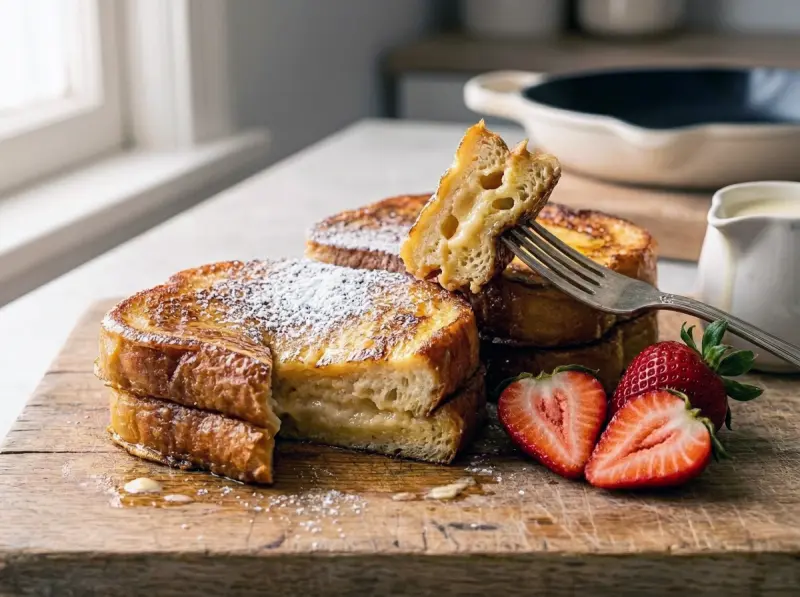
Pain perdu — literally 'lost bread' in French — is the classic French dish that turns stale bread into a custardy, golden treat: thick slices of day-old brioche or country bread soaked in a rich custard of eggs, milk…
Ingredients
- day-old brioche8 slice
- eggs4
- whole milk250 ml
- heavy cream100 ml
- granulated sugar50 g
- vanilla extract1 tsp
- orange zest1 tbsp
- unsalted butter50 g
- salt1 pinch
- powdered sugar2 tbsp
Method
- 1Prepare the bread. Use 8 thick slices, about 2.5 cm each, of day-old brioche (or country bread / batard / pain de mie / day-old baguette). The bread must be stale — fresh bread disintegrates in custard and turns into mush. If your brioche is still soft, slice it and leave the slices uncovered on a wire rack overnight, or dry them in a 100°C oven for about 10 minutes, turning once. Thickness matters: much thinner and the slice dries out or breaks, much thicker and the centre stays wet.
- 2Make the custard. In a wide shallow dish (a 23×33 cm baking dish works well), whisk together 4 large eggs, 250 ml whole milk, 100 ml heavy cream, 50 g granulated sugar, 1 teaspoon vanilla extract, 1 tablespoon orange zest, and a pinch of salt until completely smooth — but stop before foaming, you want custard texture, not eggy fluff. Optionally add 1 tablespoon of Calvados, Grand Marnier, Cognac, or Armagnac. Milk and cream at roughly 2.5 to 1 (250 ml to 100 ml) give the right texture: pure milk is stodgy, pure cream is too heavy.
- 3Soak the bread. Place brioche slices in the custard in a single layer (work in batches if needed). For brioche: 2–3 seconds per side only — brioche disintegrates with longer soaks; the slice should feel heavy and wet at the surface but still hold its shape. For day-old country bread or batard: 30 seconds to 1 minute per side. For very stale baguette: 1–2 minutes per side. Test for country bread and baguette: gently squeeze the slice — custard should bead up on the surface (1–2 drops) but not gush out. Transfer soaked slices to a wire rack to let excess custard drip off for about 30 seconds.
- 4Brown the butter. Heat a large non-stick skillet or cast iron pan over medium heat. Add half the butter (about 25 g) and swirl as it melts. Wait for it to foam and just start smelling nutty (beurre noisette stage) — about 1 minute. Use butter rather than oil: it is what gives pain perdu its nutty, caramelized crust. The foaming stage means the pan is hot enough; bread added to merely melted (not foaming) butter goes greasy.
- 5Pan-fry the slices. Place 4 soaked slices in the foaming butter without crowding (they need space to brown). Cook 2–3 minutes per side until deeply golden brown with a glossy caramelized crust — flip once carefully with a thin spatula (brioche is fragile). The exterior should look almost like crème brûlée crust, with crisp edges. The slice is done when the centre feels set and springs back when pressed, with no liquid custard seeping out (71°C in the middle if you check). If the crust darkens before that, lower the heat. Wipe out the pan and add the remaining butter for the second batch (old butter darkens and turns bitter).
- 6Keep warm if needed. If serving all 4 portions at once, hold cooked slices in a 100°C oven on a wire rack set over a baking sheet (rack prevents soggy bottoms). Holds well for up to 15 minutes; longer and the crisp exterior softens. Best served straight from the pan.
- 7Plate and dust with powdered sugar. Place 2 slices per plate, slightly overlapping. Just before serving, dust generously with powdered sugar through a small sieve, the classic French finish. Optionally add fresh berries (strawberries, raspberries, blueberries), sautéed apples with Calvados, a drizzle of salted butter caramel (caramel au beurre salé), or a small pour of crème anglaise.
- 8Serve immediately. Pain perdu is best straight from the pan — crisp exterior softens within 15–20 minutes. Pair with café au lait, hot chocolate, champagne (brunch), or a glass of Sauternes (dessert). In France this is mostly a dessert or a goûter (the afternoon snack), but nothing stops you serving it at breakfast. Knife and fork, French style. Garnish with extra orange zest if desired.