

French Pain Perdu (Classic French Toast — The Original Lost Bread)
Pain perdu — literally 'lost bread' in French — is the classic French dish that turns stale bread into a custardy, golden treat: thick slices of day-old brioche or country bread soaked in a rich custard of eggs, milk, cream, sugar, and vanilla, then pan-fried in butter to a crisp caramelized exterior with a soft jiggly interior. This is the French original behind what Americans know as French toast. Origins go back to Ancient Rome (Apicius's 'De re coquinaria', ~25 BC, known then as pain romain), with the modern French form codified by the 17th century under King Henry IV (1589-1610), a known fan who elevated the frugal peasant dish into aristocratic territory. In France today, pain perdu is typically served as dessert or afternoon snack (goûter), not breakfast — that's an American convention. Authentic toppings are powdered sugar, fresh berries, sautéed apples with Calvados, or crème anglaise. Cinnamon and maple syrup are American additions. Active 20 minutes. Serves 4 (two slices each).
Ingredients
- 8 sliceday-old brioche
- 4 eggs
- 250 mlwhole milk
- 100 mlheavy cream
- 50 ggranulated sugar
- 1 tspvanilla extract
- 1 tbsporange zest
- 25 gunsalted butter
- 1 pinchsalt
- 2 tbsppowdered sugar
Method
- Prepare the bread. Use 8 thick slices (2-2.5 cm) of day-old brioche (or country bread / batard / pain de mie / day-old baguette). The bread MUST be stale — fresh bread disintegrates in custard and turns into mush. If your brioche is still soft, slice it and leave the slices uncovered on a wire rack for 30 minutes, or dry briefly in a 100°C oven for 10 minutes. Slice thickness is critical: thinner than 2 cm and the centre dries out; thicker than 3 cm and the centre stays undercooked.
- Make the custard. In a wide shallow dish (9x13 inch baking dish works perfectly), whisk together 4 large eggs, 250 ml whole milk, 100 ml heavy cream, 50 g granulated sugar, 1 teaspoon vanilla extract, 1 tablespoon orange zest, and a pinch of salt until completely smooth — but stop before foaming, you want custard texture, not eggy fluff. Optionally add 1 tablespoon of Calvados, Grand Marnier, Cognac, or Armagnac for traditional French depth (this is the historical Henry IV touch). Milk and cream at roughly 2.5 to 1 (250 ml to 100 ml) give the right texture: pure milk is stodgy, pure cream is too heavy.

- Soak the bread. Place brioche slices in the custard in a single layer (work in batches if needed). For brioche: 2-3 seconds per side only — brioche disintegrates with longer soaks. For day-old country bread or batard: 30 seconds to 1 minute per side. For very stale baguette: 1-2 minutes per side. The bread should feel saturated through but still hold its shape. Test: gently squeeze the slice — custard should bead up on the surface (1-2 drops) but not gush out. Transfer soaked slices to a wire rack to let excess custard drip off for 30 seconds.
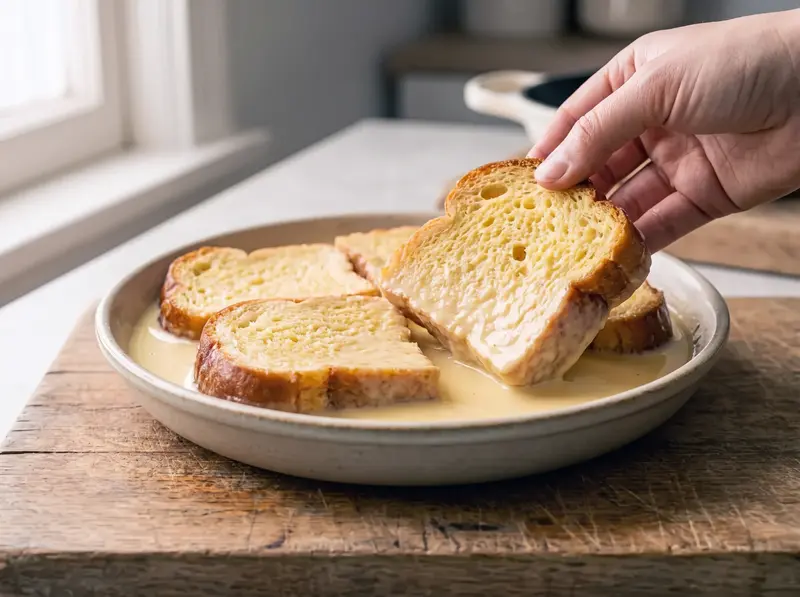
- Brown the butter. Heat a large non-stick skillet or cast iron pan over medium heat. Add 2 tablespoons of the unsalted butter and swirl as it melts. Wait for it to foam and just start smelling nutty (beurre noisette stage) — about 1 minute. Butter is non-negotiable here: French pain perdu is fried in butter, not oil. Seed oils give wrong flavour, margarine doesn't toast. The mousse-foam stage means the pan is hot enough; bread added to merely melted (not foaming) butter goes greasy.
- Pan-fry the slices. Place 3-4 soaked slices in the foaming butter without crowding (need space for browning). Cook 2-3 minutes per side until deeply golden brown with a glossy caramelized crust — flip once carefully with a thin spatula (brioche is fragile). The exterior should look almost like crème brûlée crust, with crisp edges. Repeat with remaining slices, adding fresh butter to the pan between batches (regenerate butter — old butter darkens to bitter brown).

- Keep warm if needed. If serving all 4 portions at once, hold cooked slices in a 100°C oven on a wire rack set over a baking sheet (rack prevents soggy bottoms). Holds well for up to 15 minutes; longer and the crisp exterior softens. Best served straight from the pan.
- Plate and dust with powdered sugar. Place 2 slices per plate, slightly overlapping. Just before serving, dust generously with powdered sugar through a small sieve — this is the authentic French finish, the canonical topping. Optionally add fresh berries (strawberries, raspberries, blueberries), sautéed apples with Calvados, a drizzle of caramel beurre salé, or a small pour of crème anglaise. AVOID cinnamon (American addition, not traditional) and heavy maple syrup pours (American convention).
- Serve immediately. Pain perdu is best straight from the pan — crisp exterior softens within 15-20 minutes. Pair with café au lait, hot chocolate, champagne (brunch), or a glass of Sauternes (dessert). In France this is served as dessert or goûter (afternoon snack at 4 PM), not breakfast — but adapt to your meal context. Knife and fork, French style. Garnish with extra orange zest if desired.
FAQ
Pain perdu (lost bread in French) is the classic French dish: stale bread slices soaked in a custard of eggs, milk, cream, sugar, and vanilla, then pan-fried in butter to a golden crisp exterior and custardy-soft interior. This is the original behind American French toast. History: the concept of soaking bread in egg and frying it goes back to Ancient Rome — Marcus Gavius Apicius in De re coquinaria (~25 BC) described aliter dulcia with stale bread, milk, and honey, fried in olive oil. In France the dish was once called pain romain (Roman bread). The modern French form solidified by the 17th century — King Henry IV (1589-1610) was a known fan and elevated the peasant frugal dish to aristocratic territory by adding cream and vanilla. Main differences from American French toast: (1) Bread — pain perdu requires stale crusty bread (batard, country loaf, brioche, day-old baguette); American French toast often uses soft sandwich bread that remains eggy on the surface. (2) Custard — pain perdu uses milk + cream (here 250 ml to 100 ml) + vanilla + sometimes Calvados/Armagnac; American is often just milk + cinnamon. (3) Cinnamon and maple syrup are American additions, NOT traditional in France; French pain perdu more often uses orange zest + Grand Marnier, or just powdered sugar. (4) Soak — pain perdu allows long soak (30 sec - 2 min) thanks to sturdy stale bread; American thin slices dip 5-10 seconds. (5) Texture — pain perdu has crispy caramelized exterior + custardy jiggly interior; American is eggy-uniform throughout. (6) When — in France this is dessert or afternoon snack (goûter), not breakfast; in America it's a standard breakfast. (7) Names — French toast etymology is American (one theory: chef Joseph French in the 1700s; another: descriptive label from English-speaking importers). The term French toast was never used in France. (8) Presentation — pain perdu restaurants: brioche + crème anglaise / vanilla ice cream / sautéed apples / fresh berries; American: maple syrup + powdered sugar + cinnamon.
Stale bread is mandatory — fresh bread disintegrates in custard and turns to mush. Pain perdu means lost bread, and lost means gone stale, not to be thrown away. Time: 24-48 hours at room temperature (or slice and dry briefly in a 100°C oven for 15 minutes if still soft). Options by school: (1) Brioche — restaurant favourite. Enriched bread with butter + milk + eggs + slightly sweet, gives pillowy delicate result, more custard-like, minimal crusty contrast. Downside: soft crumb easily falls apart — soak only 2-3 seconds per side, flip carefully. Ideal for dessert pain perdu and weekend brunch. (2) Country bread / batard / pain de campagne — most authentic home version, classic of frugal French kitchen. Sturdy crust + open crumb creates maximum contrast: thick crispy caramelized outside + soft custardy inside. Withstands long soaks (30 sec - 1 minute per side) — custard penetrates the whole mass. Best choice for textural contrast. (3) Pain de mie — French sandwich bread with tight soft crumb (similar to American Pullman loaf). Middle ground between brioche and country: holds custard well, mild flavour, even texture. Pardon Your French recommends. Easy for beginners. (4) Stale baguette (24h) — classic frugal French home use. Thin 2-3 cm slices (cross-section round), long soak (1-2 minutes for very stale). Crust may be too hard — choose soft batard, not crusty baguette tradition. (5) Challah — most readily available brioche substitute (Jewish bread, similar enriched structure). Same handling as brioche — quick soak. (6) Whole grain / sprouted bread — healthier alternative for nutrition upgrade. Texture rougher, not classic, but workable. Soak medium-long. What to avoid: (a) soft sandwich bread (Wonder bread style) — disintegrates even when stale, no structure. (b) Wraps / pita / focaccia — wrong texture. (c) Fresh fluffy bread — disintegrates. (d) Heavily seeded / very crusty rustic loaves — seeds prevent custard absorption. Storage tip: if bread is still soft, slice first and put in a Ziploc bag at room temperature for 24 hours (Pardon Your French trick — stales evenly, easier slicing). Slice thickness: 2-3 cm critical — thinner falls apart; thicker leaves dry/undercooked center.
Soak time depends on two factors: bread type and how stale. General rule: the more delicate the bread, the shorter the soak; the staler, the longer. (1) Brioche / challah / pain de mie: quick dip 2-3 seconds per side, max 5 seconds total. Enriched soft crumb soaks fast but disintegrates with longer soaks. Mon Petit Four explicit warning: brioche is really light and fluffy, will fall apart if soaked. Just enough to wet through surface. (2) Day-old country bread / batard / sourdough: 30 seconds to 1 minute per side. Sturdier crumb absorbs more slowly but holds shape. Cross-section should become uniformly damp but not floppy. (3) Very stale baguette / hard country bread: 1-2 minutes per side, sometimes more. Almost rock-hard slices need full regeneration with custard. (4) Brioche if very fresh (1 day): dry on wire rack 30 minutes before soaking to remove surface moisture, then quick dip as normal brioche. Readiness test: (a) Squeeze slice gently — custard beads through slightly (1-2 drops), but doesn't gush out. (b) Cross-section damp throughout (cut a corner if checking) — if center stays dry, soak longer. (c) Slice flexes without cracking but holds shape — if it flops like wet paper towel, over-soaked. Common mistakes: (i) Under-soaked center: dry bready centre, eggy edges. Fix: soak longer next time. (ii) Over-soaked falling apart: crumb broke in custard. Fix: scoop carefully with slotted spoon, drain excess, gentle handling. (iii) Uneven absorption: dry spots remained. Fix: spoon custard over slices in dish, not just dip. Two-stage technique (Mad About Macarons / Mon Petit Four): dip in custard, transfer to wire rack for 1-2 minutes equilibration — custard distributes evenly via capillary action. Pro technique (No Recipes Matsumoto): overnight soak — pour custard over thick batard slices in baking dish, refrigerate covered 8 hours; turn once midway. Maximum penetration, restaurant-tier result. Equipment: shallow wide dish (9x13 inch baking dish, or two pasta plates) — bread should lay flat in single layer. Avoid deep bowls (uneven contact, drowning edges). Custard temperature: room temperature — cold custard absorbs slower and doesn't distribute evenly.
In France, pain perdu is a dessert or afternoon snack (goûter), NOT breakfast (that's American convention). Toppings reflect this dessert positioning — more restrained than the American maple-syrup-heavy approach. Classic French toppings: (1) Sucre glace (powdered sugar) — the most classic dust. Generous shower through a small sieve right before serving. Often the only topping in traditional home versions. (2) Fresh berries — strawberries (most classic), raspberries, blueberries, blackberries. Garnish alongside, not piled on top. (3) Sautéed apples + Calvados sauce — Normandy classic. Saute thin apple slices with butter + sugar + splash of Calvados — caramel apple topping, perfect winter version. (4) Crème anglaise — light pouring vanilla custard. Ladurée Paris boulangerie endorses. Optionally chai-infused, rose-infused for modern variations. (5) Salted caramel sauce (caramel beurre salé) — Brittany regional speciality. Drizzle warm. (6) Vanilla ice cream or glace aux marrons (chestnut ice cream) — Ladurée style. (7) Confiture (jam) — apricot, raspberry, fig. (8) Honey — drizzle thin, especially with citrus zest. (9) Orange syrup — heat maple syrup + butter + orange zest for a warm sauce. Half-American compromise. (10) Lemon zest + powdered sugar — minimalist Parisian café style. What to avoid (American additions): (a) Maple syrup in large quantities — American convention, in France max a drizzle. (b) Cinnamon — NOT traditional in French pain perdu (American addition). (c) Heavy whipped cream piles — over-the-top, not French restraint. (d) Bacon — American breakfast convention, pain perdu is not paired with meat in France. (e) Pancake-style heavy syrups — break the delicate texture. (f) Nutella — too sweet on top of custard, kid-treat not proper dish. Serving: (a) room or slightly warm — not straight from pan (too hot), not cold (greasy). Hold in oven 100°C for 10 minutes if needed. (b) 1-2 slices per portion — rich dish. (c) Plate dust with powdered sugar before serving, garnish with topping. (d) Knife and fork, French style. Timing: afternoon (4 PM) with tea or coffee, dinner dessert after light meal. Weekend brunch acceptable (modern adaptation). Wine / drink: champagne (classic brunch pairing), Sauternes (sweet wine), tea, café au lait, hot chocolate. Savory variant: no sugar/vanilla, add grated Parmigiano + black pepper + herbs (thyme, chives) to custard, fry as normal, top with runny fried egg + bacon + microgreens. Excellent breakfast/lunch, not traditional pain perdu but valid French kitchen variation.
Pain perdu is best straight from the pan — the crispy exterior softens within 15-20 minutes, losing its structural appeal. But there are proven techniques for make-ahead and leftovers. Make-ahead methods: (1) Custard prep ahead — whisk custard (eggs + milk + cream + sugar + vanilla + zest) up to 24 hours ahead, store in a covered glass bowl in fridge. Whisk again before using to redistribute fat. Bring to room temperature 20 minutes before soaking — cold custard absorbs unevenly. (2) Bread prep ahead — slice fresh bread, leave uncovered at room temperature 12-24 hours to stale. Or store sliced bread in a Ziploc bag 1-2 days at room temp. No freezing — bread becomes crumbly after thaw. (3) Overnight casserole method — arrange thick country bread slices in greased 9x13 baking dish, pour custard over evenly, refrigerate covered overnight (8 hours min, 12 max). Morning: bake at 175°C for 25-30 minutes until golden, or pan-fry batch as usual. Fantastic for serving 6-12 people without stress. (4) Pre-soak ready-to-cook — soak slices in morning, transfer to wire rack with sheet pan beneath, cover loosely with plastic wrap, refrigerate 1-3 hours. Pan-fry when ready. Storage cooked: (a) Refrigerator 3-4 days in airtight container — slices separated by parchment paper between layers to prevent sticking. (b) Freezer up to 2 months — wrap individual slices tightly in plastic + foil, or in zip-bag with parchment between. Reheating: (i) Best: 5-7 minutes in oven 175°C — restores crispness, even reheating. (ii) Toaster oven — 3-5 minutes until warmed through. (iii) Air fryer — 4 minutes at 175°C, restores crisp exterior. (iv) Skillet — 1-2 minutes per side, low heat. AVOID microwave — slice goes soggy, crisp exterior dies. From frozen: thaw in fridge overnight, then reheat as above. Or directly from frozen in oven 200°C 10-15 minutes. Leftover ideas: (1) Pain perdu sandwich — sweet variant with jam + Brie / camembert between two slices; savoury with ham + Gruyère. (2) Bread pudding base — cube leftover slices, layer in casserole with extra custard, bake. (3) Croutons for salad — cube, dry in oven 100°C, sweet croutons for fruit salads. (4) Trifle layers — cube + layer with whipped cream + berries in glass for French trifle dessert. (5) Stuffed pain perdu — slice through middle (like sandwich), fill with mascarpone + jam, dip again in light custard, fry. Decadent restaurant style. (6) Crème brûlée riff — chop slices, layer in ramekin with extra custard, bake + caramelize sugar topping. Common questions: Dairy-free — coconut milk (thick variety, NOT light) + plant butter works best. Texture slightly different, creamy mouthfeel preserved. Almond/oat milk too thin. Egg yolks only — yes, richer, more custard-like (4 yolks = 3 whole eggs). Save whites for meringue. Vegan — silken tofu blended with plant milk + cornstarch + maple + vanilla as eggs replacement, plant butter for frying. Different texture but workable. Bake instead of fry — yes, soak slices, arrange on parchment-lined baking sheet brushed with melted butter, bake 200°C 12-15 minutes flipping once. Less crispy but hands-off. Greasy pain perdu fix — pan was not hot enough, butter didn't foam before adding bread. Crank heat to medium-high, add butter, wait for bubbling foam stage, then add bread.
Rate this
Recipes by email
One letter a week: a recipe picked for your taste, plus whatever is new on the site. Unsubscribe in one click.
Welcome gift: Sergei's cookbook (e-book).
By subscribing you agree to the privacy policy.
Tell us what you like to cook (30 seconds) →Keep browsing
More dishes from the French archive — picked by overlap with what you're cooking now.


Join the conversation
Comments
No comments yet — be the first!