Italy · Sauces and Dips
Pesto al Limone (Lemon Basil Pesto)
Pesto al limone is basil pesto with lemon zest and juice worked in — a citrus twist on the Genovese original that shows up along the Amalfi coast and in Campania.
Ingredients
- fresh basil leaves60 g
- pine nuts30 g
- parmesan50 g
- garlic1 clove
- lemons2
- extra virgin olive oil100 ml
- salt1 pinch
Method
- 1Toast the pine nuts. Heat a small dry skillet over medium-low heat and add 30 g of pine nuts in a single layer. Toast for 4–5 minutes, shaking the pan every minute, until the nuts turn light golden and release a nutty aroma. Watch carefully — pine nuts go from golden to burnt in 30 seconds. Transfer immediately to a plate to stop the cooking and cool to room temperature. Toasting is my addition — Italian recipes use the nuts raw — and it gives a deeper, nuttier flavour.
- 2Prepare the lemons. Wash 2 lemons (unwaxed, untreated lemons are best — wax and post-harvest fungicides sit on the peel). If yours are waxed or treated, scrub with a stiff brush, warm water, and 1 tsp baking soda for 30 seconds, rinse and dry. Use a microplane or fine zester to remove only the yellow zest from both lemons (about 2 tablespoons total) — avoid the white pith underneath, which is bitter and ruins the sauce. Cut the zested lemons in half and squeeze out 2 tablespoons of fresh juice; reserve.
- 3Prep the remaining ingredients. Pick 60 g of fresh basil leaves from the stems — choose small Genovese-type leaves for the best flavour and avoid large leaves with a liquorice note. Wash gently and pat completely dry — wet basil leaves dilute the sauce and accelerate oxidation. Grate 50 g of Parmigiano-Reggiano finely on a microplane. Peel 1 garlic clove and remove the green germ from the centre with a knife tip — it's the bitter part. For best colour: chill the food processor bowl and 100 ml of extra virgin olive oil in the fridge for 10 minutes.
- 4Combine in food processor. Add the toasted pine nuts, garlic clove, and a pinch of salt to the chilled food processor or high-powered blender. Pulse 4–5 times for 1–2 seconds each to break down the nuts and garlic into a coarse paste. Then add the dry basil leaves, lemon zest, lemon juice, and grated Parmigiano. Pulse another 5–6 times for 2–3 seconds — never continuous blending at this stage, which heats the basil and turns the pesto brown.
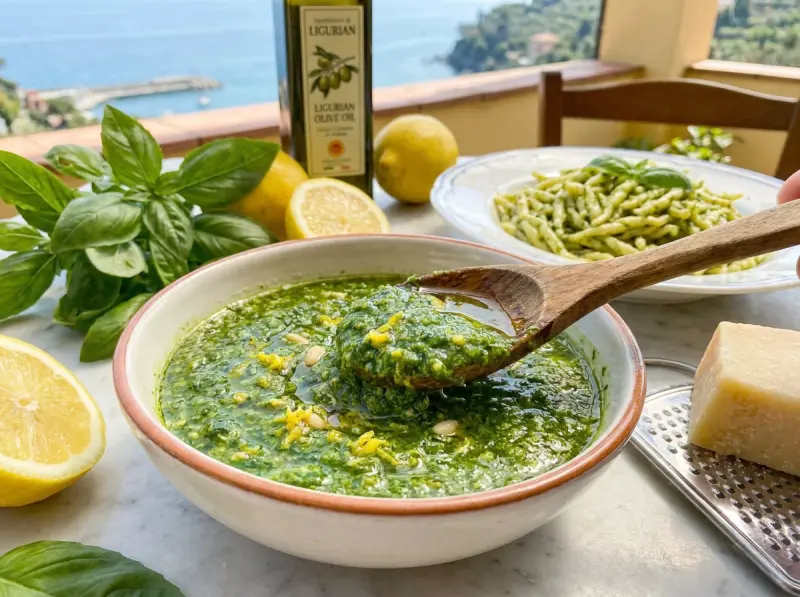
- 5Drizzle in the olive oil. With the motor running on low speed, slowly drizzle in 100 ml of chilled delicate extra virgin olive oil through the feed tube in a thin stream. Total active blending time: 20–30 seconds maximum. Use mild Ligurian (Olio Riviera Ligure DOP) or Spanish Arbequina — never aggressive peppery Sicilian or Tuscan, which overpowers the lemon and turns the sauce bitter from oxidised polyphenols. The final pesto should be bright emerald-green, slightly chunky with visible flecks of basil and pine nut.
- 6Taste and adjust. The texture should be a thick paste, looser than a butter spread but holding shape on a spoon. Too thick: add 1–2 tablespoons more olive oil and pulse briefly. Too loose: add a tablespoon more grated Parmigiano. Taste — salt may not be needed (Parmigiano provides salinity), but add a pinch if flat. More lemon juice (½ tablespoon) brightens; more zest deepens citrus aroma without thinning.
- 7Use immediately or store. Best fresh — use within 2 hours of making for peak aroma and bright green colour. To store: transfer to a glass jar, smooth the surface flat, drizzle a thin film of olive oil on top to seal against air, cover tightly, refrigerate for up to 4 days. Never leave the jar at room temperature: raw garlic and herbs under oil are a botulism risk without cold. For longer storage: freeze in ice cube trays (~30 ml per cube), transfer to a freezer bag; keeps 3 months.
- 8Serve with pasta or as a condiment. For pasta: cook 500 g of linguine (or trofie, trenette, spaghetti) al dente, reserve 120 ml (½ cup) of the pasta water, drain. In a large warm bowl, mix nearly the whole batch of pesto — about 200–250 ml — with 2–3 tablespoons of the starchy pasta water, then add the hot pasta and toss; the warm water helps the sauce coat evenly instead of clumping. Don't heat the pesto directly on the stove — direct heat kills the lemon aroma. Finish with extra Parmigiano and a little more zest. As a condiment: spread it on focaccia or bruschetta, spoon it over grilled fish or chicken, toss it with roasted vegetables, or stir it into risotto.