Japan · Vegetable and Mushroom Dishes
Potato Galette with Pork and Cheese (Jagaimo Galette)
Jagaimo galette (じゃがいものガレット, jagaimo no garetto) is the Japanese home version of a potato galette: raw potato cut into matchsticks, pressed into one round cake in a frying pan and fried until both faces are crisp.
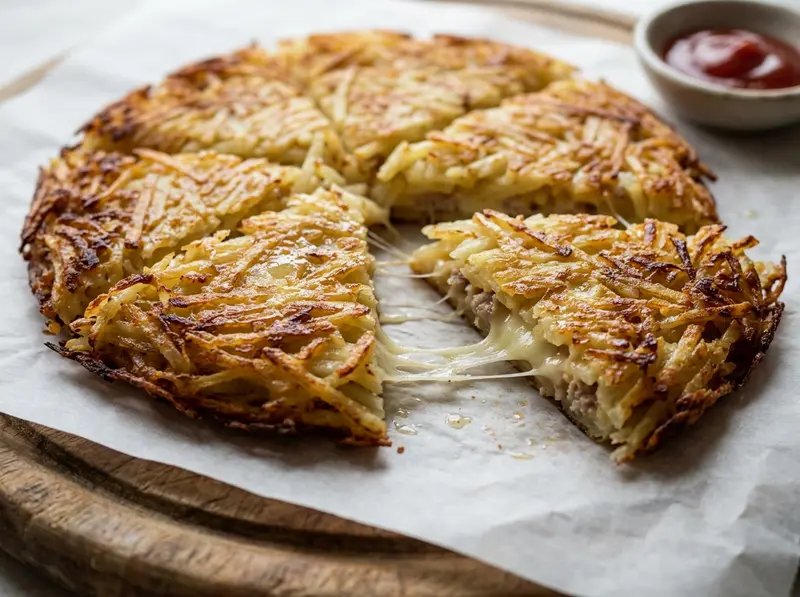
Ingredients
- potatoes400 g
- pork shoulder180 g
- mozzarella80 g
- potato starch2 tbsp
- salt0.5 tsp
- black pepper0.25 tsp
- vegetable oil2 tbsp
Method
- 1Cut the potatoes into matchsticks. Before you start, check the pork: it has to be sliced about 3 mm thin already, and a thicker piece must be sliced first (see the questions below). Peel the 400 g of potatoes and slice them into rounds about 3 mm thick, then stack a few rounds at a time and cut across into sticks about 3 mm wide. A mandoline or a slicer with a julienne blade does this faster than a knife, and Japanese recipes often use one. Put the sticks straight into a large bowl. Do not rinse or soak them: the starch on the cut surfaces is the glue that holds the galette together, and water washes it off. Go on to the pork without a break, because cut potato darkens as it stands.
- 2Fry the pork first. Cut the 180 g of sliced pork shoulder into pieces 2 to 3 cm across. Heat 1 tsp of the vegetable oil in a 26 cm nonstick frying pan that has a lid, over medium heat, for about 1 minute. Add the pork with a pinch taken from the ½ tsp salt and fry for 2 to 3 minutes, stirring, until no piece shows any pink. Tip the pork into the bowl on top of the potato. It goes in cooked so that no raw meat ends up in the middle of the cake, where the heat arrives last. Wipe the pan with a paper towel, because browned bits left in it would scorch under the galette. Wash the board, the knife and your hands now: they have touched raw pork, and the finished galette will be cut on a board.
- 3Mix the potato and pork. If the mozzarella is a block, grate it coarsely and keep it apart. Add 2 tbsp potato starch, the rest of the salt and ¼ tsp black pepper to the bowl. Toss with a fork and a spoon for about 1 minute, until the pork is spread evenly through the potato and no dry starch shows. Start frying at once, because salt pulls water out of the potato.
- 4Build the galette in the pan. Put the wiped pan back on medium heat with 1 tbsp vegetable oil. It is hot enough when a stick of potato dropped in sizzles. Spread about two thirds of the mix over the base in an even round and press it flat with a spatula. Scatter the 80 g of mozzarella over it, stopping 2 cm short of the edge. Cover with the remaining third so that no cheese shows, then press down with the spatula and push the edge in to make a round about 22 cm across and about 2 cm thick. Press hardest around the edge: the two layers grip each other only through that bare 2 cm border.
- 5Fry the first side under the lid. Put the lid on and fry over medium heat for 6 minutes, lifting the lid twice to press the galette flat with the spatula. Do not move or stir it. The lid traps steam, and the steam softens the potato in the top layer before that side reaches the pan. It is ready to turn when the edge is golden brown and the galette slides in one piece when you shake the pan.
- 6Turn it over with a plate. Take the pan off the heat. Slide the galette, browned side down, onto a flat plate at least as wide as the pan. A flat pan lid or a thin board does the same job if your plates are smaller. Hold the pan upside down over the plate with an oven glove, grip plate and pan together and turn them over, so the pale side lands in the pan. Put the pan back on medium heat and pour the remaining 2 tsp vegetable oil in around the edge of the galette. The galette never leaves a flat surface this way, which makes it safer than tossing.
- 7Fry the second side without the lid. Fry over medium heat for 6 minutes, pressing with the spatula now and then, until the underside is golden brown and crisp. Leave the lid off so the steam escapes and the crust stays dry. To check, push a skewer or the tip of a knife into the centre: it should go through the potato with no resistance and come out with melted cheese on it. If it meets resistance, turn the heat down to low, put the lid back on for 2 minutes and check again. Slide the galette onto a clean board or a serving plate, leave it for 2 minutes so the cheese settles, then cut it into 8 wedges and serve hot.