
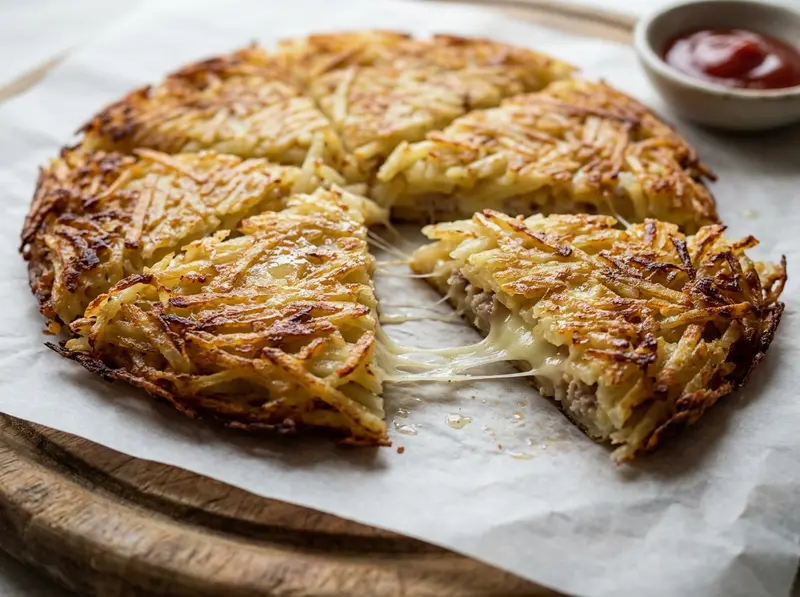
Potato Galette with Pork and Cheese (Jagaimo Galette)
Jagaimo galette (じゃがいものガレット, jagaimo no garetto) is the Japanese home version of a potato galette: raw potato cut into matchsticks, pressed into one round cake in a frying pan and fried until both faces are crisp. This one has thinly sliced pork mixed through it and a layer of melting cheese in the middle. Japanese recipe sites publish the pork version under several names, among them 豚じゃがガレット (buta jaga garetto) and 豚こまとじゃがいもチーズガレット (butakoma to jagaimo chīzu garetto). The word galette is French. In Japan it usually means a buckwheat crêpe, and recipe sites use it for this potato cake too. The cut potato is never rinsed, because its own starch is what glues the strands together. Most of the pork versions we read use 豚こま切れ肉 (buta komagire), cheap thin offcuts of pork, and thinly sliced pork shoulder does the same job outside Japan. Belly works too but makes a much fattier galette. We fry the pork for a few minutes before it goes into the potato, so no raw meat sits in the middle of the cake. The recipe makes one galette of about 22 cm, enough for 2 as a main dish with rice, and takes about 35 minutes if the pork is bought already sliced.
What is a jagaimo galette?
Jagaimo galette, じゃがいものガレット in Japanese, is a round cake of raw potato matchsticks fried in a frying pan until the outside is crisp and the inside is soft. Nothing holds it together except the potato's own starch, sometimes helped by a spoonful of potato starch or flour. That is why the Japanese recipes we read keep repeating one warning: do not rinse the potato after cutting.
The name is borrowed. DELISH KITCHEN, a Japanese recipe service, explains that a galette is a French regional dish much like a crêpe and usually made with buckwheat flour, and that the potato and cheese version is the one that is easy to make at home.
Pork turns it into a main dish. The versions on Japanese recipe sites go by several names, among them 豚じゃがガレット (buta jaga garetto) and 豚こまとじゃがいもチーズガレット, and most of those we read use 豚こま切れ肉, thin offcuts of pork. They handle the pork differently. Lettuce Club chops it and mixes it in raw, and DELISH KITCHEN stir-fries pork and potato together before shaping the cake. We fry the pork on its own first and put the cheese in the middle, the way Meiji, Orange Page and NHK's Kyō no Ryōri build their cheese galettes.
Jagaimo galette vs rösti and potato pancakes
Swiss rösti is the closest relative: coarsely grated potato, raw or parboiled, shaped in the pan and fried, sometimes with bacon, onion or cheese added. In the Japanese recipes we read the potato is cut into matchsticks with a knife or a slicer, goes into the pan raw and unrinsed, and is pressed into one cake that is cut into wedges.
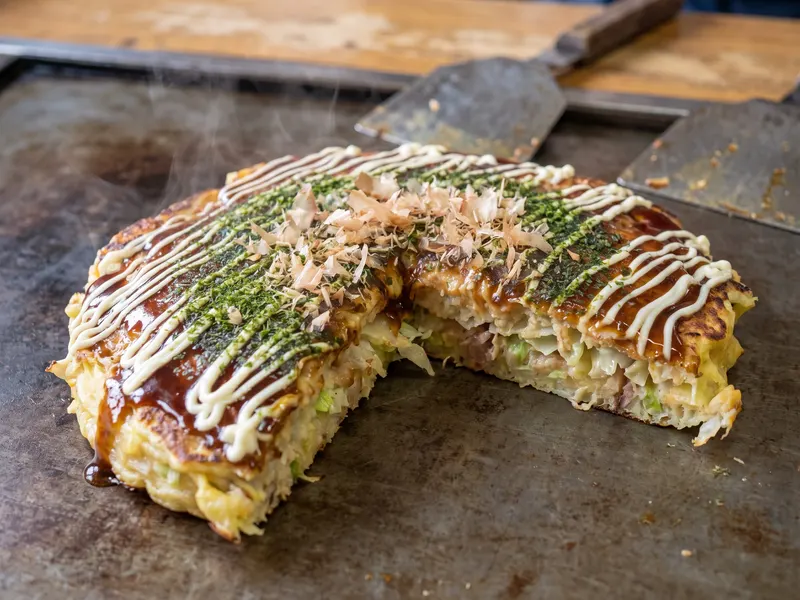
Belarusian draniki are a different thing again: the potato is grated with onion and fried as pancakes. Okonomiyaki, Japan's pancake with pork, has no potato in it and is held together by batter and cabbage.
How to serve potato galette with pork and cheese
Cut the galette into 8 wedges and bring it to the table hot. With pork in it, Japanese recipe sites treat it as an okazu, a dish eaten with rice, so a bowl of rice and miso soup make it dinner for 2.
Japanese recipes put ketchup on the side more often than anything else. Lettuce Club serves its pork galette with 2 tbsp mayonnaise stirred with 1 tsp soy sauce, though soy sauce brings wheat with it if you are cooking gluten-free. Orange Page suggests a fried egg and a handful of baby leaves on top.
Ingredients
- 400 gpotatoes
- 180 gpork shoulder
- 80 gmozzarella
- 2 tbsppotato starch
- 0.5 tspsalt
- 0.25 tspblack pepper
- 2 tbspvegetable oil
Method
- Cut the potatoes into matchsticks. Before you start, check the pork: it has to be sliced about 3 mm thin already, and a thicker piece must be sliced first (see the questions below). Peel the 400 g of potatoes and slice them into rounds about 3 mm thick, then stack a few rounds at a time and cut across into sticks about 3 mm wide. A mandoline or a slicer with a julienne blade does this faster than a knife, and Japanese recipes often use one. Put the sticks straight into a large bowl. Do not rinse or soak them: the starch on the cut surfaces is the glue that holds the galette together, and water washes it off. Go on to the pork without a break, because cut potato darkens as it stands.
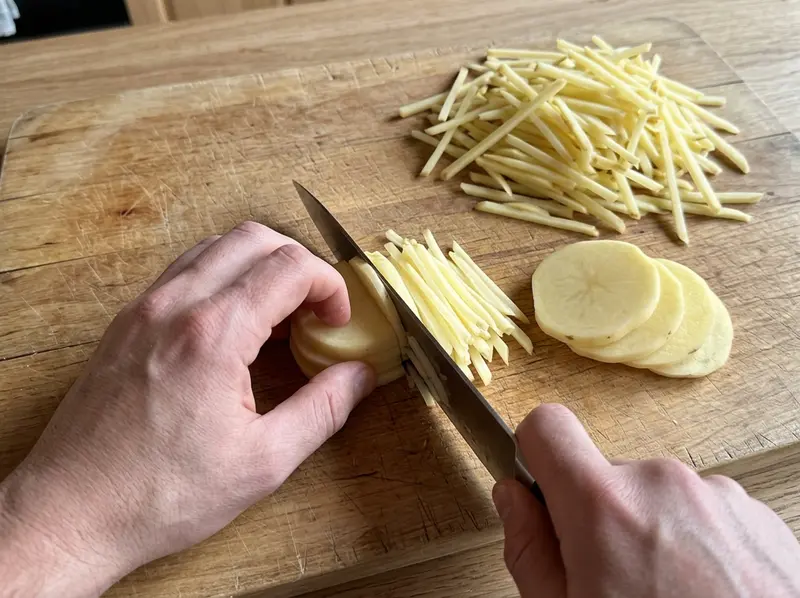
- Fry the pork first. Cut the 180 g of sliced pork shoulder into pieces 2 to 3 cm across. Heat 1 tsp of the vegetable oil in a 26 cm nonstick frying pan that has a lid, over medium heat, for about 1 minute. Add the pork with a pinch taken from the ½ tsp salt and fry for 2 to 3 minutes, stirring, until no piece shows any pink. Tip the pork into the bowl on top of the potato. It goes in cooked so that no raw meat ends up in the middle of the cake, where the heat arrives last. Wipe the pan with a paper towel, because browned bits left in it would scorch under the galette. Wash the board, the knife and your hands now: they have touched raw pork, and the finished galette will be cut on a board.
- Mix the potato and pork. If the mozzarella is a block, grate it coarsely and keep it apart. Add 2 tbsp potato starch, the rest of the salt and ¼ tsp black pepper to the bowl. Toss with a fork and a spoon for about 1 minute, until the pork is spread evenly through the potato and no dry starch shows. Start frying at once, because salt pulls water out of the potato.
- Build the galette in the pan. Put the wiped pan back on medium heat with 1 tbsp vegetable oil. It is hot enough when a stick of potato dropped in sizzles. Spread about two thirds of the mix over the base in an even round and press it flat with a spatula. Scatter the 80 g of mozzarella over it, stopping 2 cm short of the edge. Cover with the remaining third so that no cheese shows, then press down with the spatula and push the edge in to make a round about 22 cm across and about 2 cm thick. Press hardest around the edge: the two layers grip each other only through that bare 2 cm border.
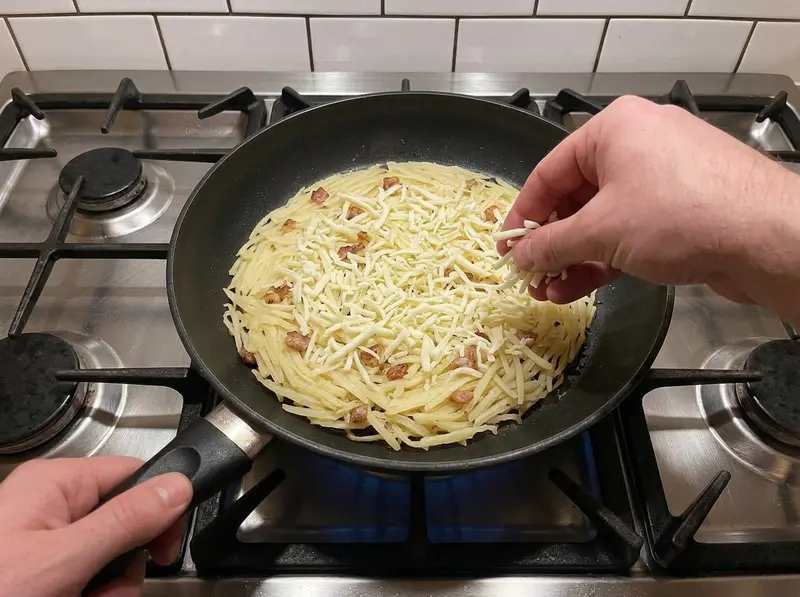
- Fry the first side under the lid. Put the lid on and fry over medium heat for 6 minutes, lifting the lid twice to press the galette flat with the spatula. Do not move or stir it. The lid traps steam, and the steam softens the potato in the top layer before that side reaches the pan. It is ready to turn when the edge is golden brown and the galette slides in one piece when you shake the pan.
- Turn it over with a plate. Take the pan off the heat. Slide the galette, browned side down, onto a flat plate at least as wide as the pan. A flat pan lid or a thin board does the same job if your plates are smaller. Hold the pan upside down over the plate with an oven glove, grip plate and pan together and turn them over, so the pale side lands in the pan. Put the pan back on medium heat and pour the remaining 2 tsp vegetable oil in around the edge of the galette. The galette never leaves a flat surface this way, which makes it safer than tossing.
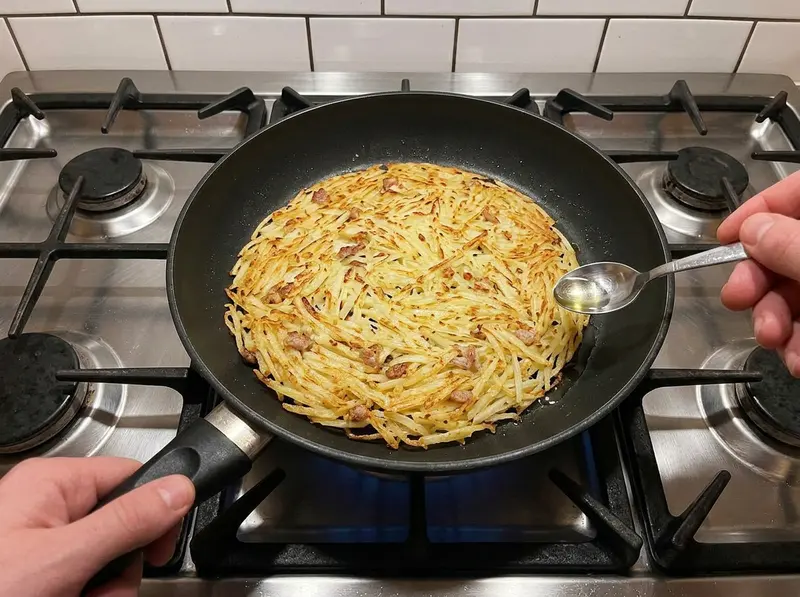
- Fry the second side without the lid. Fry over medium heat for 6 minutes, pressing with the spatula now and then, until the underside is golden brown and crisp. Leave the lid off so the steam escapes and the crust stays dry. To check, push a skewer or the tip of a knife into the centre: it should go through the potato with no resistance and come out with melted cheese on it. If it meets resistance, turn the heat down to low, put the lid back on for 2 minutes and check again. Slide the galette onto a clean board or a serving plate, leave it for 2 minutes so the cheese settles, then cut it into 8 wedges and serve hot.
FAQ
The usual cause is rinsed potato: rinsing or soaking washes away the starch that glues the sticks together, so the cut potato goes straight into the bowl. Thick sticks are the second cause, so keep them to about 3 mm. Pork between the strands gives the potato less to hold on to, which is why this recipe adds 2 tbsp potato starch and presses hardest around the edge, where the two layers join. Then leave the galette alone for the full 6 minutes under the lid, and turn it only when the edge is golden brown and it slides in one piece. Turn it on a plate, not with a spatula.
Any pork sliced about 3 mm thin works, because buta komagire is simply thin offcuts, the same kind of thin pork that goes on okonomiyaki. Pork shoulder sliced for hot pot at an Asian grocer is the closest thing, and belly sliced the same way works too but makes a much fattier galette. To slice a piece yourself, Just One Cookbook's method is to freeze about 450 g for 1½ to 2 hours until firm and cut 3 mm slices across the grain. Japanese recipes also make the galette with ham, which is mixed in without frying. Ham is already salted, so cut the salt to ¼ tsp, the amount Orange Page uses in its ham galette.
Either. Japanese recipes call for ピザ用チーズ (pizza cheese), a bag of shredded cheese sold for melting. Outside Japan this recipe uses 80 g of low-moisture mozzarella, the firm block or the shredded kind, and any melting cheese sold grated for pizza does the same job. Sliced melting cheese works too: Orange Page lays 80 g of slices between two layers of potato. Whichever you choose, stop 2 cm short of the edge and cover it completely so the cheese stays inside the galette.
Put leftovers in a closed container in the fridge within 2 hours and eat them within 3 days. Reheat the wedges in a dry frying pan over medium heat, turning once, until they are hot right through (74 °C in the centre) and crisp again. For a bento, Japan's agriculture ministry gives three rules for cooked food made ahead: reheat it thoroughly just before packing, let it cool before the lid goes on so steam does not collect in the box, and carry the box with an ice pack if it travels for long.
Yes, with flour: Japanese recipes that bind a potato galette with wheat flour use about 1 tbsp for 300 g of potato. Here pork is mixed in as well, so we keep the binder at the same 2 tbsp, and the galette is then no longer gluten-free. Leaving the binder out is fine for a plain potato and cheese galette, where the potato's own starch is enough. With pork in the mix it is a risk: under one Japanese pork galette made without a binder, reviewers wrote that it would not hold together, and a scant 1 tbsp of starch fixed it for one of them and not for another. For grated potato bound with flour, see our draniki.
Rate this
Recipes by email
One letter a week: a recipe picked for your taste, plus whatever is new on the site. Unsubscribe in one click.
Welcome gift: Sergei's cookbook (e-book).
By subscribing you agree to the privacy policy.
Tell us what you like to cook (30 seconds) →Keep browsing
More dishes from the Japanese archive — picked by overlap with what you're cooking now.

Join the conversation
Comments
No comments yet — be the first!