France · Sauces and Dips
Rouille (Provençal Saffron Garlic Sauce for Bouillabaisse)
Rouille (literally 'rust' in French — for its rusty-red color) is a Provençal garlic, saffron and hot pepper sauce, the usual partner of bouillabaisse.
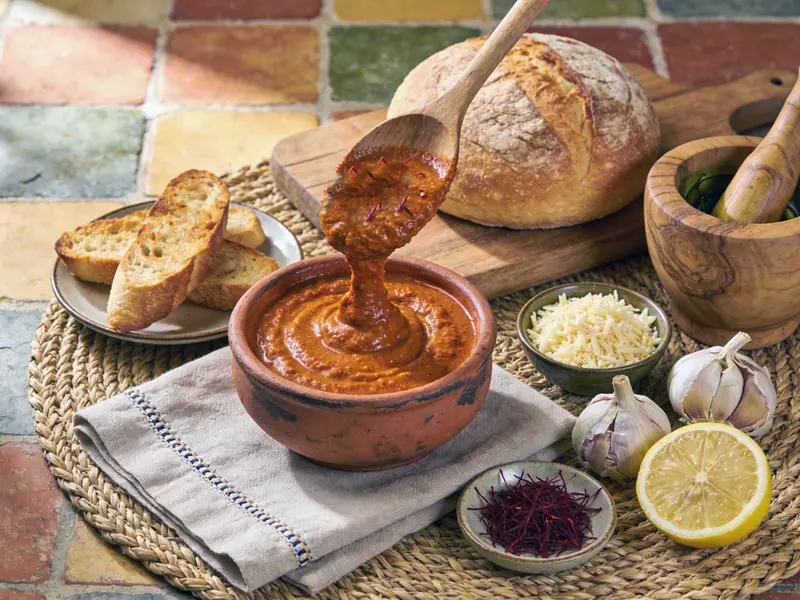
Ingredients
- white bread crumb30 g
- warm fish stock30 ml
- egg yolk1 piece
- garlic cloves4
- saffron threads0.1 g
- piment d'Espelette1 tsp
- sweet paprika0.5 tsp
- extra virgin olive oil200 ml
- flaky sea salt0.5 tsp
- fresh lemon juice1 tsp
- small baguette, for croutons, to serve1 piece
- Gruyère, grated, to serve50 g
Method
- 1Take the egg out of the fridge 30 minutes ahead; the oil should be at room temperature too. Activate the saffron. Warm 30 ml of fish stock (or hot water if you have no stock) until just below boiling, never boiling. Add the saffron threads to the stock, stir, and let steep for 5–10 minutes. The liquid should turn deep golden-orange — this is the saffron releasing its crocin pigment and aroma compounds. Skip this step and the saffron stays sealed inside the threads.
- 2Soak the bread. Tear 30 g of white bread crumb (interior of a baguette or country bread, no crust) into rough pieces and place in a small bowl. Pour the warm saffron stock over the bread and let it absorb for 2–3 minutes. Squeeze the bread gently with your fingers to break it up — it should be a uniform paste, slightly damp but not dripping wet.
- 3Make sure the yolk and oil are at room temperature. Cold ingredients emulsify poorly, and this is the most common cause of broken rouille.
- 4Prep the garlic. Peel 4 garlic cloves and cut each in half lengthwise. Remove the green germ from the center of each clove with a knife tip — the germ can taste harsh and bitter in a raw sauce. Crush the garlic to a smooth paste in a mortar and pestle, or grate on a microplane. Add the flaky sea salt — salt breaks the cell walls of the garlic and releases the essential oils.
- 5Combine the base. In a medium bowl, combine the saffron-soaked bread paste, garlic paste, egg yolk, piment d'Espelette, and sweet paprika. The yolk stays raw, so use a pasteurized egg, and do not serve this sauce to pregnant women, small children, the elderly or anyone with a weakened immune system. Whisk vigorously for 30 seconds with a wire whisk until uniform, smooth, and starting to look creamy. The mixture should be deep orange-red at this stage.
- 6Build the emulsion. Begin adding olive oil drop by drop, whisking constantly. The first 60 to 90 seconds are critical — literally one drop of oil at a time, fully absorbed before the next. After about 2 tablespoons of oil are incorporated and the sauce visibly thickens, switch to a very thin stream. Continue with the thin stream until all 200 ml are incorporated. The finished rouille is glossy, thick, deep rusty-orange, with a texture between mayonnaise and a thick paste.
- 7Finish with lemon juice and adjust seasoning. Whisk in 1 tsp of fresh lemon juice (it goes in at the end so you can judge how much brightness the finished sauce needs; the acid itself does not break the emulsion — pouring the oil in too fast does). Taste and adjust: more salt for seasoning, more piment d'Espelette for heat, more lemon for brightness. The sauce should taste of saffron first, garlic second, with the chili warmth lingering at the finish.
- 8Cover and rest 30 minutes at room temperature before serving — flavors integrate and the emulsion stabilizes. Serve at room temperature, never cold from the fridge — saffron and garlic aromatics are muted when cold. Do not leave it out for more than 2 hours in total. Spread on toasted baguette croutons, float on bouillabaisse, or use as a dip for cooked seafood. Keep it in an airtight container in the fridge and use it within a day; do not freeze.