Italy · Sauces and Dips
Italian Salsa Rossa (Piedmontese Bagnet Ross Tomato Sauce)
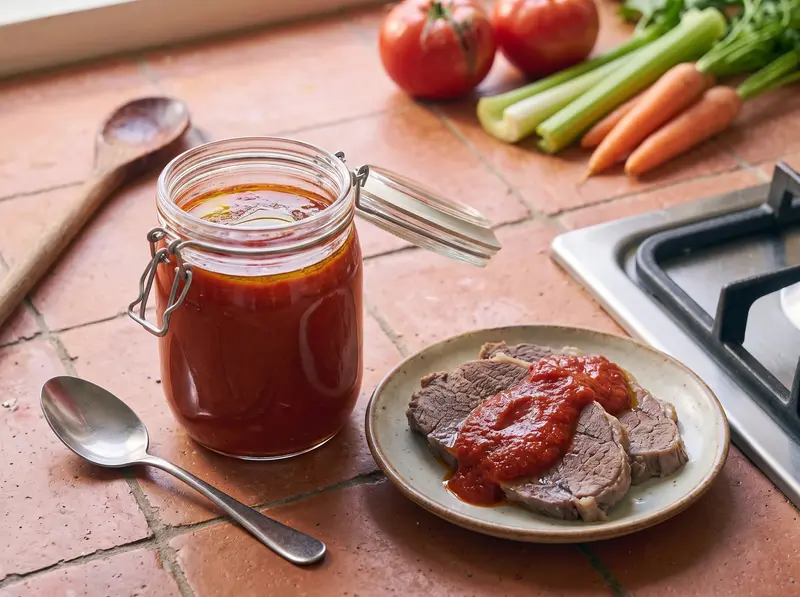
Salsa rossa — known as bagnet ross in Piedmontese dialect — is a slow-cooked tomato sauce from Piedmont in northern Italy, traditionally spooned alongside bollito misto, the region's winter dish of mixed boiled meats.
Ingredients
- ripe tomatoes800 g
- yellow onion2
- carrot1
- celery stalk1
- garlic3 cloves
- sugar1 tbsp
- red wine vinegar2 tbsp
- extra virgin olive oil75 ml
- extra virgin olive oil, to finish1 tbsp
- chili flakes1 pinch
- salt1 pinch
Method
- 1Prepare the tomatoes. For ripe seasonal tomatoes (the ideal): score a small X on the bottom of each tomato, blanch in boiling water for 30 seconds, then transfer to ice water for 1 minute. Peel the skins (they slip off easily), halve each tomato, scoop out the seeds with a spoon — the seeds carry bitterness and excess water. Rough-chop the flesh. For canned: drain 800 g of San Marzano DOP pelati, reserve the juice, and rough-chop the whole tomatoes; use the reserved juice to thin the sauce later if needed. This peeling and seeding matters most if you'll be finishing the sauce in a blender rather than a food mill — the mill strains out skins and seeds on its own, but starting with cleaner tomatoes still keeps a blended sauce from turning watery or bitter.
- 2Prepare the soffritto vegetables. Peel and rough-chop 2 yellow onions (about 250 g total). Peel and rough-chop 1 medium carrot (about 120 g). Trim and rough-chop 1 celery stalk (about 80 g) — remove the strings if tough. Peel 3 garlic cloves and lightly crush them with the flat of a knife — no need to mince, the food mill will catch any larger pieces at the end. The cuts can be coarse since everything will be milled later.
- 3Start the simmer. Pour 75 ml of extra virgin olive oil into a heavy-bottomed pot or Dutch oven (4-litre minimum). Add the chopped onions, carrot, celery, garlic, and a pinch of salt. Cook over medium-low heat for 8–10 minutes, stirring every minute or two, until the vegetables are softened and the onions are translucent — but do not let them brown. Browning gives a caramelized note that conflicts with the bright vegetable character of bagnet ross.
- 4Add the tomatoes and aromatics. Add the chopped tomatoes (with reserved juice if using canned), 1 tablespoon of sugar, a pinch of chili flakes (peperoncino), and another pinch of salt. Stir well to combine. Bring to a gentle simmer over medium heat, then reduce to low — you want a steady but lazy bubble, not a rolling boil. Slow reduction concentrates the flavour; a hard boil dulls it.
- 5Simmer 60 minutes uncovered. Cook on low heat for 60 minutes, uncovered, stirring every 10–15 minutes to prevent scorching at the bottom. The sauce should reduce to about half its original volume and become thick — when you draw a wooden spoon through it, the trail should hold for a moment before the sauce closes back. If it reduces too fast or sticks to the bottom, lower the heat further and add 50 ml of water.
- 6Add the vinegar and finish cooking. Stir in 2 tablespoons of red wine vinegar and cook 5 more minutes — the vinegar must cook briefly to lose its raw bite and integrate with the tomato. Taste and adjust: more salt if flat; more sugar if too sour (sometimes happens with winter pelati); more vinegar if too sweet (rare with seasonal tomatoes). Remove from heat.
- 7Pass through a food mill (passatutto). The traditional Piedmontese method: ladle the hot sauce into a food mill fitted with a 3–4 mm disc, set over a clean bowl, and crank handle steadily. The mill catches any tomato seeds and skin remnants and produces a velvety smooth red sauce of even consistency. If using a blender or immersion blender (less ideal): let the sauce cool for 10 minutes first; with a jug blender, fill the jug no more than half full, vent the lid and hold it down with a folded towel, because steam from hot sauce can blow the lid off. Blend on low speed for 20–30 seconds at most — high speed whips air, fades the colour from rich red to orange-pink, and pulverises any remaining seeds into a bitter haze.
- 8Adjust and rest. Stir 1 tablespoon of fresh olive oil into the milled sauce — this final raw drizzle adds gloss and aroma the cooking destroys. Taste once more — the sauce develops as it cools, so go light on salt at this stage. Let cool to room temperature before serving (about 1 hour) for best flavour. To keep it, spoon into a clean glass jar, cover with a film of olive oil and refrigerate within 2 hours of cooking. Serve at room temperature or slightly warm with bollito misto, grilled meats, polpettoni, tomini cheese, or as a dip with crusty bread.