Italy · Sauces and Dips
Italian Salsa Tonnata (Piedmontese Tuna Sauce, Pellegrino Artusi 1891)
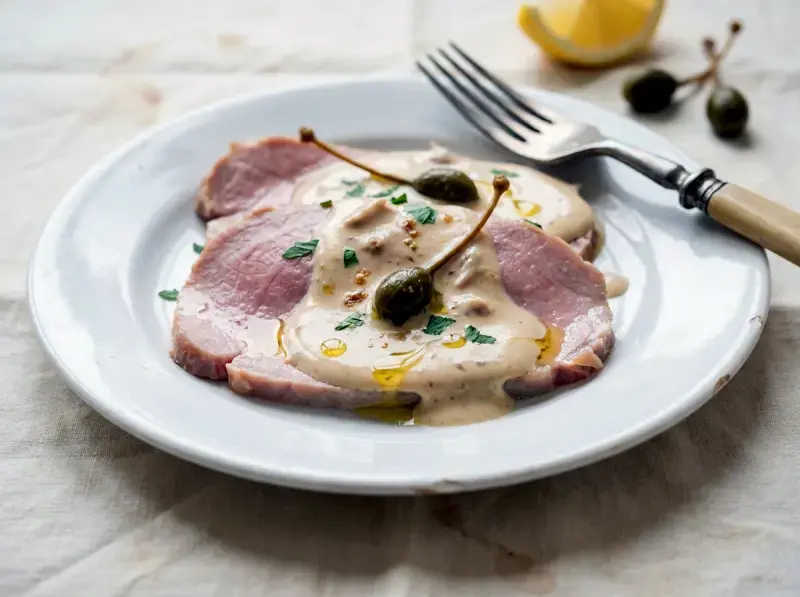
Salsa tonnata is the Piedmontese emulsion sauce of canned tuna, anchovies, capers, hard-boiled egg yolks, olive oil, and lemon juice — a creamy savory cream that defines the iconic vitello tonnato (cold sliced veal…
Ingredients
- canned tuna in oil200 g
- anchovy fillets4
- capers2 tbsp
- hard-boiled egg yolks2
- extra virgin olive oil100 ml
- lemon juice1 tbsp
- salt1 pinch
Method
- 1Hard-boil the eggs (in parallel). Cover 2 eggs with cold water by 2 cm in a small saucepan, bring to a boil, then reduce to a gentle simmer for 10 minutes — fully hard-boiled, with a pale yellow yolk that crumbles dry, exactly what's needed for emulsion. Cool under running cold water for 2 minutes to stop the cooking. Peel and separate the yolks; reserve the whites for another use (egg salad, garnish). The yolks act as emulsifier and add body without the salmonella risk of raw yolks.
- 2Drain the tuna. Open a 200 g can of quality Italian or Spanish tuna in olive oil — Ortiz Cantabrian, Callipo, Tonnino, or Maruzzella. Drain off most of the oil but reserve 1-2 tablespoons of the rich tuna oil for extra umami in the final sauce. Tip the drained tuna into the food processor bowl. Quality matters: do not substitute supermarket chunk light in water — the result will be flat and fibrous. The drained weight should be about 180 g.
- 3Prep anchovies and capers. If using salt-packed anchovies (preferred — Cetara, Recca): rinse 4 fillets briefly under cold water for 30 seconds, then soak in cold water for 5 minutes to soften, lift out the central spine with a finger. If using oil-packed: pat dry with paper towel, no further prep. For capers: if salt-packed (Pantelleria), rinse 2 tablespoons under water for 30 seconds and soak for 10 minutes; if brined, drain and rinse briefly. Salt-packed give the deepest flavour but oil-packed and brined work well too.
- 4Combine in food processor. Add the drained tuna, prepared anchovies, drained capers, the 2 hard-boiled egg yolks, 1 tablespoon of fresh lemon juice, and the reserved 1-2 tablespoons of tuna oil to a food processor or high-powered blender. Pulse 5-6 times for 2-3 seconds each to break everything down before continuous blending — this prevents motor strain and uneven texture.
- 5Blend with olive oil drizzle. With the motor running on low speed, slowly drizzle in 100 ml of delicate extra virgin olive oil through the feed tube in a thin stream — like making mayonnaise. The slow drizzle is critical: dumping all the oil at once will not emulsify properly. Use a mild Ligurian or Spanish Arbequina, NOT peppery Sicilian or Tuscan — aggressive polyphenols oxidize during high-speed blending and turn the sauce bitter. Total blending time: 30-60 seconds maximum, until smooth and creamy.
- 6Check texture and adjust. The finished sauce should be thick and creamy like mayonnaise, pourable but holding shape on a spoon. Too thick: add 1-2 tablespoons of cold water (or veal poaching liquid if making vitello tonnato) and pulse briefly. Too thin: add more drained tuna and pulse. Taste — salt is rarely needed (anchovies and capers provide salinity), but add a pinch if flat. A touch more lemon juice can brighten if too rich.
- 7Rest in the fridge. Transfer to a glass jar or covered bowl and refrigerate for at least 1-2 hours before serving — flavours integrate, texture sets, the sauce thickens slightly. Best after 12-24 hours when 'aged taste' develops fully. Cover the surface with a thin film of olive oil to prevent oxidation if storing more than a day.
- 8Serve chilled. Present salsa tonnata cold, never at room temperature — chill defines the proper silky texture. Spoon over thinly-sliced cold roasted veal for classic vitello tonnato; over halved hard-boiled eggs for egg tonnato; over thick tomato slices for tomato tonnato; over blanched asparagus or roasted vegetables; spread on focaccia or crostini; in tramezzini sandwiches with lettuce. Garnish with extra capers and chopped parsley. Pair with white wine — Arneis, Gavi di Gavi, Vermentino, or Pinot Grigio.