USA · Meat Dishes
Texas Smoked Brisket
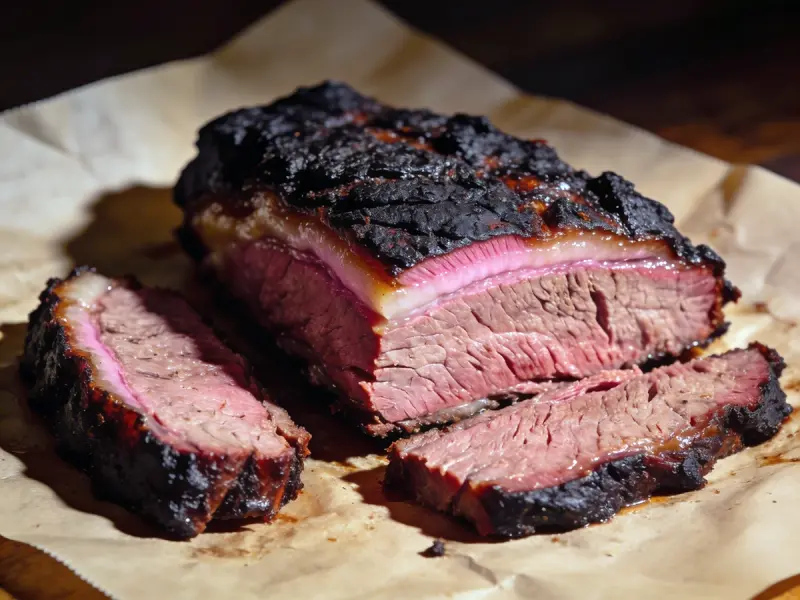
Texas smoked brisket is the most technically demanding and most celebrated dish in American barbecue.
Ingredients
- whole packer brisket5 kg
- coarse kosher salt3 tbsp
- coarsely cracked black pepper3 tbsp
- garlic powder1 tbsp
- apple cider vinegar mixed with 120 ml water120 ml
- large sheet pink butcher paper1
Method
- 1Trim the brisket cold. Remove the brisket from the refrigerator and work while it is still cold — cold fat is firm and easy to trim precisely. Place fat-side up. Trim the fat cap to a uniform 6 mm (¼ inch) — thick enough to baste the meat during the long cook, thin enough for smoke and bark to penetrate. Remove the hard, waxy fat nodes between the point and flat muscles (they will not render). Trim any thin edges of the flat that would dry out and burn during the cook. The goal is a smooth, aerodynamic surface that allows even smoke contact. Season generously on all sides with the salt, pepper, and garlic powder. Wrap loosely and refrigerate uncovered overnight (8 to 24 hours) — the dry brine seasons the meat and dries the surface for maximum bark formation.
- 2Set up the smoker and begin the cook. Preheat your smoker to 225°F (107°C). Add post oak wood — the traditional Texas choice — for clean, thin blue smoke. Never use thick white smoke (billowing smoke contains incomplete combustion products that make meat acrid and bitter). Remove the brisket from the refrigerator 30 minutes before cooking. Place the brisket fat-side down if cooking on a smoker with heat from below (pellet/drum), or fat-side up on an offset where heat enters from the side. Insert a probe thermometer into the thickest part of the flat, avoiding fat pockets. Do not open the smoker for the first 3 hours.
- 3Manage the stall and build the bark. After 3 to 4 hours, begin spritzing the brisket every 45 to 60 minutes with the apple cider vinegar and water mixture. The brisket will develop a dark, mahogany bark over hours 4 to 8. At approximately 71 to 77°C (160 to 170°F) internal temperature, the brisket will enter 'the stall' — a phenomenon where evaporative cooling from the meat surface exactly matches the oven's heat input, holding the internal temperature flat for 2 to 5 hours. This is normal. Do not increase temperature. The stall is where the collagen-to-gelatin conversion intensifies. Wait for the bark to be dark and firm before wrapping — typically 6 to 8 hours into the cook.
- 4Wrap in butcher paper and push through the stall. Once the bark is fully set and the brisket is at 71°C or above, pull it from the smoker. Place the brisket in the center of a large sheet of pink butcher paper and wrap tightly — fold in the sides first, then roll the brisket forward so the paper overlaps several times, creating a firm, leak-resistant package. Butcher paper (unlike aluminium foil) is porous: it retains the moisture and juices pressed against the meat while allowing steam to escape, which preserves the bark's texture. Return the wrapped brisket to the smoker. Continue cooking until the probe registers 93 to 96°C (200 to 205°F) — but temperature is only a guide. The true test of doneness is probe feel: when a thermometer probe slides into the thickest part of the flat with zero resistance — the texture of inserting a probe into softened butter — the brisket is done.
- 5Rest — the most important step. Remove the wrapped brisket from the smoker. Do not unwrap it. Place it in a cooler or unheated oven to rest for a minimum of 1 hour, preferably 2 to 4 hours. Resting is not optional: during the long cook the muscle fibres have contracted and squeezed liquid toward the surface. Resting allows the fibres to relax and reabsorb the juices into the meat. A brisket sliced immediately will be dry; the same brisket rested 2 hours will be noticeably juicier. To slice: identify the grain direction of the flat (it runs lengthwise). Slice the flat across the grain in 6 mm (¼ inch) pencil-thick slices — against the grain means maximum tenderness. When you reach the point, rotate 90° and slice the point across its own grain direction. Serve on butcher paper with white bread, pickles, and sliced white onion — the traditional Texas accompaniment.