
Texas Smoked Brisket
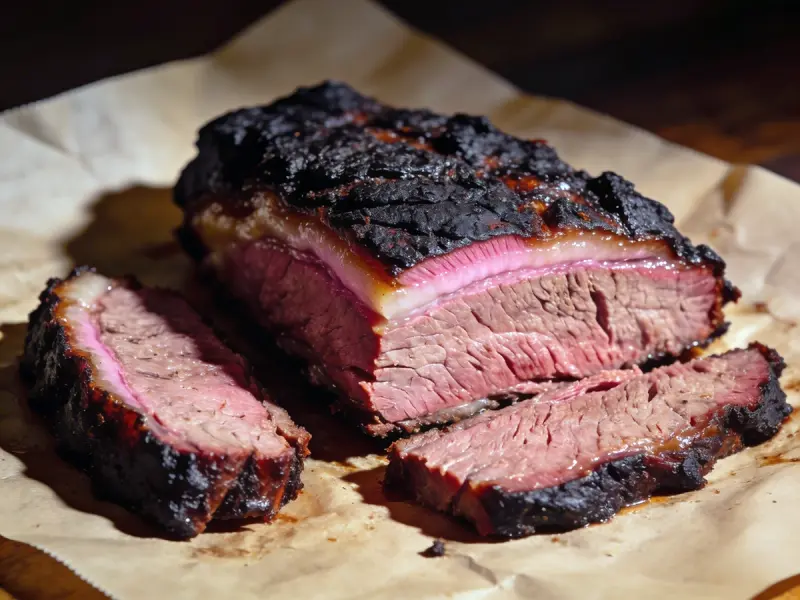
Texas smoked brisket is the most technically demanding and most celebrated dish in American barbecue. A whole packer brisket — the entire chest muscle of the steer, comprising two overlapping muscles (the lean flat and the fatty point) — is seasoned with only coarse salt and cracked black pepper (the Dalmatian rub), smoked over post oak at 225°F (107°C) for 12 to 16 hours, wrapped in pink butcher paper when the bark is set, and rested for a minimum of two hours before slicing. What separates Texas brisket from all other regional styles is its radical simplicity: no sugar in the rub (sugar burns over long cooks), no sauce (the bark carries all the flavor), no foil (butcher paper preserves the bark while allowing moisture to breathe). The result — when done correctly — is a brisket with a jet-black bark, a visible smoke ring beneath, and meat that is simultaneously deeply smoky, heavily rendered with melted intramuscular fat, and yielding enough that a probe thermometer slides in with the resistance of room-temperature butter.
Ingredients
- 5 kgwhole packer brisket
- 3 tbspcoarse kosher salt
- 3 tbspcoarsely cracked black pepper
- 1 tbspgarlic powder
- 120 mlapple cider vinegar mixed with 120 ml water
- 1 large sheet pink butcher paper
Method
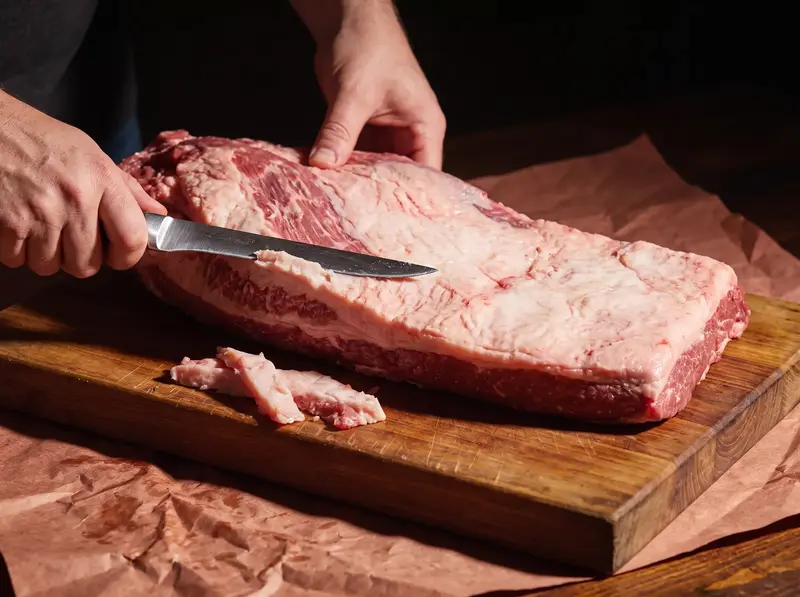
- Trim the brisket cold. Remove the brisket from the refrigerator and work while it is still cold — cold fat is firm and easy to trim precisely. Place fat-side up. Trim the fat cap to a uniform 6 mm (¼ inch) — thick enough to baste the meat during the long cook, thin enough for smoke and bark to penetrate. Remove the hard, waxy fat nodes between the point and flat muscles (they will not render). Trim any thin edges of the flat that would dry out and burn during the cook. The goal is a smooth, aerodynamic surface that allows even smoke contact. Season generously on all sides with the salt, pepper, and garlic powder. Wrap loosely and refrigerate uncovered overnight (8 to 24 hours) — the dry brine seasons the meat and dries the surface for maximum bark formation.
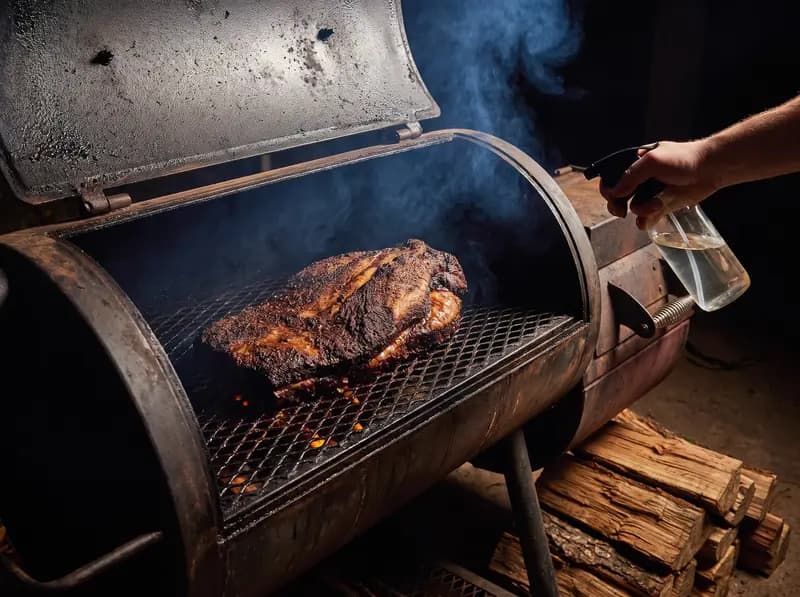
- Set up the smoker and begin the cook. Preheat your smoker to 225°F (107°C). Add post oak wood — the traditional Texas choice — for clean, thin blue smoke. Never use thick white smoke (billowing smoke contains incomplete combustion products that make meat acrid and bitter). Remove the brisket from the refrigerator 30 minutes before cooking. Place the brisket fat-side down if cooking on a smoker with heat from below (pellet/drum), or fat-side up on an offset where heat enters from the side. Insert a probe thermometer into the thickest part of the flat, avoiding fat pockets. Do not open the smoker for the first 3 hours.
- Manage the stall and build the bark. After 3 to 4 hours, begin spritzing the brisket every 45 to 60 minutes with the apple cider vinegar and water mixture. The brisket will develop a dark, mahogany bark over hours 4 to 8. At approximately 71 to 77°C (160 to 170°F) internal temperature, the brisket will enter 'the stall' — a phenomenon where evaporative cooling from the meat surface exactly matches the oven's heat input, holding the internal temperature flat for 2 to 5 hours. This is normal. Do not increase temperature. The stall is where the collagen-to-gelatin conversion intensifies. Wait for the bark to be dark and firm before wrapping — typically 6 to 8 hours into the cook.
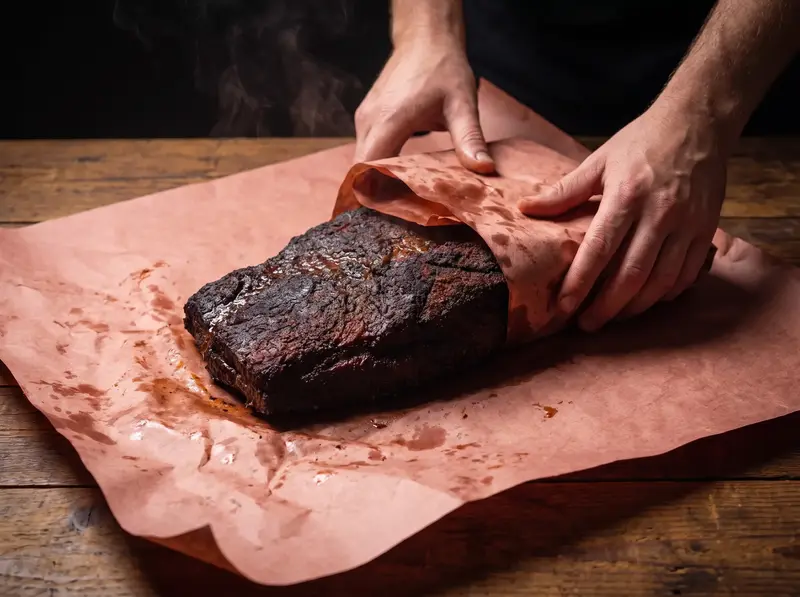
- Wrap in butcher paper and push through the stall. Once the bark is fully set and the brisket is at 71°C or above, pull it from the smoker. Place the brisket in the center of a large sheet of pink butcher paper and wrap tightly — fold in the sides first, then roll the brisket forward so the paper overlaps several times, creating a firm, leak-resistant package. Butcher paper (unlike aluminium foil) is porous: it retains the moisture and juices pressed against the meat while allowing steam to escape, which preserves the bark's texture. Return the wrapped brisket to the smoker. Continue cooking until the probe registers 93 to 96°C (200 to 205°F) — but temperature is only a guide. The true test of doneness is probe feel: when a thermometer probe slides into the thickest part of the flat with zero resistance — the texture of inserting a probe into softened butter — the brisket is done.
- Rest — the most important step. Remove the wrapped brisket from the smoker. Do not unwrap it. Place it in a cooler or unheated oven to rest for a minimum of 1 hour, preferably 2 to 4 hours. Resting is not optional: during the long cook the muscle fibres have contracted and squeezed liquid toward the surface. Resting allows the fibres to relax and reabsorb the juices into the meat. A brisket sliced immediately will be dry; the same brisket rested 2 hours will be noticeably juicier. To slice: identify the grain direction of the flat (it runs lengthwise). Slice the flat across the grain in 6 mm (¼ inch) pencil-thick slices — against the grain means maximum tenderness. When you reach the point, rotate 90° and slice the point across its own grain direction. Serve on butcher paper with white bread, pickles, and sliced white onion — the traditional Texas accompaniment.
FAQ
A packer brisket is the whole, untrimmed beef brisket — the entire pectoral muscle of the steer — comprising both the flat and the point together in one cut, typically weighing 5 to 8 kg. It is the correct cut for Texas-style brisket. The flat is a large, thin, relatively lean muscle with a pronounced grain; the point overlaps the flat at one end and is smaller, thicker, and heavily marbled with intramuscular fat and connective tissue. Buying them together is essential because the point protects the flat from drying out during the long cook. Buying only the flat (sold as 'brisket flat' in many supermarkets) is a common home-cook mistake — without the fat and collagen mass of the point to moderate the cook, flat-only brisket almost always comes out dry.
The stall (also called the plateau) is a phenomenon in smoking where the internal temperature of the meat stops rising — often holding at 71 to 77°C (160 to 170°F) for 2 to 5 hours — despite the smoker maintaining a constant temperature. It is caused by evaporative cooling: moisture rising from inside the meat evaporates on the surface and cools the meat at exactly the same rate the smoker heats it. The meat is sweating. The stall is not a sign of failure — it is when the collagen-to-gelatin conversion is working at its highest rate. You can wait it out (the stall ends eventually as the surface dries) or wrap in butcher paper or foil to reduce evaporation. Wrapping shortens the stall by an hour or two and does not significantly compromise the result.
Both are used widely, with genuine trade-offs. Aluminium foil creates a fully sealed, steam-tight environment — the meat braises in its own juices, which softens the bark into something closer to a braise crust than a smoked bark. The result is very moist but with a softer outer layer. This is sometimes called the Texas Crutch. Pink butcher paper (unwaxed, food-grade peach paper) is porous — it holds the meat's juices against the surface while allowing steam to escape. The bark firms up rather than softening. The result is slightly drier but with a better texture contrast between the crunchy bark and the moist interior. Competition pitmasters and most Texas barbecue restaurants use butcher paper. For home cooks who prioritise maximum moisture over bark texture, foil is a reasonable choice.
Slicing brisket incorrectly — with the grain rather than against it — produces long, stringy, tough slices regardless of how well the brisket was cooked. The flat and the point are two separate muscles with different grain directions, and both must be identified and sliced against their respective grain. First, identify the grain direction of the flat by looking at the long muscle fibres running across the surface. Slice perpendicular to those fibres in 6 mm (¼ inch) slices. When you reach the junction between flat and point, the grain direction shifts approximately 90°. Rotate your cutting board or the meat and slice the point against its own grain. Many pitmasters separate the two muscles completely before slicing. Correct slicing can rescue a slightly tough brisket; incorrect slicing can ruin a perfect one.
Texas brisket is defined by what it is not: not sweet, not sauced, not brined in anything complex. The Dalmatian rub — coarse salt and cracked black pepper only — deliberately lets the quality of the beef and the wood smoke carry all the flavor. Other major American BBQ regions take different approaches: Kansas City ribs and burnt ends use a sweet, tomato-based sauce as the primary flavor; Memphis relies on a complex dry rub with paprika, onion, garlic, and sometimes sugar; Carolina whole hog is served with a thin vinegar-pepper sauce that cuts through the rich pork fat. Texas beef brisket is the style where no sauce appears on the meat at all — traditionally, sauce is served on the side or not offered. The black bark of a Texas brisket is the flavor delivery mechanism, developed over hours of smoke and heat.
Rate this
Recipes by email
One letter a week: a recipe picked for your taste, plus whatever is new on the site. Unsubscribe in one click.
Welcome gift: Sergei's cookbook (e-book).
By subscribing you agree to the privacy policy.
Tell us what you like to cook (30 seconds) →Keep browsing
More dishes from the American archive — picked by overlap with what you're cooking now.


Join the conversation
Comments
No comments yet — be the first!