Germany · Flour and Confectionery Products
Soft Pretzels (Laugenbrezeln)
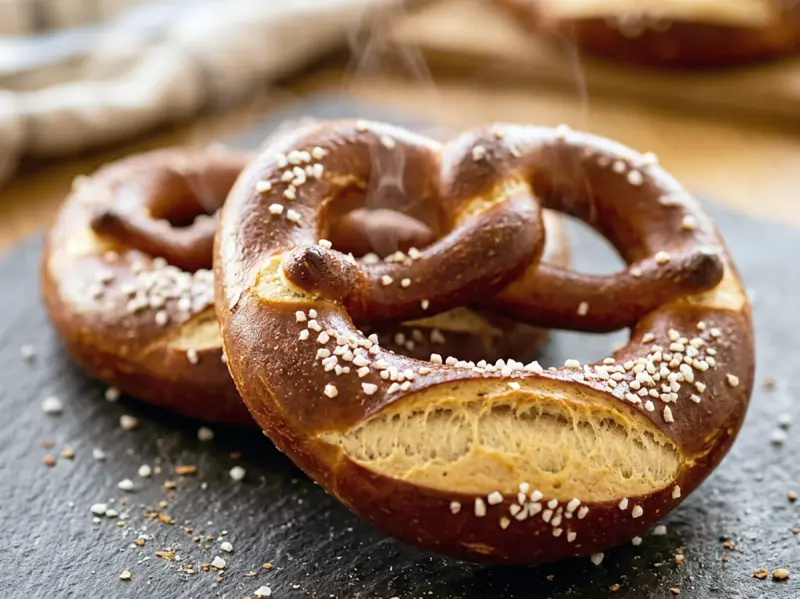
Laugenbrezeln (lye pretzels) are Germany's most iconic baked bread — a yeast dough shaped into the traditional looped knot, dipped in an alkaline bath, and baked at high heat until the crust turns a deep, glossy…
Ingredients
- bread flour or plain flour500 g
- instant yeast7 g
- fine salt1 tsp
- sugar1 tsp
- unsalted butter30 g
- warm water300 ml
- baking soda100 g
- water1 l
- coarse pretzel salt or flaky sea salt2 tbsp
Method
- 1Bake the baking soda. Spread the baking soda on a foil-lined baking sheet and bake at 120°C (250°F) for 1 hour. This converts it to sodium carbonate — a stronger alkali that produces a deeper color and more authentic pretzel flavor than plain baking soda. Allow to cool. Handle with care: baked baking soda is more caustic than regular baking soda — wear gloves when making the bath. Skip this step if using food-grade lye (4% solution instead).
- 2Make and knead the dough. Combine flour, yeast, salt, and sugar. Add the softened butter and warm water. Knead by hand for 8 to 10 minutes, or in a stand mixer with a dough hook for 5 to 6 minutes, until the dough is smooth, firm, and slightly tacky. Pretzel dough should be noticeably firmer than bread dough — a stiffer dough produces the characteristic chew. Cover and rise until doubled, 45 to 60 minutes.
- 3Shape the pretzels. Divide the dough into 8 equal portions (about 105 g each). Roll each portion into a long rope, about 60 cm (24 inches), thicker in the center and tapering to thin ends. Form a U shape, cross the two ends twice (creating two twists), then fold the ends down and press firmly onto the thick bottom arc of the U — the classic pretzel knot. Place on lined baking sheets. Refrigerate or freeze for 20 to 30 minutes — the cold firms the dough, making it much easier to handle for dipping without losing its shape.
- 4Make the alkaline bath and dip. Bring 1 liter of water to a gentle boil in a wide pot. Add the baked baking soda carefully and stir — it will bubble. Wear rubber gloves. Using a slotted spatula, submerge each cold pretzel in the bath for 20 to 30 seconds, turning once. The pretzel surface will immediately begin to look dull and slightly slimy — this is the alkali reacting with the surface proteins, exactly as intended. Transfer to lined baking sheets.
- 5Salt and bake. Sprinkle the wet pretzels with coarse salt immediately after dipping. Using a sharp knife or razor blade, score the thick bottom arc of each pretzel with a single decisive cut about 5 mm deep — this allows the inside to expand and produces the characteristic split. Bake at 220°C (430°F) for 14 to 18 minutes until deep mahogany brown. Do not underbake — a pale pretzel will be doughy and lack pretzel flavor. Cool on a wire rack for at least 5 minutes before eating. Best consumed warm on the day of baking.