
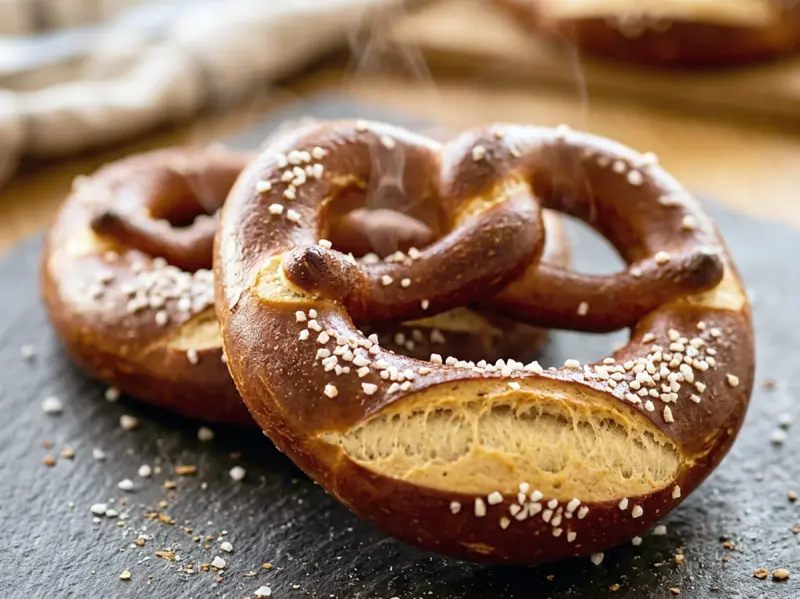
Soft Pretzels (Laugenbrezeln)
Laugenbrezeln (lye pretzels) are Germany's most iconic baked bread — a yeast dough shaped into the traditional looped knot, dipped in an alkaline bath, and baked at high heat until the crust turns a deep, glossy mahogany with a characteristic chewy outer layer and a soft, slightly dense interior. The word Lauge means lye, referring to the sodium hydroxide solution that bakeries use — it is the alkali bath that produces the distinctive pretzel flavor and color through the Maillard reaction at a lower temperature than bread normally allows. At home, baked baking soda (regular baking soda heated in the oven to convert it to sodium carbonate, which is more alkaline) produces a result close to the bakery original. Served with coarse pretzel salt, they are essential at Oktoberfest, Bavarian beer gardens, and across southern Germany.
Ingredients
- 500 gbread flour or plain flour
- 7 ginstant yeast
- 1 tspfine salt
- 1 tspsugar
- 30 gunsalted butter
- 300 mlwarm water
- 100 gbaking soda
- 1 lwater
- 2 tbspcoarse pretzel salt or flaky sea salt
Method
- Bake the baking soda. Spread the baking soda on a foil-lined baking sheet and bake at 120°C (250°F) for 1 hour. This converts it to sodium carbonate — a stronger alkali that produces a deeper color and more authentic pretzel flavor than plain baking soda. Allow to cool. Handle with care: baked baking soda is more caustic than regular baking soda — wear gloves when making the bath. Skip this step if using food-grade lye (4% solution instead).
- Make and knead the dough. Combine flour, yeast, salt, and sugar. Add the softened butter and warm water. Knead by hand for 8 to 10 minutes, or in a stand mixer with a dough hook for 5 to 6 minutes, until the dough is smooth, firm, and slightly tacky. Pretzel dough should be noticeably firmer than bread dough — a stiffer dough produces the characteristic chew. Cover and rise until doubled, 45 to 60 minutes.
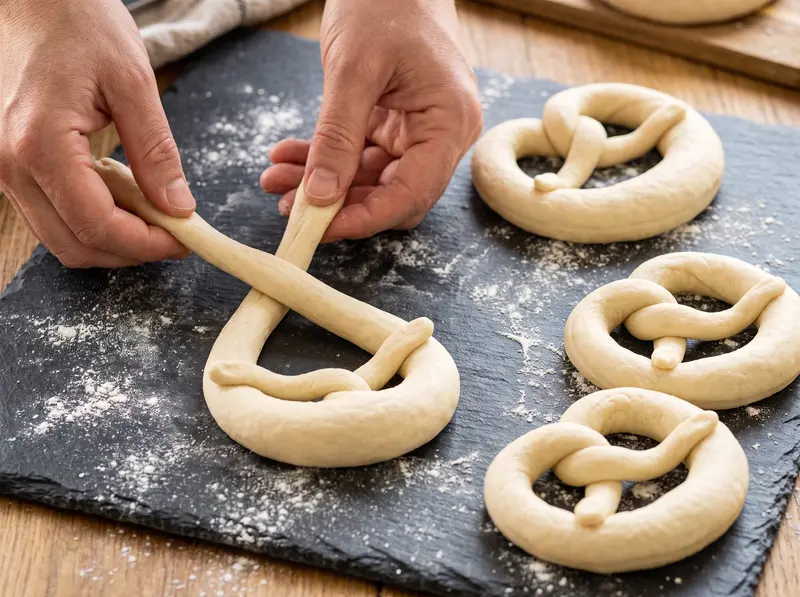
- Shape the pretzels. Divide the dough into 8 equal portions (about 105 g each). Roll each portion into a long rope, about 60 cm (24 inches), thicker in the center and tapering to thin ends. Form a U shape, cross the two ends twice (creating two twists), then fold the ends down and press firmly onto the thick bottom arc of the U — the classic pretzel knot. Place on lined baking sheets. Refrigerate or freeze for 20 to 30 minutes — the cold firms the dough, making it much easier to handle for dipping without losing its shape.
- Make the alkaline bath and dip. Bring 1 liter of water to a gentle boil in a wide pot. Add the baked baking soda carefully and stir — it will bubble. Wear rubber gloves. Using a slotted spatula, submerge each cold pretzel in the bath for 20 to 30 seconds, turning once. The pretzel surface will immediately begin to look dull and slightly slimy — this is the alkali reacting with the surface proteins, exactly as intended. Transfer to lined baking sheets.
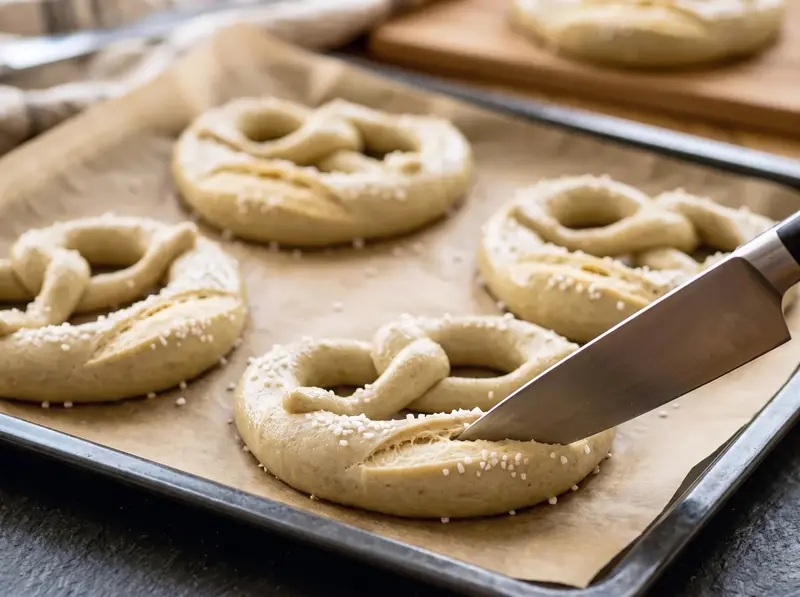
- Salt and bake. Sprinkle the wet pretzels with coarse salt immediately after dipping. Using a sharp knife or razor blade, score the thick bottom arc of each pretzel with a single decisive cut about 5 mm deep — this allows the inside to expand and produces the characteristic split. Bake at 220°C (430°F) for 14 to 18 minutes until deep mahogany brown. Do not underbake — a pale pretzel will be doughy and lack pretzel flavor. Cool on a wire rack for at least 5 minutes before eating. Best consumed warm on the day of baking.
FAQ
The alkaline bath — traditionally sodium hydroxide (lye) diluted in water, or at home a solution of baked baking soda — is the defining technique of pretzel making. When raw dough is dipped in an alkaline solution, the high pH breaks down the surface proteins into smaller peptides and amino acids. When these modified proteins and the dough's sugars hit the hot oven, they undergo the Maillard reaction — the same browning reaction that creates flavor in seared meat — but at a much lower temperature than unbathed bread. This produces the deep mahogany color, the signature slightly bitter-savory crust flavor, and the distinctive chewy texture of the crust. Without the alkaline bath, you have flavourful bread shaped like a pretzel; with it, you have an actual pretzel.
Baked baking soda (also called sodium carbonate, washing soda) is a genuinely good substitute for home bakers. Regular baking soda is sodium bicarbonate (pH approximately 8 to 9). Baking it at 120°C for 1 hour drives off carbon dioxide and water, converting it to sodium carbonate (pH approximately 11 to 11.5). This is more alkaline than regular baking soda and produces noticeably better results — a darker color, more pretzel flavor, and better crust texture. It is still less alkaline than lye (pH 13 to 14), so the professional bakery result is not completely achievable, but the difference is small enough that most home bakers find baked baking soda entirely satisfying. Handle with care: baked baking soda is irritating to skin and eyes.
Start with a dough rope of consistent thickness: roll from the center outward, working the rope to about 60 cm (24 inches) long and keeping the center (the belly) noticeably thicker than the final 8 cm of each end. Pick up the rope by the two thin ends. Form a U shape — the thick center hangs down. Cross the right end over the left, then cross again (two twists). Fold both ends downward and press them firmly onto the left and right sides of the thick arc — one end on each side. Press firmly to seal. The knot should sit above the center of the arc. Common mistake: not crossing twice, producing only one twist; or making the belly too thin, which gives a bready rather than chewy center.
Shaped pretzel dough at room temperature is soft, slack, and deforms easily when handled with a spatula or slotted spoon during dipping. Cold, firm dough — refrigerated for 20 to 30 minutes or briefly frozen — holds its shape during dipping and transfer, producing cleanly shaped pretzels with the knot intact. There is also a secondary benefit: cold dough has a tighter surface tension that helps the alkali react more evenly across the dough surface. Warm, soft pretzel dough dipped in a hot bath tends to partially unravel at the knot, puff unevenly, and stick to the dipping tool.
Pretzels are best eaten within hours of baking. The crust, which is the defining feature, softens rapidly in a sealed container as moisture migrates from the interior. Do not store in an airtight container or plastic bag — the salt draws moisture and the crust becomes wet and chewy in a bad way. Store in a paper bag or wrapped in a clean cloth at room temperature for up to 1 day. To reheat: place directly on the oven rack at 200°C (400°F) for 3 to 4 minutes — this re-crisps the crust and reheats the interior. Do not microwave (produces a tough, rubbery pretzel). Shaped, unbaked pretzels that have been dipped in the baking soda bath can be frozen on a baking sheet, then transferred to a bag and frozen for up to 1 month. Bake from frozen at 220°C for 20 to 22 minutes.
Keep browsing
More dishes from the German archive — picked by overlap with what you're cooking now.
Recipes by email
One letter a week: a recipe picked for your taste, plus whatever is new on the site. Unsubscribe in one click.
Welcome gift: Sergei's cookbook (e-book).
By subscribing you agree to the privacy policy.
Tell us what you like to cook (30 seconds) →
Join the conversation
Comments
No comments yet — be the first!