
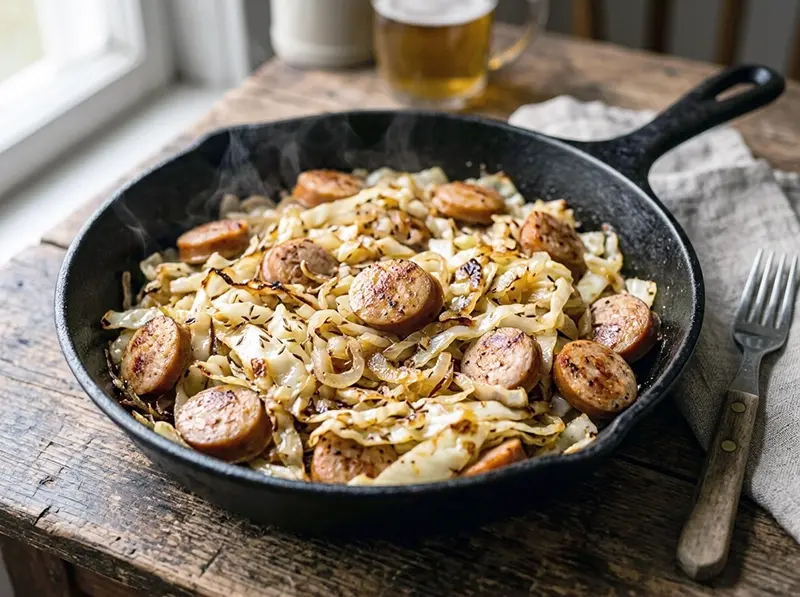
Krautpfanne (German Cabbage and Sausage Skillet)
Krautpfanne is a southern German one-pan supper: white cabbage cut into ribbons, onion and smoked sausage cooked down in lard with caraway and sweet paprika. Kraut is simply what cabbage is called in Bavaria, Swabia and Austria, and the pan takes its name from it. The sausage goes in first so that the fat it renders is what the cabbage cooks in, and the last few minutes happen with the lid off, which is where the browned edges come from. A spoonful of vinegar at the end keeps it from sitting heavy.
Ingredients
- 400 gsmoked sausage
- 800 gwhite cabbage
- 2 pcsonion
- 1 clovesgarlic
- 2 tbsplard
- 1 tspcaraway seeds
- 1 tspsweet paprika
- 1 tspdried marjoram
- 2 tbspapple cider vinegar
- 1 tspsalt
- 0.5 tspblack pepper
Method
- Quarter the cabbage, cut out the hard core and slice the quarters into ribbons about 1.5 cm wide. Anything thinner falls apart by the time the sausage comes back to the pan. Halve and slice the onions, mince the garlic clove, cut the sausage into rounds roughly 1 cm thick.
- Melt 1 tablespoon of the lard in a wide skillet over medium-high heat. Thirty centimetres is the minimum here, because cabbage needs pan floor, not pan walls. Lay the sausage rounds flat and leave them alone for 2 to 3 minutes a side. You are after dark edges and a film of rendered fat on the bottom of the pan; that fat is what carries the smoke into everything that follows. Lift the sausage onto a plate.
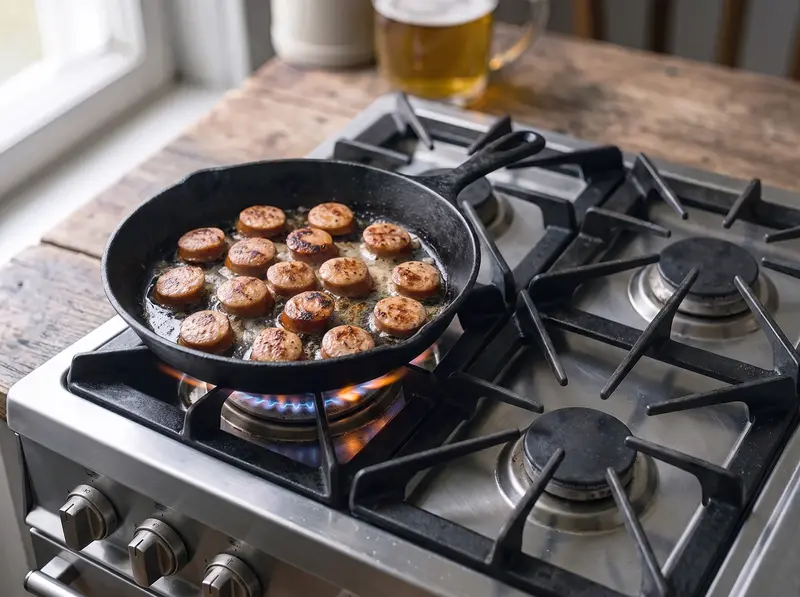
- Turn the heat down to medium, add the rest of the lard and the onions and cook them 4 to 5 minutes, until soft and coloured at the edges. Stir in the garlic, caraway and marjoram for half a minute. Caraway needs hot fat to open up, and German cooks put it in cabbage as much for the digestion as for the flavour.
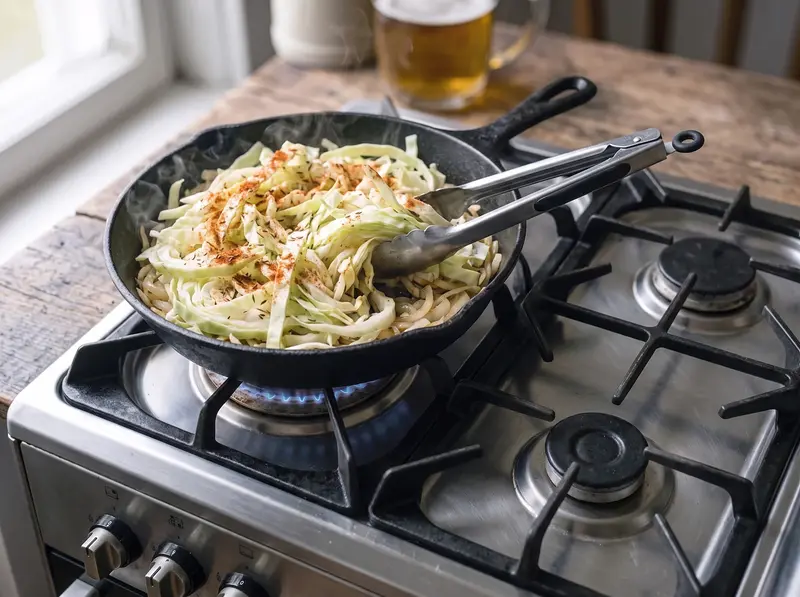
- Pile in the cabbage. It will stand above the rim and look like far too much; it drops to half the volume within ten minutes. Season with salt, pepper and sweet paprika, turn it over a few times with tongs, then cover and cook 8 to 10 minutes, stirring now and then. If the pan goes dry before the cabbage softens, add two tablespoons of water and no more.
- Take the lid off and put the heat back up to medium-high. Cook uncovered for 5 to 7 minutes, stirring about once a minute, until the liquid has gone and some of the strands are brown at the tips. This is the step people leave out, and it is the whole difference between a Krautpfanne and a pan of boiled cabbage.
- Return the sausage along with any juices on the plate, pour in the vinegar and toss for 2 minutes so everything heats through and the acid gets into the cabbage. Taste it — cabbage takes more salt than you expect. Serve straight from the pan with dark rye bread and a spoonful of medium-hot mustard.
FAQ
In Germany this is a butcher-counter dish: Mettenden, Debreziner, Krakauer or plain Rauchwurst, all smoked and already cooked, so they need nothing but browning. Fleischwurst and Cabanossi show up in published Krautpfanne recipes too and behave the same way. Outside Germany, Polish kielbasa is the closest thing on most shelves, because it is cured, smoked and renders the same kind of fat. Raw sausage is a different job: Bratwurst has to be fried through on its own before the cabbage goes in, and since it brings no smoke, add another half teaspoon of sweet paprika to make up for it.
Bayrisch Kraut is a side dish rather than a meal: shredded white cabbage braised in lard with onion and apple, seasoned with caraway, sugar and vinegar, loosened with beef stock and served next to roast pork, Schweinshaxe or sausages. It stays soft and mildly sweet-sour, and there is no sausage in the pot. Krautpfanne puts the sausage into the pan instead of beside it, uses far less liquid and finishes uncovered so the cabbage colours. Same vegetable, same caraway, different job: one fills the plate around the meat, the other is the plate.
Cabbage is mostly water and lets go of it the moment it meets heat. Two things stop it boiling in its own juice. Pan size first: 800 g of cabbage wants 30 cm of pan floor, and in a small pan it sits in a heap and steams whatever you do. The lid second: covered is right for the first 8 to 10 minutes, because the steam collapses the volume, but after that the lid comes off and the heat goes up so the moisture can evaporate. Salt early rather than late as well — it pulls the water out while there is still time to cook it away.
You can, and it is a normal German variation. Rinse the sauerkraut if it is very sour, squeeze it dry and give it about 10 minutes in the pan with the sausage; it needs no wilting stage and no vinegar at the end, since the acid is already there. Half fresh cabbage and half sauerkraut is the version I make most often. It still is not bigos. Polish bigos is a long stew of sauerkraut and fresh cabbage together with several meats at once, often pork, sausage and game, plus mushrooms, simmered for hours and reheated over several days to build its flavour. Krautpfanne is half an hour from cold pan to plate and tastes of three things.
At home in Germany it needs nothing but dark rye bread, medium-hot mustard and beer. Boiled potatoes with butter and parsley are the standard way to feed more people from the same pan. Small waxy potatoes, diced and added with the cabbage, also work, though the pan then needs the lid for a full 20 minutes and gives up some of its browning. Spaetzle or Schupfnudeln tipped in at the end turn it into a proper Bavarian one-pot. For a cold plate alongside, German potato salad with its warm vinegar and broth dressing is the pairing that belongs here; mayonnaise-based salads fight with the caraway.
Rate this
Recipes by email
One letter a week: a recipe picked for your taste, plus whatever is new on the site. Unsubscribe in one click.
Welcome gift: Sergei's cookbook (e-book).
By subscribing you agree to the privacy policy.
Tell us what you like to cook (30 seconds) →Keep browsing
More dishes from the German archive — picked by overlap with what you're cooking now.
Join the conversation
Comments (2)
Классно с индюшачьими колбасками!
The mistake I made for years with this pan was leaving the lid on the whole time. Cabbage carries a lot of water, and under a lid that water never leaves — you end up boiling the kraut instead of frying it. Lid on for the first ten minutes so it collapses, then lid off and the heat up until the edges start to catch and go brown. The smoked sausage is already cooked when you buy it, so it only needs colour, not time.