
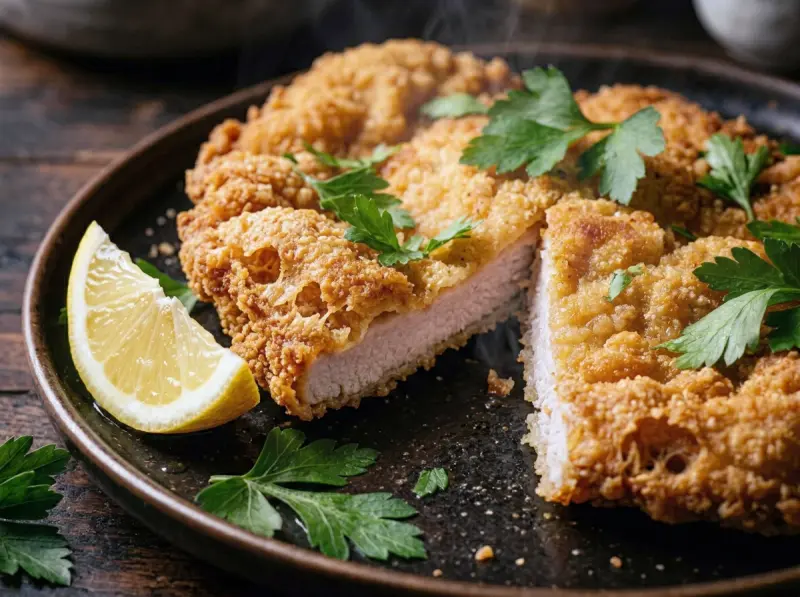
Schnitzel
Thin pork or veal cutlets pounded to 3 to 4 mm, breaded with flour, egg, and breadcrumbs, and fried in hot fat until the crust is golden and crackling. The mark of a well-made schnitzel is a crust that has puffed slightly away from the meat and blisters with air pockets — this happens only when the breadcrumbs are not pressed in. The fat must be deep enough that the schnitzel floats rather than sits on the pan base. Serve immediately with a wedge of lemon. This is the Schweineschnitzel (pork) version; for Wiener Schnitzel, use veal.
Ingredients
- 4 boneless pork loin cutlets or pork leg steaks, about 150 g each
- 1 tspfine salt
- 0.5 tspwhite pepper
- 80 gplain flour
- 2 eggs
- 1 tbspwhole milk
- 120 gfine plain breadcrumbs
- 200 mlneutral oil for frying
- 2 tbspunsalted butter
- 1 lemon
Method
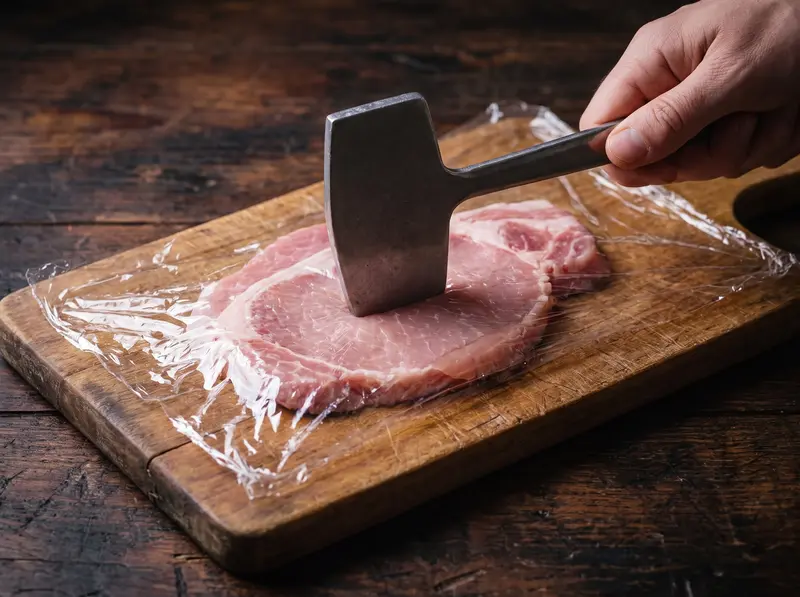
- Pound the cutlets. Place each cutlet between two sheets of cling film or inside a zip-lock bag. Using the flat side of a meat mallet or the base of a heavy pan, pound from the center outward until the cutlet is uniformly 3 to 4 mm thick — genuinely thin, not just flattened slightly. This is the most important step: a schnitzel cut too thick will not cook through in the time it takes the crust to brown. Season both sides with salt and white pepper.
- Set up the breading station. Place flour in one shallow bowl, the eggs beaten with the milk in a second, and the breadcrumbs in a third. Work through the station one at a time: flour on all surfaces (shake off excess), then egg (let excess drip off, ensuring full coverage), then breadcrumbs. Do not press the breadcrumbs into the meat — lay the cutlet flat in the crumbs, lift it, and gently shake off the loose ones. Pressing compacts the crumbs, preventing the characteristic puffed crust.
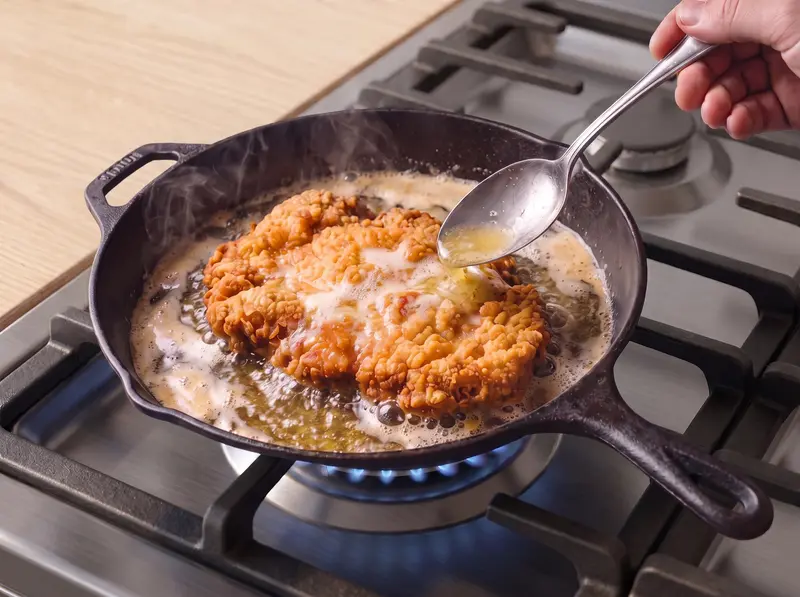
- Fry immediately. Do not let the breaded schnitzel sit — fry it straight away. Heat the oil in a large heavy pan over medium-high heat. When the oil is hot (a breadcrumb dropped in should sizzle immediately and turn golden within 15 seconds), add the butter. The foam will subside. Add one or two schnitzels — do not crowd the pan. Tilt and swirl the pan so the hot fat continuously washes over the crust surface as it fries. Cook 2 to 3 minutes per side until deep golden. The crust should blister and puff slightly away from the meat.
- Drain and serve immediately. Remove with tongs and place briefly on a wire rack or paper towel — just 30 seconds to a minute. Do not cover or stack, which traps steam and softens the crust. Serve on warm plates with lemon wedges pressed alongside. The lemon is squeezed over the moment before eating.
FAQ
Wiener Schnitzel is a legally protected term in both Germany and Austria: it can only be made with veal. The name means Viennese cutlet and refers specifically to a thin veal escalope breaded and fried in clarified butter. German Schnitzel — properly called Schweineschnitzel — is made with pork, which is cheaper, more widely available, and has a richer, fattier flavor than veal. The technique is identical. Pork schnitzel made in the Viennese style is called Schnitzel Wiener Art (Viennese-style schnitzel) on German menus. Both are excellent; veal is more delicate and expensive, pork is more accessible and arguably juicier.
Pressing compacts the breadcrumbs into a dense, solid layer directly against the meat. When fried, this layer browns but does not lift — it becomes a hard, tight crust stuck to the surface. The characteristic schnitzel crust — blistered, puffed slightly away from the meat, with visible air pockets — only develops when the breadcrumbs are left loose. The steam that rises from the meat during frying pushes the light, unpressed crumb layer away from the surface, creating the separated, soufflé-like crust. So: coat, shake off gently, fry immediately.
Three conditions must be met simultaneously. First, the crumbs must not be pressed — they need room to move. Second, the fat must be deep enough for the schnitzel to float rather than sit on the pan base; the oil coming up from underneath pushes the crust up as steam forms. Third, the pan must be tilted and swirled constantly so that hot fat washes continuously over the top surface of the schnitzel, accelerating the crust formation before the steam pressure subsides. If any one of these three conditions is missing, the crust will be flat rather than puffed.
The traditional choice for Wiener Schnitzel is clarified butter (Butterschmalz), which has a higher smoke point than regular butter and imparts a rich, nutty flavor without burning. Regular butter burns at schnitzel temperatures and leaves dark bitter specks in the crust. A practical home approach: neutral oil (sunflower or vegetable) heated to frying temperature, with a tablespoon or two of regular butter added just before the schnitzel goes in — the butter adds flavor and helps browning before it has time to burn. Pure lard is traditional in many German households and produces an excellent crust with a deeper savory flavor.
Jäger means hunter in German, and Jägerschnitzel is schnitzel served with a mushroom cream sauce — a version found across Germany and Austria. The schnitzel itself is made the same way. The sauce: sauté sliced mushrooms (traditionally forest mushrooms, button mushrooms work well) in butter until golden. Add diced onion and cook until soft. Pour in white wine or stock and reduce by half. Add double cream and a sprig of thyme. Simmer 5 minutes until slightly thickened, then season. The sauce is spooned over or around the schnitzel at serving. Rahmschnitzel is the cream-sauce-only version, without mushrooms.
Rate this
Recipes by email
One letter a week: a recipe picked for your taste, plus whatever is new on the site. Unsubscribe in one click.
Welcome gift: Sergei's cookbook (e-book).
By subscribing you agree to the privacy policy.
Tell us what you like to cook (30 seconds) →Keep browsing
More dishes from the German archive — picked by overlap with what you're cooking now.
Join the conversation
Comments (5)
Das Fleisch muss dünn geklopft werden, sonst wirds nix. Und die Panade: Mehl, Ei, Semmelbrösel — keine Abkürzungen! Hab auch schon versucht mit Cornflakes, schmeckt komisch
Genau so macht mans richtig. Paniermehl muss frisch sein, nicht aus der Packung. Hab extra Semmelbrösel selbst gemacht und der Unterschied ist enorm.
Sehr gut, fast wie bei meiner Oma in Wien. Einziger Tipp: das Fleisch muss wirklich dünn sein, sonst wird's nix. Ich hab es heute mit Kartoffelsalat serviert und die Kinder waren begeistert.
I learned to make schnitzel from an Austrian grandmother who insisted on three things: pound the meat until it is uniformly thin (about 5mm), use your hand to press the breadcrumbs on firmly before frying, and use enough fat that the schnitzel floats. If the bottom of the pan is visible through the oil, you do not have enough. The breadcrumb coating should puff away from the meat slightly — that air pocket is the mark of a properly fried schnitzel.
Шницель получился отличный с первого раза. Единственое что я отбивал мясо молотком через пищевую плёнку — так не рвётся и толщина равномерная. Панировку делаю тройную: мука, яйцо, сухари. И жарю именно в смеси масла и сливочного, как тут написано. Хрустит идеально.