Russia · Appetizers and Sandwiches
Russian Fermented Pickles (Solyonye Ogurtsy)
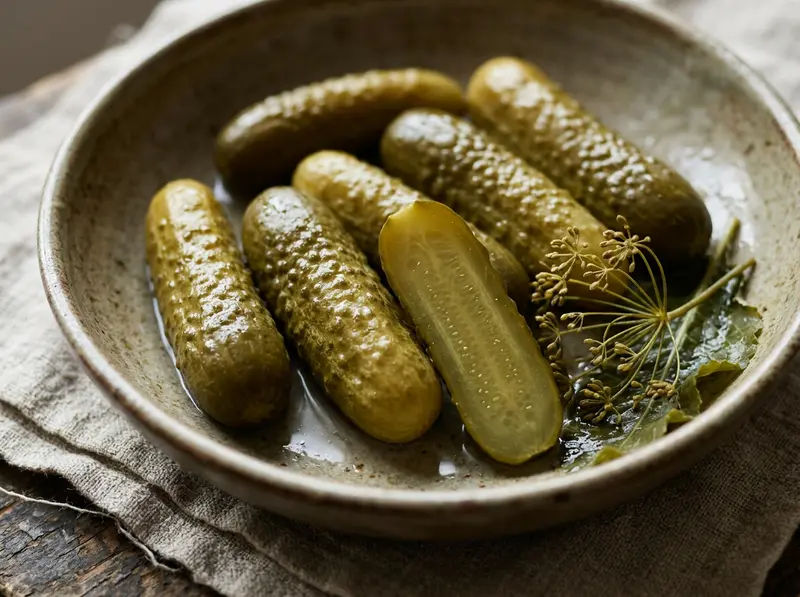
Solyonye ogurtsy (солёные огурцы) are Russian sour pickles: small whole cucumbers fermented in a cold salt brine with dill, garlic and horseradish, blackcurrant and cherry leaves, and no vinegar.
Ingredients
- cucumber1.5 kg
- water1.5 l
- salt105 g
- dill4 head
- horseradish leaves2
- garlic4 clove
- blackcurrant leaves6
- cherry leaves6
Method
- 1Sort and soak the cucumbers. You need 1.5 kg of small pickling cucumbers, 9 to 11 cm long, firm and bumpy. Throw out any that are soft, yellow or damaged. Wash the rest under cold running water without scrubbing them hard, then cover them with cold water in a large bowl and leave them for 3 hours. Any that float in the water are usually hollow inside, so take those out. Russian cooks soak shop-bought cucumbers so they firm up again and come out hard and squeaky; cucumbers picked the same day can skip the soak. Drain them and slice 2 mm off both ends of each one. The blossom end can carry an enzyme that softens pickles, so do not skip the trimming.
- 2Wash the jar and get the leaves ready. Wash a 3-litre glass jar and its plastic lid in hot soapy water and rinse them well with very hot water, until the glass squeaks and no soap film is left. Dip the lid in boiling water for 30 seconds. Rinse the 4 heads of dill, the 2 horseradish leaves, the 6 blackcurrant leaves and the 6 cherry leaves in cold water and shake them dry. Peel the 4 cloves of garlic and cut each one in half. Use only fresh, clean garlic and leaves, because mouldy ones are a known cause of soft pickles.
- 3Pack the jar. Put 2 heads of dill, 1 horseradish leaf torn into pieces, all the garlic, 3 blackcurrant leaves and 3 cherry leaves on the bottom. Stand the cucumbers upright on top of them, as tightly as they will go, in two tiers. Tuck the other 3 blackcurrant leaves, 3 cherry leaves and 2 heads of dill between the cucumbers and over them, then fold the second horseradish leaf over the top like a cap. The jar is packed well when nothing shifts as you tilt it and the top sits 2 to 3 cm below the rim. Tight packing and the leaf on top stop the cucumbers from floating up out of the brine.
- 4Make the cold brine and fill the jar. Weigh 105 g of coarse salt with no iodine in it and stir it into 1.5 l of cold drinking water, filtered or bottled and not boiled, until the water is clear again. That is 70 g of salt per litre. Weigh it, because spoonfuls of coarse salt vary too much, and do not use less: the salt is what keeps the wrong bacteria out while the cucumbers ferment. Let the brine stand for 2 to 3 minutes so any grit settles. Stand the jar on a deep plate and pour the brine in right up to the brim, leaving the sediment behind. About 1.3 l goes in. Every cucumber and leaf should be under the liquid. Keep the remaining 200 ml or so of brine in a small covered jar in the fridge for topping up.
- 5Ferment at room temperature for 5 to 7 days. Rest the lid on the jar without pressing it down, so gas can get out, and leave the jar on its plate at 20 to 24 °C, away from direct sun. Never let it sit above 27 °C, or the cucumbers turn soft. Below 16 °C the fermentation hardly starts. Within a day or two the brine goes cloudy, small bubbles rise, foam collects at the top and some brine spills onto the plate. It smells sour and garlicky, and the cucumbers change from bright green to olive. All of that is normal. Once a day, skim off the foam and any white film with a clean spoon, top up with the spare brine so nothing sticks out of the liquid, and empty the plate. If a cucumber works loose and floats up, push it back under the horseradish leaf with the clean spoon. The warm stage is over when no new foam forms, no bubbles rise and every cucumber is olive. If bubbles are still rising on day 7, leave the jar in the warm, keep skimming and topping up, and look again every 1 to 2 days. If you have pH test strips, dip one into the brine: it should read 4.6 or lower before the jar goes into the cold. If it reads higher, wait and test again every 1 to 2 days. The acid made by the fermentation is what protects the pickles, so do not cut this stage short.
- 6Check the jar and move it to the cold. The brine should be cloudy and smell pleasantly sour, and the cucumbers should feel firm. If the cucumbers are soft or slimy, if the smell is foul, or if you see fuzzy or coloured mould, throw the whole jar out without tasting anything. If all is well, top the jar up to the brim, press the lid on, wipe the glass and put the jar in the fridge, or in a cellar that stays at 0 to 4 °C. The cold slows the fermentation down before the pickles turn too sour. Left in the warm they would go on fermenting and spoil.
- 7Wait 4 weeks before you taste them. The salt and the acid need that long to reach the middle of each cucumber. A finished pickle is olive and evenly translucent right through when you cut it, with no white raw core, and it snaps when you bend it. A layer of white sediment on the bottom of the jar is normal. Take pickles out with a clean fork, keep the rest under the brine with the lid on, and keep the jar at 0 to 4 °C the whole time. Look at the jar each time you open it. Skim off any white film; if the pickles turn soft or slimy, smell foul, or fuzzy or coloured mould appears, throw the jar out without tasting. Eat them within 4 to 6 months. Because this method is shorter than the tested one, do not serve these pickles to anyone very young, very old, pregnant or chronically ill.